• The Heart in a Jar

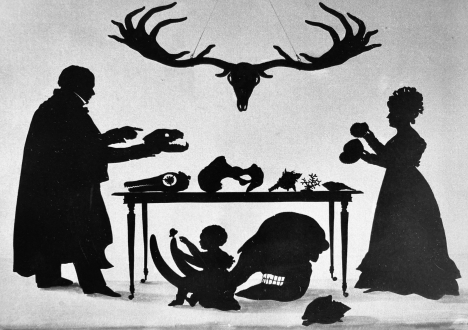
    When Richard Rawlinson died in April 1755, he left instructions in his will that his heart ‘be taken out, enclosed in a silver cup with spirits and put into a black marble urn’. Then, after the rest of his body was laid to rest in St Giles Church in Oxford, this once beating organ was to be taken across the road to be stored separately at his old university college, St John’s.

  • Candlemas at Carfax Conduit

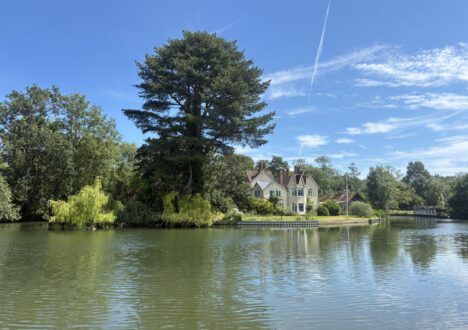
    It is the 2nd February, or Candlemas, the date in the church calendar that marks the end of Christmastide and the beginning of spring. And to celebrate my friend, walking companion and expert in all things flora and fauna has taken me on a jaunt to see Candlemas Bells, more widely known as snowdrops, but so nicknamed after the time of year their delicate drooping heads emerge from the darkness of their frozen winter beds. A great place to see them in profusion, she claims, is not far from Oxford in the gardens of Nuneham House. About which I am secretly thrilled. For this is the resting place of the Carfax Conduit, a proud monument that once stood in the very centre of the city. I’d been keen to take a closer look for ages.  

  • At the Rumble Museum

    Today I am heading east, up Headington Hill to visit Oxford’s Rumble Museum. I’m intrigued for I had not heard the name before. Yet the place has secured accredited status from Arts Council England on an equal footing with the most famous museums in the city. The Ashmolean may have opened in 1682, is Britain’s oldest public museum and the worlds earliest attached to a university, but the Rumble Museum at Cheney School is the first and currently the only one to be housed in a UK state school.

  • The Levellers last stand

    It is early September in 1649. The feelings amongst the rank and file of Oliver Cromwell’s New Model Army stationed in Oxford are running high. It is now nine months since King Charles I was executed, and the promise of a more equal and tolerant society that some expected, has not been forthcoming. This is especially true for a group of highly organised agitators in the army nicknamed the Levellers.

  • Sarah Cooper and her jars of sunshine

    One of the regular activities that perks me up as I claw my way through dull grey January is marmalade making. A couple of weeks into the New Year, crates of the bitter Seville oranges needed in its production (smaller and more pitted than their sweeter counterparts) being to appear in the shops. They are available for a short period only, a couple of weeks if you are lucky. So as Oxford is a city of marmalade eaters you must be quick to secure your basketful of Spanish sunshine, sufficient to fill enough jars to last a good way into the coming year.

  • At the Elijah Terrace with Cordelia

    Just before Christmas I get a call from my friend Cordelia. She asks if I’d be interested in meeting her by what is affectionately known as the Elijah Terrace on Walton Well Road just north of Jericho. For she wants to explore the story of the Old Testament prophet as told in the magnificent stone carvings that decorate in exquisite detail the lunettes above nine of the first-floor windows here. It is from these that this row of houses has derived its nickname. 

  • Elizabeth Jennings Way

    It was on the way to have lunch with a friend last week in Summertown that I first encounter the name Elizabeth Jennings. I’d decided to take the scenic route north out of the city along the Oxford Canal. Starting at Hythe Bridge, over Isis Lock, under Walton Well, Aristotle Lane and Frenchay Road Bridges, and then just at the point at which I need to peel off to reach my destination there it is; Elizabeth Jennings Way Bridge, the painted words on the arches of its underbelly part of a fun folk-artsy mural portraying the story of the neighbourhood.

  • Farewell Simon Murison-Bowie, photographer 1940 – 2025

    In between showers I cycled over Magdalen Bridge to East Oxford to meet with photographer Simon Murison-Bowie. He’s written a book in which he explores some of the very first photographs taken of Oxford, back in the 1840’s. What were the images of? From what vantage points are they taken? At what time of day and year? Might it be possible if he were able to find the exact same spot, to make the same composition with his own camera? Or has too much of our cityscape changed over the last 180 years or so? It all sounded right up my street.

  • The Marvellous Mary Murals at Campion Hall

    Once inside you are immediately transported into a painted ivy clad walled garden, set in the English countryside with summer skies and well-tended flowerbeds. The architecture of the windows, doors and vaulted ceiling are cleverly incorporated into the pictorial rich scheme, white arched recesses framing the colourful narrative of Mary’s life. Here is portrayed her birth to elderly parents, her betrothal to Joseph, the Annunciation, the Nativity, as well as the family’s flight to Egypt, her crowning as Queen of Mercy, and her Dormition, the ‘falling asleep’ or leaving of her earthly life. 

  • A magical mistletoe tour from Magdalen College to Music Meadow

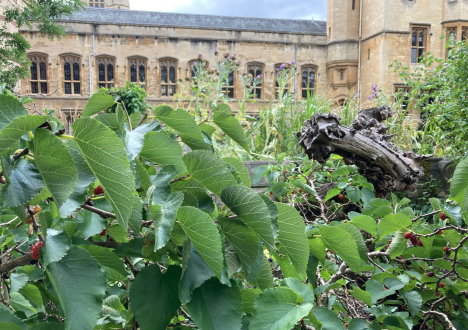
    It’s at this dead time of year that the stuff becomes suddenly visible. When the leaves have fallen from the trees, revealing what appear to be giant birds’ nests perched amongst the fragile beauty of the bare winter branches. But these hanging baskets of vibrant green foliage are in fact huge balls of mistletoe. Magically, mysteriously, bearing fruit even through the shortest and darkest days of the year.