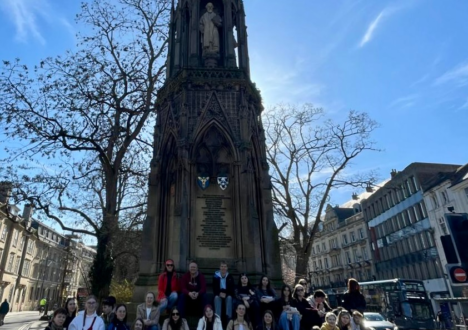
Meeting up at the Martyrs’ Memorial
Not far from where I live stands the Martyrs’ Memorial, a tall spire like edifice crowned with a cross positioned at the northern gateway into the city centre.
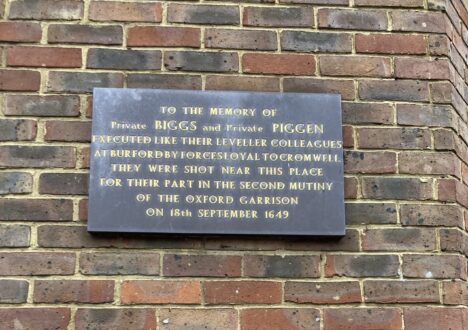
It is early September in 1649. The feelings amongst the rank and file of Oliver Cromwell’s New Model Army stationed in Oxford are running high. It is now nine months since King Charles I was executed, and the promise of a more equal and tolerant society that some expected, has not been forthcoming. This is especially true for a group of highly organised agitators in the army nicknamed the Levellers.
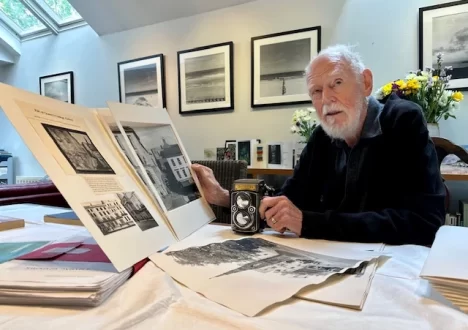
In between showers I cycled over Magdalen Bridge to East Oxford to meet with photographer Simon Murison-Bowie. He’s written a book in which he explores some of the very first photographs taken of Oxford, back in the 1840’s. What were the images of? From what vantage points are they taken? At what time of day and year? Might it be possible if he were able to find the exact same spot, to make the same composition with his own camera? Or has too much of our cityscape changed over the last 180 years or so? It all sounded right up my street.
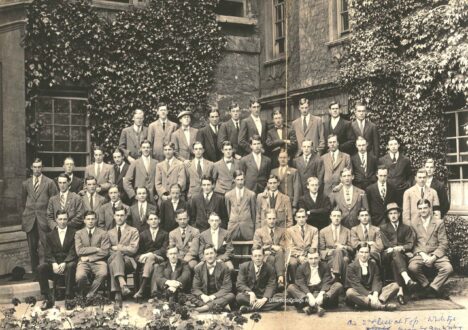
The photograph above shows the latest cohort of undergraduates coming to study at Hertford College, Oxford. It is taken on the west side of the Old Buildings Quadrangle – you can just glimpse the corner of the famous stone spiral staircase that leads up to the dining hall on the left. But this is 1919, one year after the end of the Great War. Some of the men smile but the general air is one of pensive seriousness. Look closely and one man wears a black armband. And there’s a vacant seat in the middle.
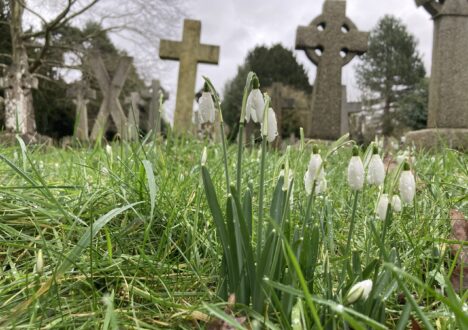
I find January and February the gloomiest of all the months. When the days are still short and the weather wet and cold. I become desperate for a pick-me-up, something to lift the spirits, a promise that there are brighter things on the horizon. And then suddenly pushing up from somewhere beneath the sodden soil, the first of the snowdrops appears.
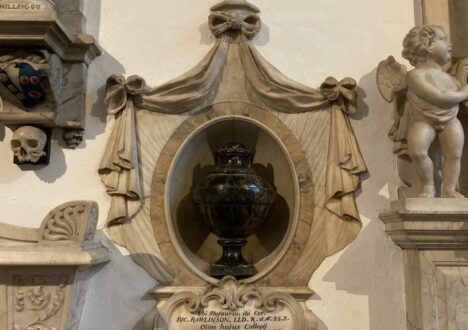
When Richard Rawlinson died in April 1755, he left instructions in his will that his heart ‘be taken out, enclosed in a silver cup with spirits and put into a black marble urn’.
From Wittgenstein to Thom Yorke many remarkable people have resided in the honey stone terraced houses of St John Street in central Oxford, built to accommodate the growing number of…
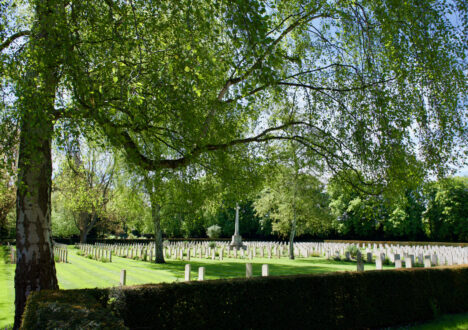
“A young boy scout once asked me which was my favourite grave,” smiles Dick Richards, a volunteer guide for the Commonwealth War Graves Commission, as he stands amidst the rows…