• Farewell Simon Murison-Bowie, photographer 1940 – 2025

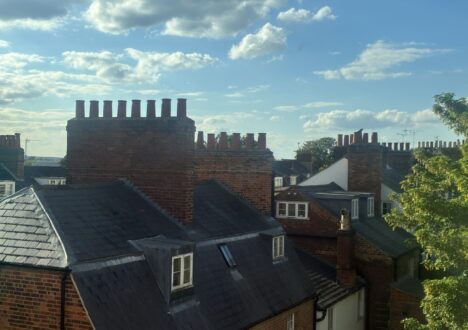
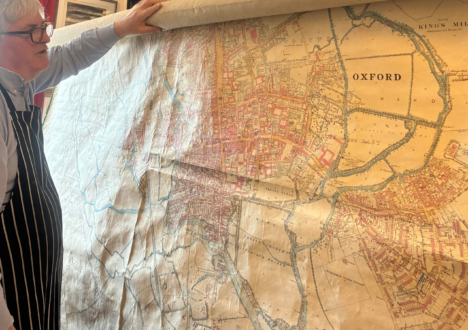
    In between showers I cycled over Magdalen Bridge to East Oxford to meet with photographer Simon Murison-Bowie. He’s written a book in which he explores some of the very first photographs taken of Oxford, back in the 1840’s. What were the images of? From what vantage points are they taken? At what time of day and year? Might it be possible if he were able to find the exact same spot, to make the same composition with his own camera? Or has too much of our cityscape changed over the last 180 years or so? It all sounded right up my street.

  • The Marvellous Mary Murals at Campion Hall

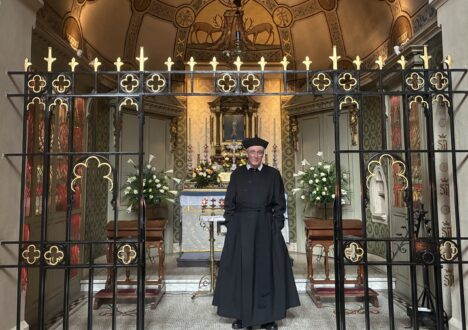
    Once inside you are immediately transported into a painted ivy clad walled garden, set in the English countryside with summer skies and well-tended flowerbeds. The architecture of the windows, doors and vaulted ceiling are cleverly incorporated into the pictorial rich scheme, white arched recesses framing the colourful narrative of Mary’s life. Here is portrayed her birth to elderly parents, her betrothal to Joseph, the Annunciation, the Nativity, as well as the family’s flight to Egypt, her crowning as Queen of Mercy, and her Dormition, the ‘falling asleep’ or leaving of her earthly life. 

  • A magical mistletoe tour from Magdalen College to Music Meadow

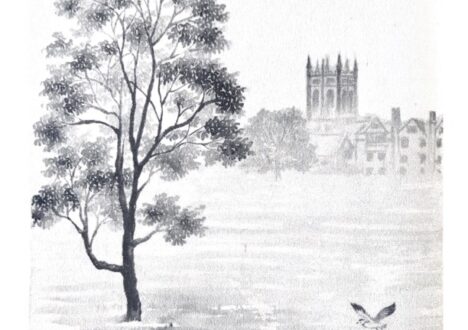
    It’s at this dead time of year that the stuff becomes suddenly visible. When the leaves have fallen from the trees, revealing what appear to be giant birds’ nests perched amongst the fragile beauty of the bare winter branches. But these hanging baskets of vibrant green foliage are in fact huge balls of mistletoe. Magically, mysteriously, bearing fruit even through the shortest and darkest days of the year.

  • Hunting for Beaumont Palace

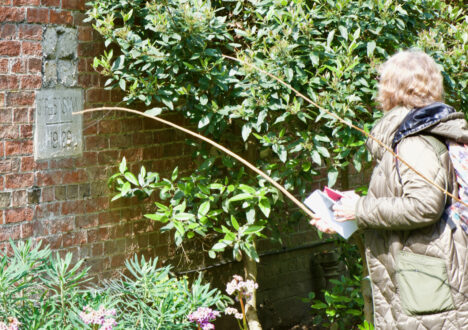
    Down I go and on reaching ground level it becomes clear exactly what it is that I have just traversed. A high wall of roughly hewn field stone. Not grand by any means. But exciting nonetheless. For this was once the western boundary of a royal palace. The curtilage wall for the King’s Houses or Beaumont Palace as it became known. Built around 900 years ago in the 1130’s for William the Conqueror’s youngest son Henry I. And as I was on a mission to uncover anything that might remain of this royal residence I was absolutely delighted. 

  • the crooked house

    Kybald Twychen

    I have long been intrigued by the pretty gabled house that stands in a quiet cul de sac near Oxford’s High Street. For it is a miracle as to how the place stays upright. The walls sag, the windows are wonky and the drainpipes don’t quite run in straight lines. I often wonder whether the Corpus Christi students who now live here negotiate the lopsided landings and how they keep their books and belongs from sliding from the sloping shelves.

  • The Vacant Chair

    The photograph above shows the latest cohort of undergraduates coming to study at Hertford College, Oxford. It is taken on the west side of the Old Buildings Quadrangle – you can just glimpse the corner of the famous stone spiral staircase that leads up to the dining hall on the left. But this is 1919, one year after the end of the Great War. Some of the men smile but the general air is one of pensive seriousness. Look closely and one man wears a black armband. And there’s a vacant seat in the middle.

  • Autumn in Oxford

    Autumn has arrived in Oxford. And it is glorious. For the city and its parks are awash with fiery reds, buttery yellows and orange oches.

  • Of dustcarts, pigs’ swill and white linen towels

    Albert Ernest Smith was born in 1903 and started work aged 13 for what was then known by the Orwellian title of The Cleansing Department, part of Oxford Corporation (now Oxford City Council). His first job was as a dustman, later driving a small van from which he serviced the central Oxford public lavatories.