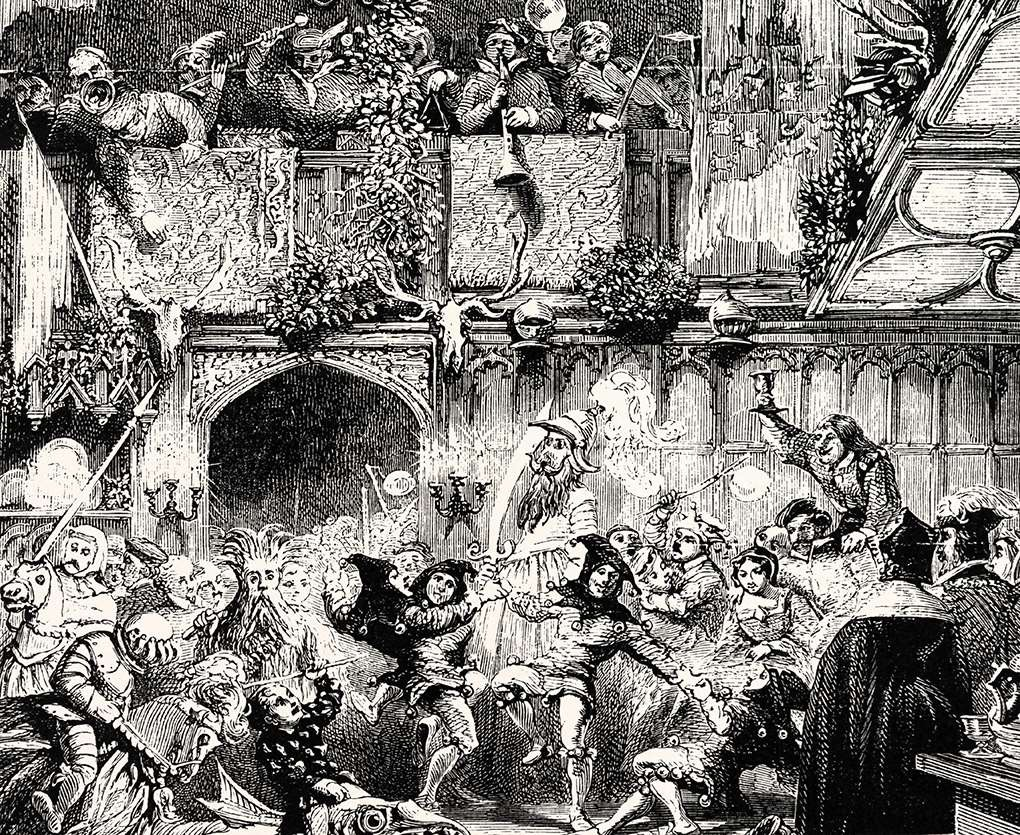
It is 31 October 1607, All Saints’ Eve, and after dinner in the hall of St John’s College the students are becoming restless. Indeed, a little rowdy. For it has yet to be agreed on what entertainments are to be had during what will soon be the Christmas holidays. This is an important consideration, for after formal teaching ends it is the norm to stay put in Oxford. Nobody goes home. And as many are as young as 16, it is imperative that some sport is laid on whereby they can let off steam, party, have some fun.
And so it is that the decision is made to appoint a Master of Revels from amongst them, a kind of academic Lord of Misrule. A mock Christmas Prince given the power ahead of the senior fellows during December and January, to oversee a set of seasonal celebrations; masques and music, plays, processions and the like. Thomas Tucker, a 21-year-old Bachelor of Arts, is duly elected and on 30 November there is great excitement at the promise of a play, Ara Fortunae or Fortune’s Altar, to celebrate his inauguration. Many St John’s men have brought along friends from other colleges, and the hall is so packed that tables have to be hastily pushed together to create a raised platform for a makeshift stage. But the play goes well. Indeed, a second burst of appreciative clapping brings the house down, as well as the scenery.
That I am able to bring you this account is because the text of this and the other plays performed during the winter vacation of 1607/8 (five in Latin, three in English, all in verse) is recorded in a manuscript, together with a running commentary of how they went down. A kind of debrief if you like. Bound in leather, with a gold salamander embossed on the front, the book is normally kept under lock and key in the St John’s library. But today the college archivist Michael Riordan has been kind enough to bring it out to show me. It is a beautiful thing. The script is all squirls and curls, and fancy flourishes. The content, clever with a deliberately satirical comedic narrative arc.
This is the tale, told over two months, of the rise and fall of Thomas Tucker. A man endowed by the goddess Fortuna with a long list of ludicrous titles; Prince of Alba Fortunata (alluding to the college founder, Sir Thomas White), Lord of St John’s, High Regent of Ye Hall, Duke of St Giles, Marquess of Magdalen’s (both neighbouring parishes), Chief Bailiff of ye Beaumonts (land belonging to the college) Master of the Manor of Walton, Governor of Gloucester Green, and so it goes on. He immediately appoints a Privy Council from amongst the actors, a Lord Chancellor and Keeper of the Great Seal, a Lord High Chamberlain, and others including a High Admiral and Lord Chief Justice, each with their own amusing make believe coat of arms.
And with them he sets about raising money for the shenanigans, from wealthy benefactors and commoners alike. Tenants send wine and venison. They are given 10 shillings on two occasions by one William Laud (then a college senior fellow later Archbishop of Canterbury and Chancellor of the University) to buy amongst other things ten dozen torches, a flute of taffeta, pins, a gown for Philomela (one of the lead roles), a trumpeter, and wood to erect a scaffold (there was a proper stage built especially for some of the dramas).
And then the fun begins. According to the commentary (which Michael believes may have been deliberately contrived for comic effect, but I’d like to believe it to be true) some plays land better than others. In ‘Times Complaint’, performed on New Year’s Day and the first in English, the prologue clean forgets all of his six lines, Goodwife Spigott comes on too early, and Humphrey Swallow the drunken cobbler overacts so outrageously he is booed off stage. In another the whole of town seems to have turned up and when they discover there is not enough room for many of the hopeful attendees, they set about the gardens shouting and breaking windows. And then when Tucker resigns his rule and all members of college are expected to attend, those who are absent are forcibly removed from their beds still in their nightshirts and carried in a chair to the hall, proceeded by two squires holding the captive’s doublet and breeches, shoes and stockings.
But in truth this was all part of the sport. And like the medieval tradition in the election of a boy bishop, when for a short period over Christmas a choir boy is elected in popular role reversal to be Bishop, everyone knows that when the time comes everything will return to how it once was. The student actors have had their fun. They have shown off a keen ability to write plays in Latin verse. But in February as expected they were always going to return to their studies. Indeed, Thomas Tucker along with his fellow actors go on to serve, like St John’s students are intended to do at this time, as educated clergymen in the natural and established order of things.
That this was the time and fashion for such a Yuletide celebration there is no doubt. The era of Shakespeare and Marlowe, when the King’s Players were no strangers to Oxford. Elizabeth I and James I were entertained with neo-Latin overtures on their visits to Christ Church, a college that also fancied themselves with their amateur dramatics. They even launched their own rival offering in response to the Christmas Prince in January 1608, a comedy called Yuletide.
But though a Lord of Revelry is recorded at St John’s some thirty years earlier, there is no documentation of anything in Oxford before or since quite like the festivities that took place at St John’s in the early days of the reign of King James I. And as if for dramatic effect, Michael shows me out of the college by way of the great hall, the setting for most of the student high jinks I have described above. And although I am told the place is now a little bigger than it was in the 17th century, with its high ceiling, long communal tables and portraits of scholars long since departed this world, it is not hard to imagine it as it was during the reign of Thomas Tucker. Indeed, as I turn to leave, I could have sworn I could feel the heat of a hundred bodies pressed up close. And as the door closes behind us, I think I hear the echo of stamping feet and the clamour of excited voices. Bravo they are shouting. Bravo for the Christmas Prince.
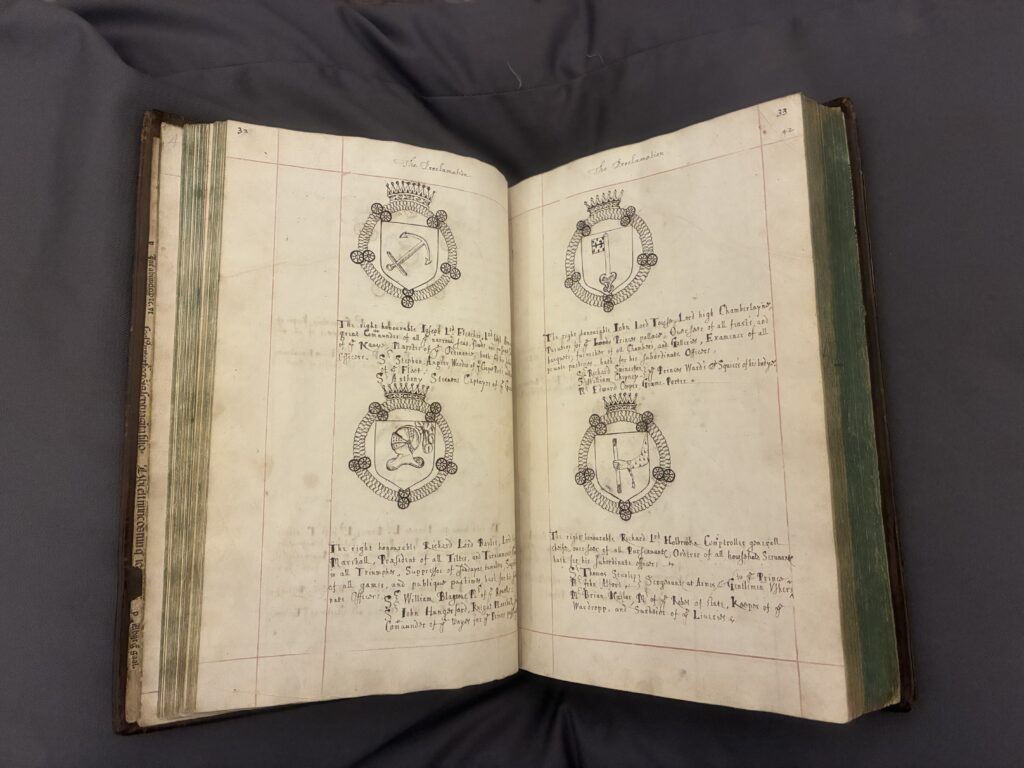
Coats of arms created for the members of the Privy Council
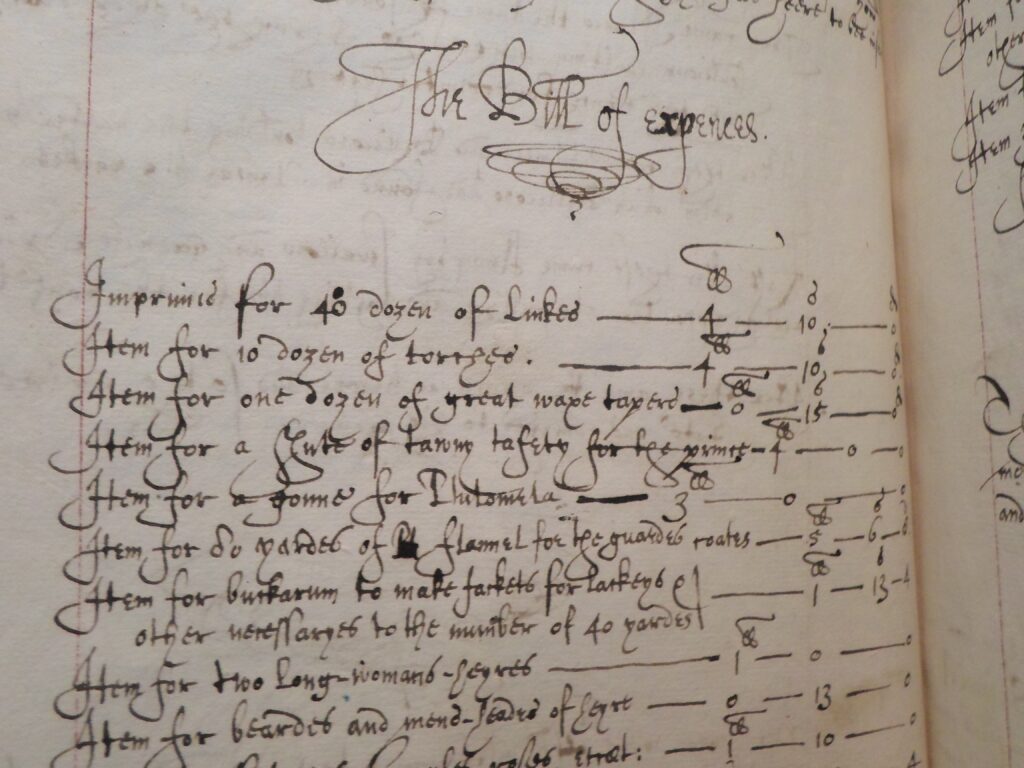
The bill of expenses
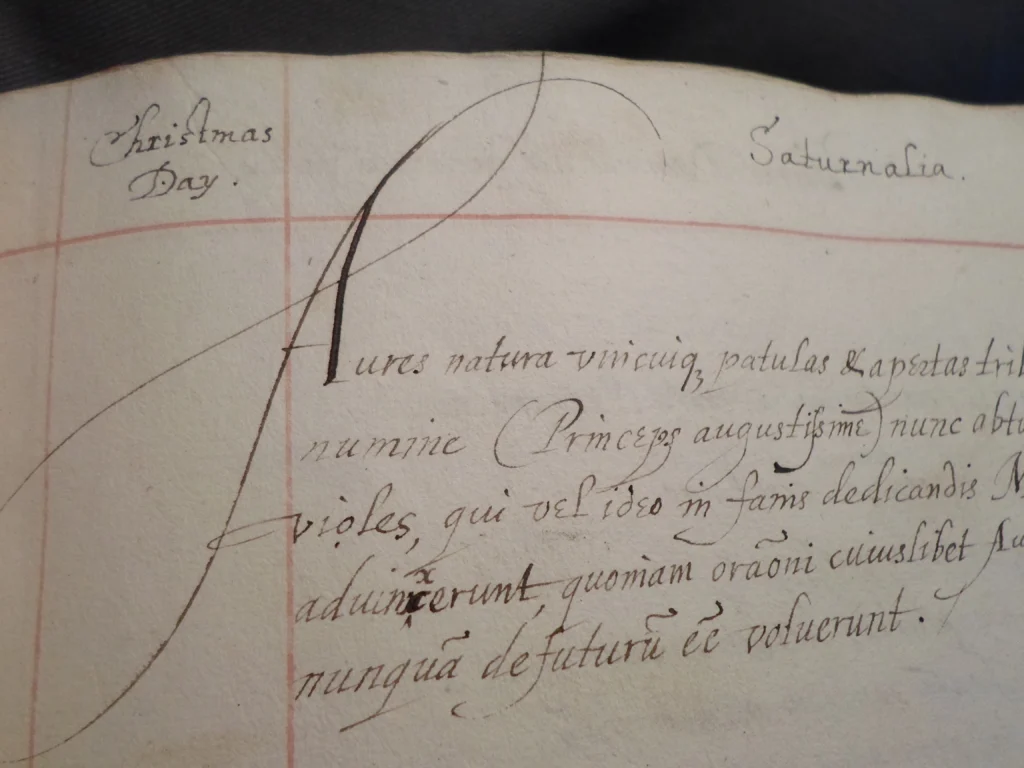
The opening of ‘Saturnalia’ a play in Latin performed on Christmas Day. It is based on the mid December Roman festival in which the roles of master and slave are reversed. But only temporarily. Like the Christmas Prince, a Lord of Misrule is chosen to oversee the celebrations, until the normal hierarchy is resumed.
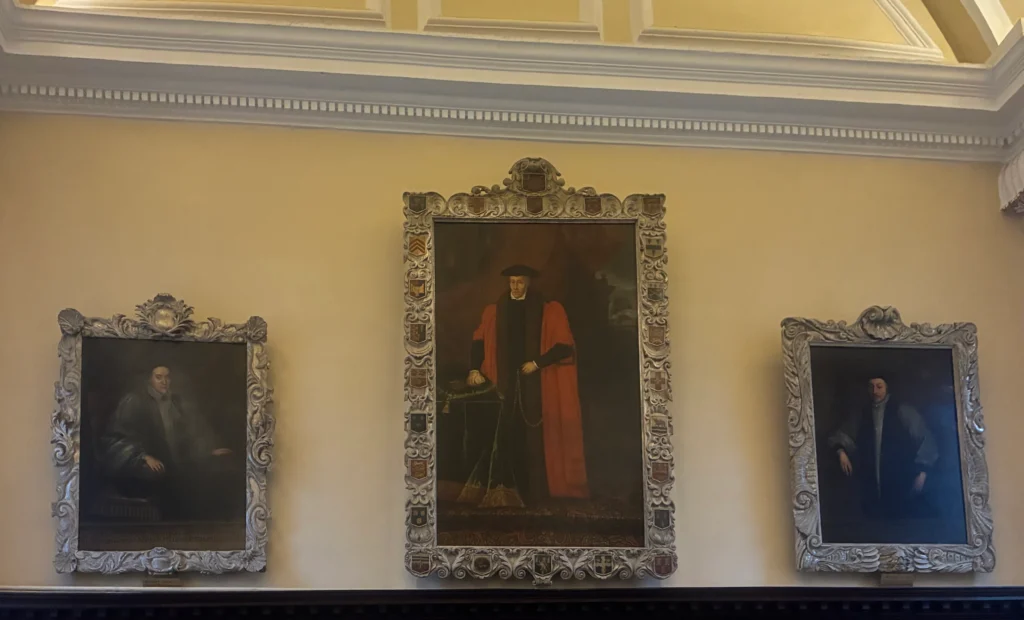
These portraits in the hall are from left to right William Juxon (a senior fellow who gave money towards the revels and later became Archbishop of Canterbury accompanying Charles 1 to the scaffold), Sir Thomas White (the Founder of the College in 1555) and William Laud (who also gave money for the goings on in 1607/8. He preceded Juxon as Archbishop of Canterbury but was executed for treason by Parliament in 1645). Both Juxon and Laud are buried in the chapel.
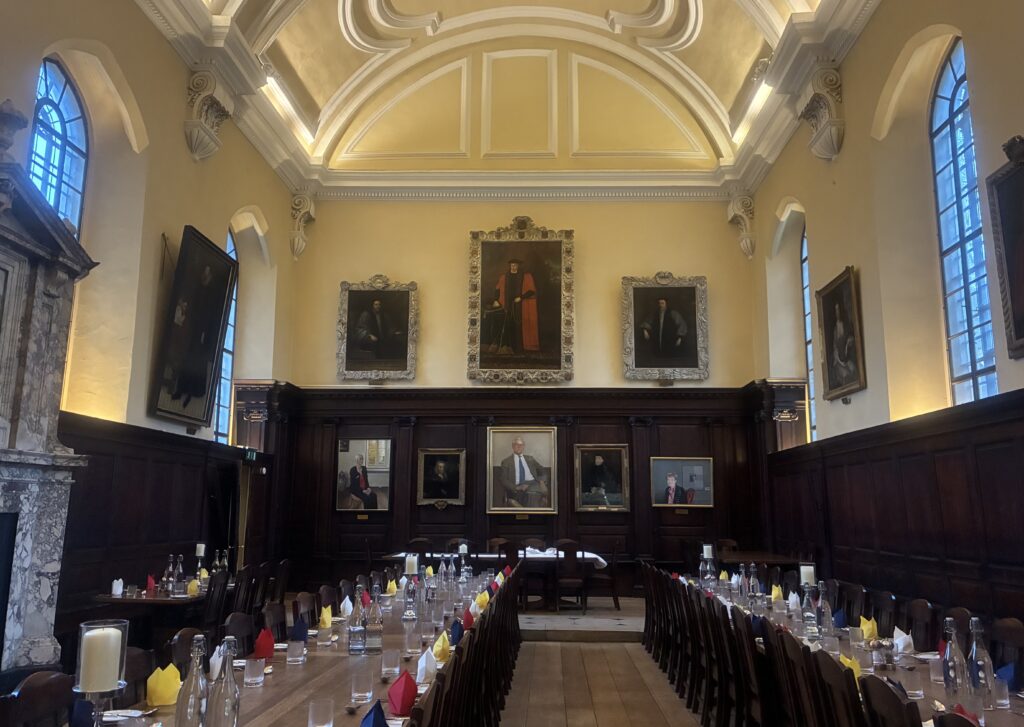
The St John’s College hall. In the era of the Christmas Prince, teaching was done by disputation in Latin. This would have happened like the Christmas revels in the hall.
All pictures of the manuscript by kind permission of St John’s College