I know at once that this is Julian Munby’s house. Because outside is parked his famous butcher’s bike – the one he used to cycle around Oxford, a cardboard box perched on the front carrier, into which his children affectionately remember being tucked up when tiny and transported around the city. It also served as a place to pop any interesting curiosities that he came across on his travels. From medieval tiles and timbers to manuscripts, maps and mouldings, old ledgers and locks to animal skulls and ancient string. For Julian is an antiquary, that is a person who studies the past through looking at historical artefacts. And it is his lifetime’s collection of the stuff (and still counting), that I am delighted to have been invited to see today.
He has been preparing our lunch he announces enthusiastically as he greets me at the door, suitably attired in blue and white striped apron. Most exciting, for his culinary concoctions are almost as legendary (think whole turbots and haunches of venison) as his archaeological insights. And although we begin our conversation by swapping marmalade making methodologies, all the while I cannot help but be drawn towards the vast array of serendipitous sights seeking my attention. For every shelf, every table, chair, mantlepiece is overflowing, even the walls are covered with treasures, each with its own unique story.
“Those are old wallpapers from a house in Chichester,” explains Julian, when I enquire about two aged but exquisitely decorated papers hanging on his kitchen wall. He’d had a job in the town in the 70’s and one winter evening as he was walking back to his lodgings, he spotted a light on in an upstairs window through which he could make out what were clearly medieval timbers. Immediately interested, he struck up a conversation with the workman inside, who informed him that they’d found nothing of any note, just some bits of old rolled up wallpaper. Which they were more than happy to hand over. And which as it turned out, were from the 17thcentury.
“Exactly the same as the ones dated 1684 found in Epsom,” says Julian remembering the discovery with the excitement as though it was yesterday. The kind of pretty wood block print used to line the drawers of a Georgian chest, or a bible box, or in this case to form a repeat pattern which joined up could decorate a wall.
Immediately below them, is a square wooden box frame containing what appears to be a squashed rodent. “That’s what I call my “career in ruins”, he laughs identifying some of the bits and pieces he has chosen to include from his lifetime as an archaeologist. The ‘Tyntesfield rat’, discovered mummified up a chimney of a National Trust house he was helping with their conservation programme, a piece of cornice from the Old Bank, a packet of Woodbines from Hampton Court.
“When you go into an old house, you always have to take something away,” he maintains. No wonder his house is full to the gunwails. For he has been at it a long time.
When Julian turned 70, he was presented with a festschrift, that is a collection of academic writings from friends, family and colleagues that celebrate his many interests and diverse enthusiasms. In which I discover his passions for all things past started long ago when as a young child he was taken every Saturday by his father (a transport economist and Oxford academic) to look at old churches and country houses. By seven years old he was attending excavations in Christ Church Cathedral. While at Magdalen College School he avoided the CCF by becoming a conscientious objector, swapping army drills for digs on the old medieval Greyfriars site in Westgate and the Anglo-Saxon waterfront at St Aldates. By then he was also attending the weekly lectures given by Oxford University Archaeological Society at the Ashmolean. Dressed in a large, brimmed hat and smoking a pipe he was often mistaken for an undergraduate. Which he soon became, studying at London University’s Institute of Archaeology, after which he went on to work for amongst other organisations Oxford Archaeology, English Heritage and the National Trust. He is a fellow of the Society of Antiquaries of London, and a trustee of the Oxford Preservation Trust. For which he does the most wonderful tours of Old Oxford, (he has after all trawled through most of its medieval buildings) whatever the weather always dressed in a splendid old Tweed jacket.
But back to his house.
I have a quick look into the garage which has been converted into a library space complete with rolling stacks of books. To ensure he can accommodate his many thousands of volumes. And while manuscripts in the British Library might be historically categorised by the names of Roman emperors and housed in bookcases topped with the bust of an ancient ruler, each subject in Julian’s catalogue is identified by a different hat.
Indeed, everything has a bit of the ‘tongue in cheek’ about it. ‘TEMPLUM CLOACINAE’ has been inscribed on the lavatory door. There’s a Cloaca Maxima in Rome apparently, the Roman sewer presided over by the goddess whose shrine was near the forum. And while sitting on the throne, there is plenty to keep you amused however long you take, including a cartoon portrait of the lady who used to lead tourists around the Christ Church Picture Gallery. Her name? Mrs Showwell. You couldn’t make it up.
My favourite room is the one with the old Pitt Rivers Museum showcase. Bought for £4.50 from Joan Wheare, the wife of the then Rector of Exeter College, who used to amass things people threw out and sell them at jumble sales to raise money for Cheshire Homes and other good causes. Inside are displayed more marvels including a piece of old pyramid, a mammoth tooth, and the shells of a horseshoe crab and her baby, that Julian found on the beach after a storm on Cape Cod and brought back on the plane.
“And of course every collection has to have a bun from Abingdon,” he continues, pointing to a petrified pastry, thrown into the crowd by members of the town council on occasions such as royal weddings. “This one was caught by my son, Hal,” he remembers. “In order to get it he had to do battle with an archaeologist friend in front of us who was behaving like a school boy.”
Above it hangs a shrunken head (actually a carved gourd), a turtle shell given to him for his 60th birthday and a Bishop fish he bought at Mallams when they were flogging the contents of Desmond Morris’s house.
And I haven’t even started on the maps; he owns a collection of beautiful David Loggan prints of Oxford colleges made from original engravings on copper plates in 1675 to accompany Anthony Wood’s History of the University – he has that too. Bought from Blackwells for a fraction of its worth because the prints were presented out of order and in a modern binding.
And then there are Julian’s pictures. Lots and lots of them. Too many to name. But each comes with a story about the artist, or how he came about it, or tracked its lineage. Many are understandably of old Oxford, a picture by Hugh O’Neill of Magpie Lane (“he starved himself to death in an attic”), a drawing by John Malchair of Folly Bridge (“the first picture I ever bought – he was also a brilliant musician and leader of the Holywell orchestra”), and by Malchair’s friend Dr William Crotch (“also an artist musician and in his time more famous than Mozart”).
It’s a wonder Julian knows where everything is. But he does. For every item is catalogued he tells me. And has been designated a home after he dies.
Which I would hope is not any time soon. For lunch looms. And there is homemade duck liver pate and a feast of fabulously colourful salads to consume. And when they are finished an online auction to attend to. I wonder what he has his eye on this time. Whatever it is, the butcher’s bike outside stands at the ready.
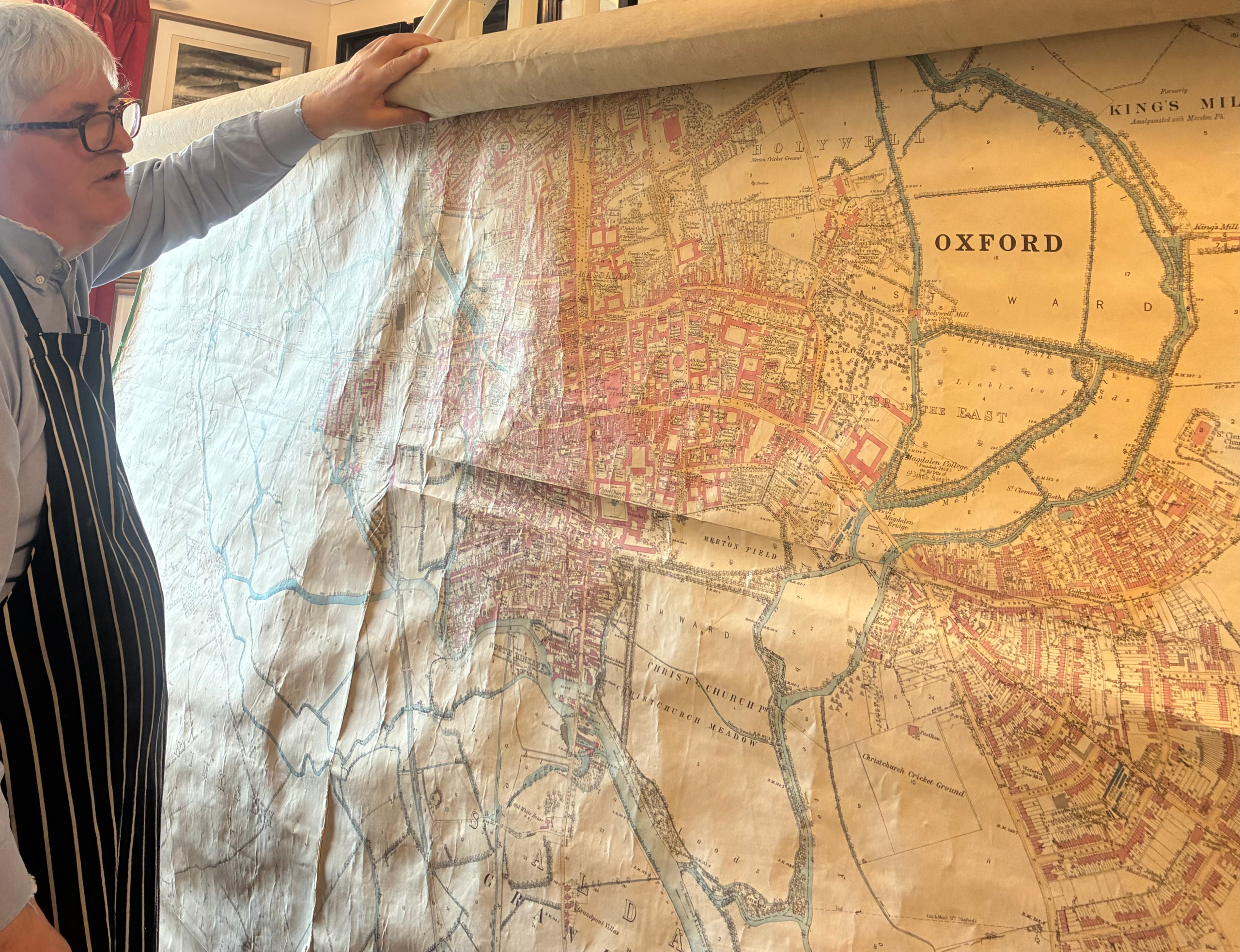
Main image: Julian with a 1st edition 1:25-inch map of Oxford. Rivers are in blue and buildings in red.
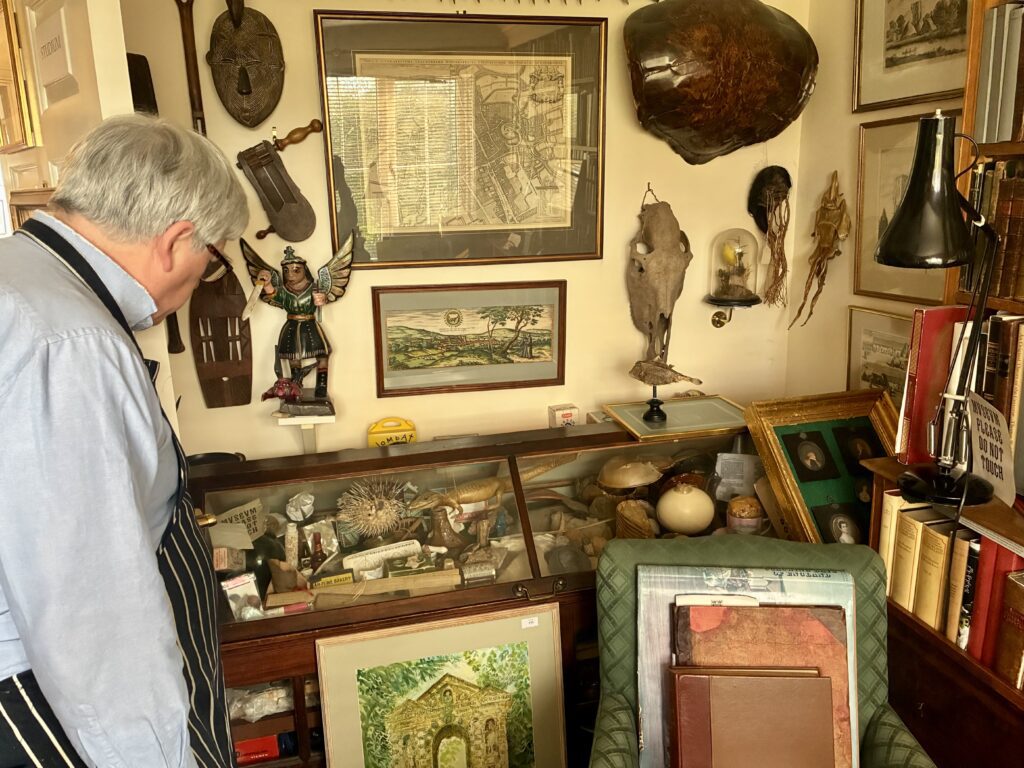
Julian with his cabinet of curiosities – which include a puffer fish, crocodile, ostrich egg, piece of the Berlin Wall and a model of an old coracle made by the last coracle maker in Wales.
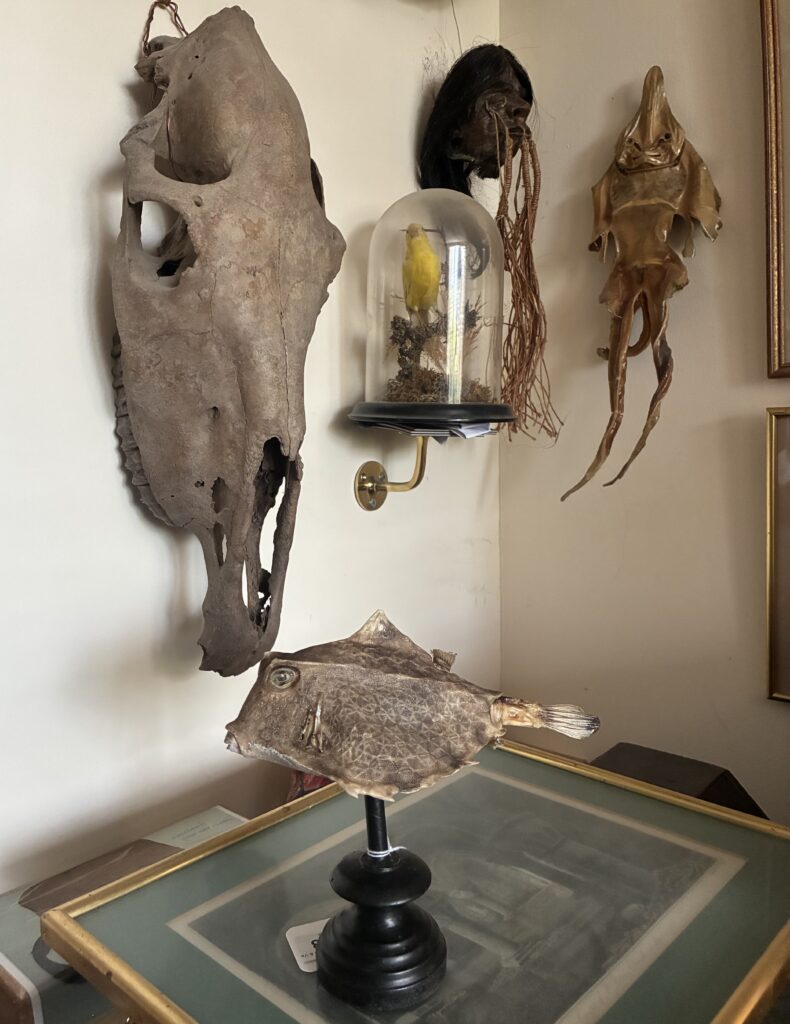
The shrunken head (a gourd), and a Bishop fish (on the wall, the head looks like a mitre).
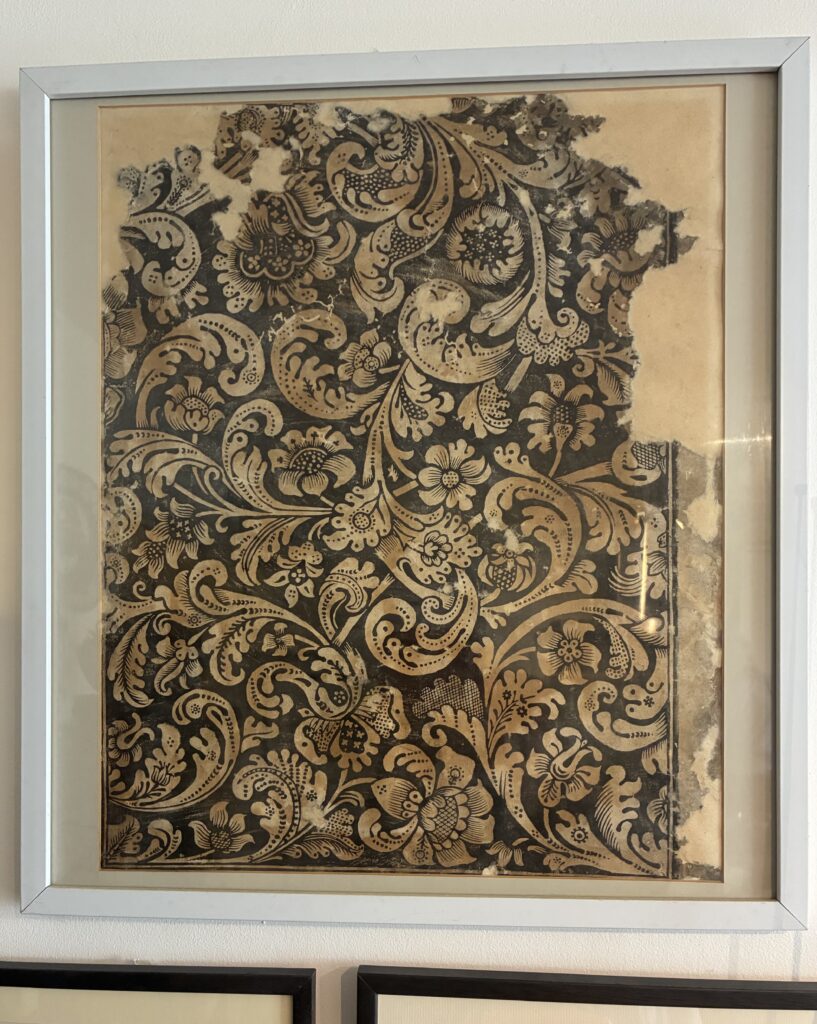
17th century wallpaper
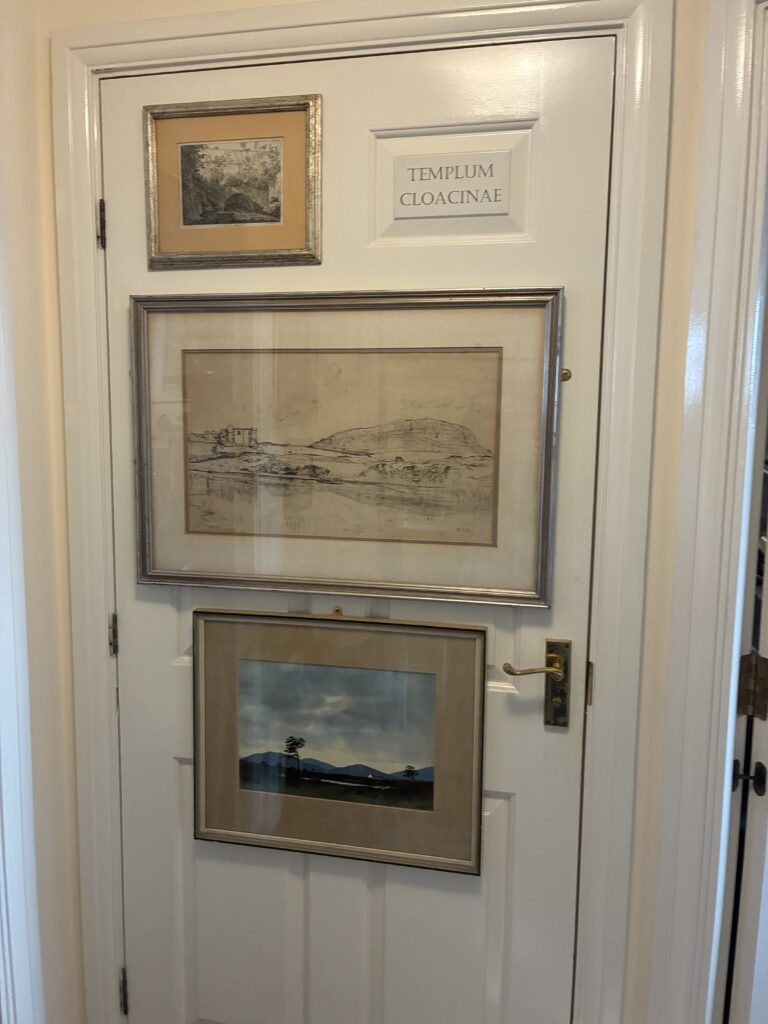
The lavatory door
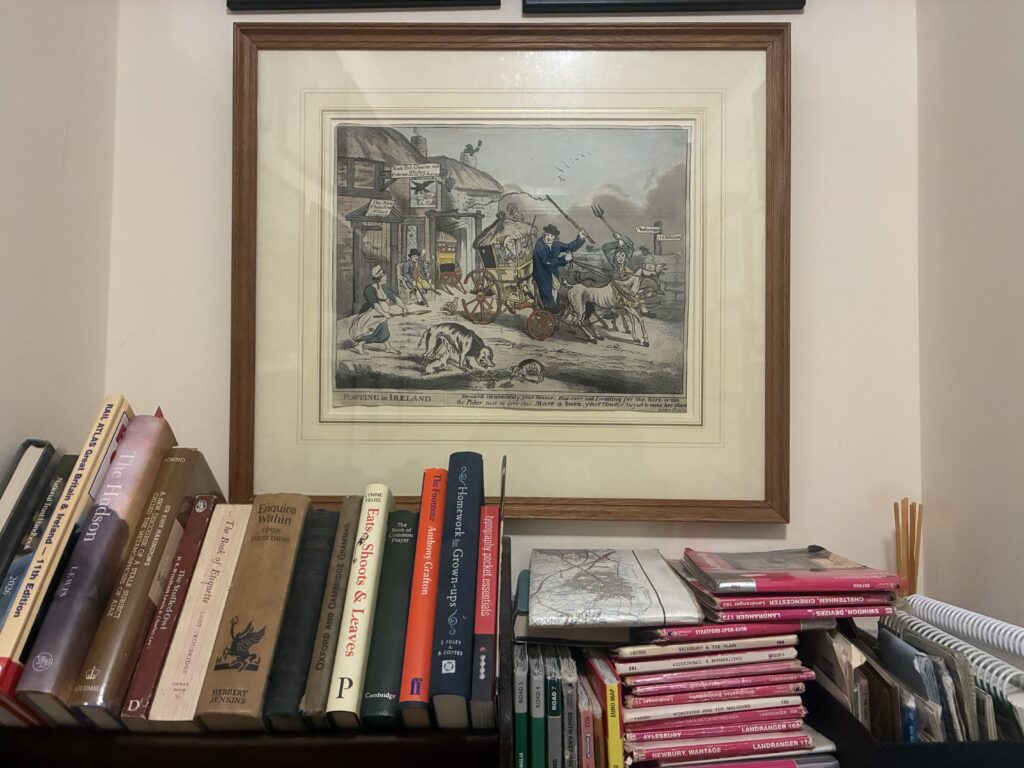
With plenty of reading material inside.
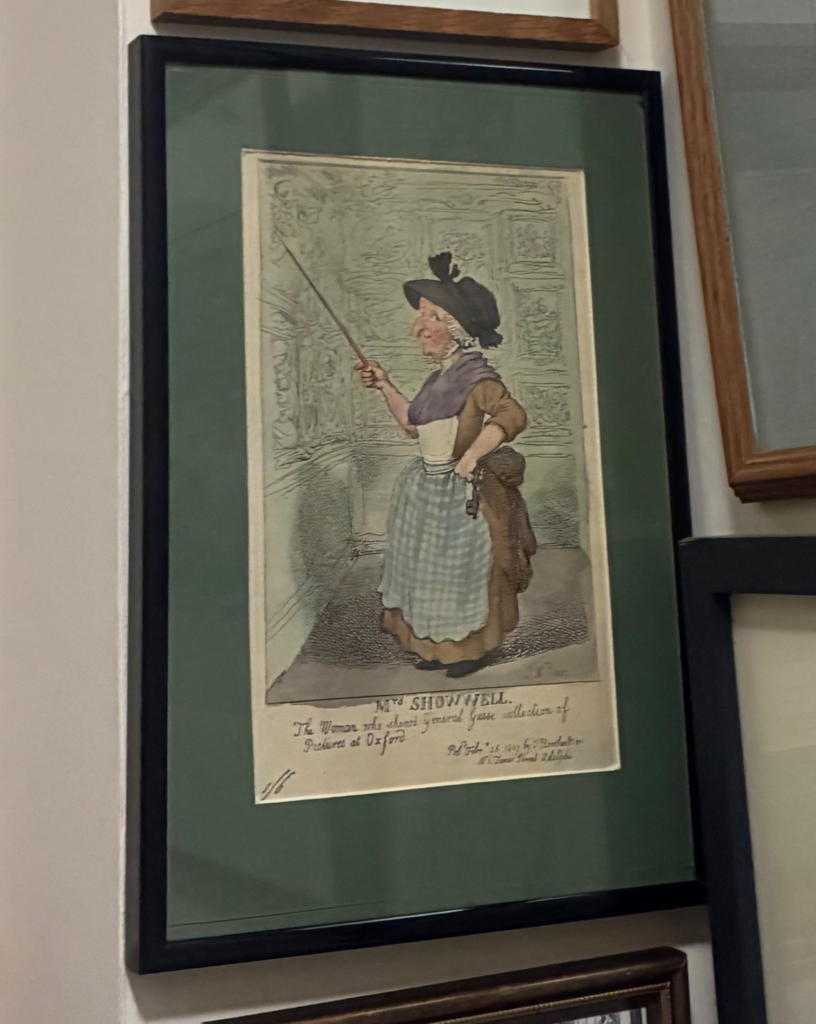
And lots to look at including the splendid Mrs Showwell.
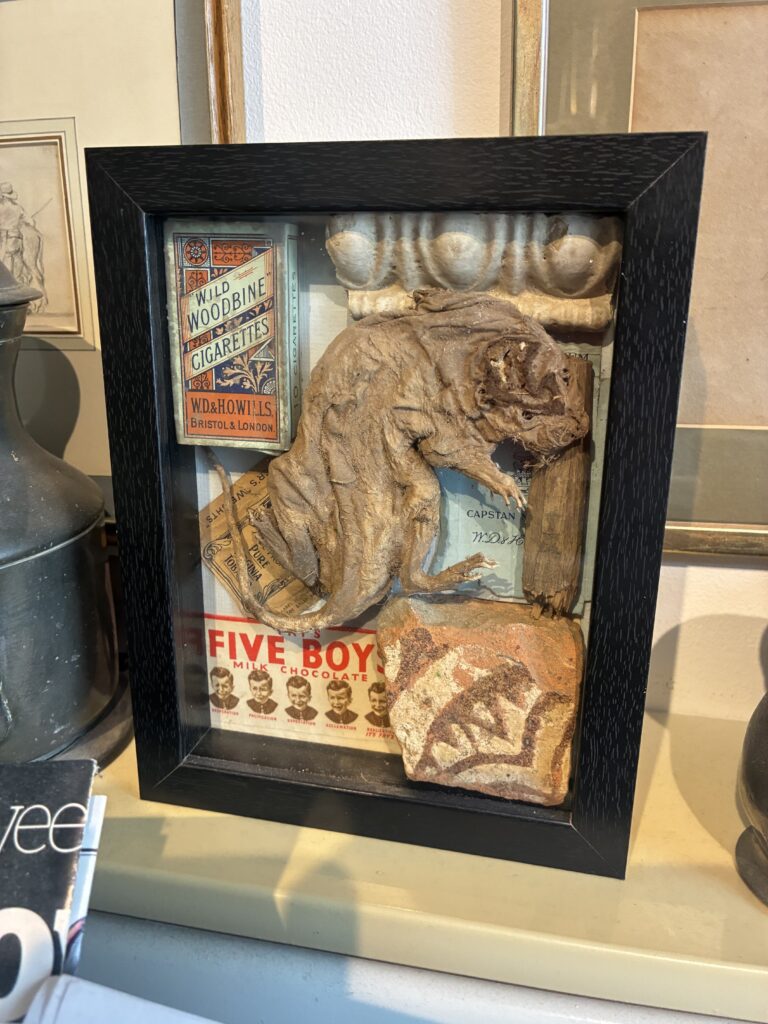
“My career in ruins box” with the mummified rat
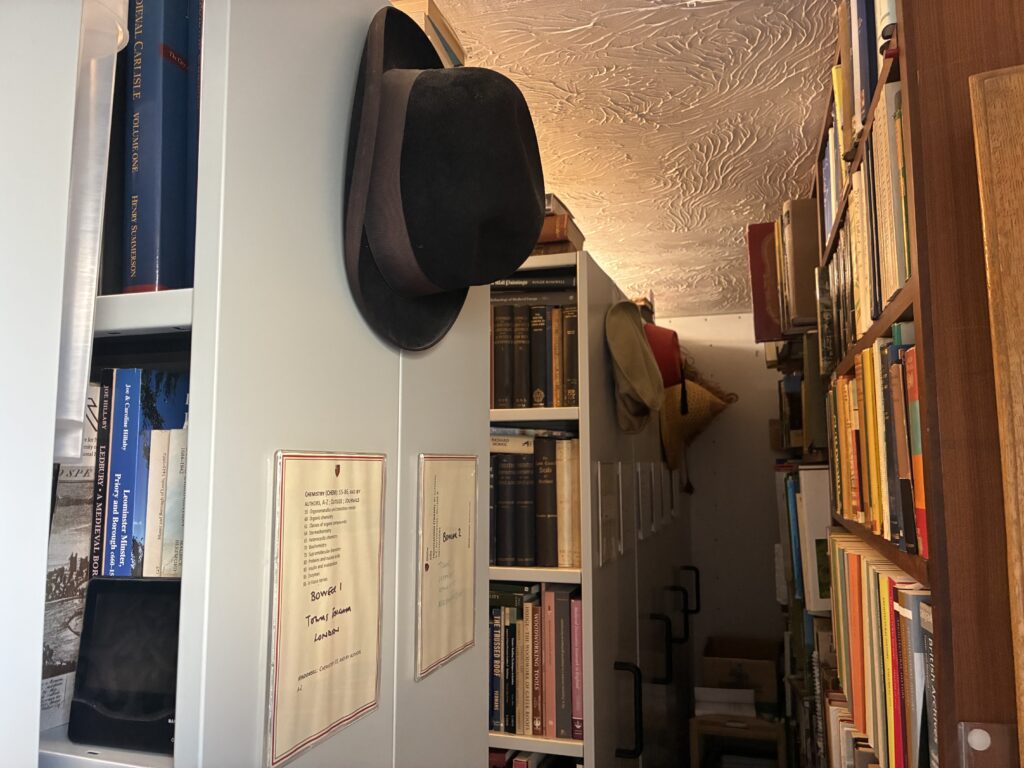
The library.
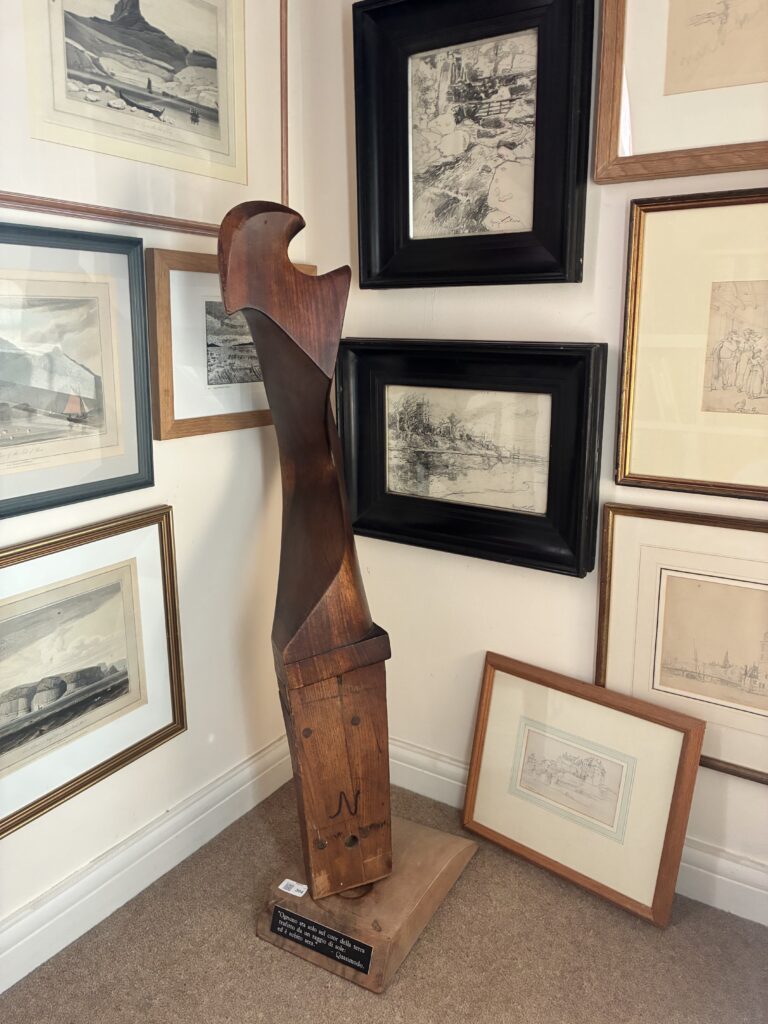
“My treasured forcola, which as you know, or don’t, is no more than a Venetian rowlock. I’d always wanted one, and it just turned up at Mallams and nobody bid for it! It’s real, has been used and is made of walnut,” says Julian.
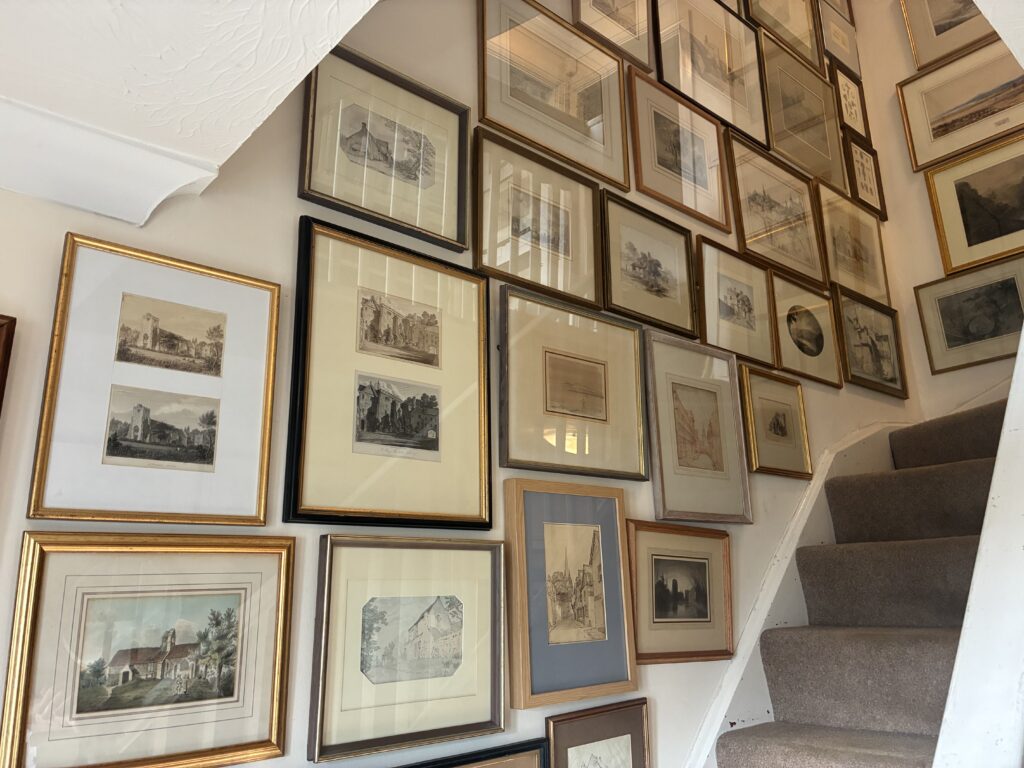
Pictures, pictures, everywhere.
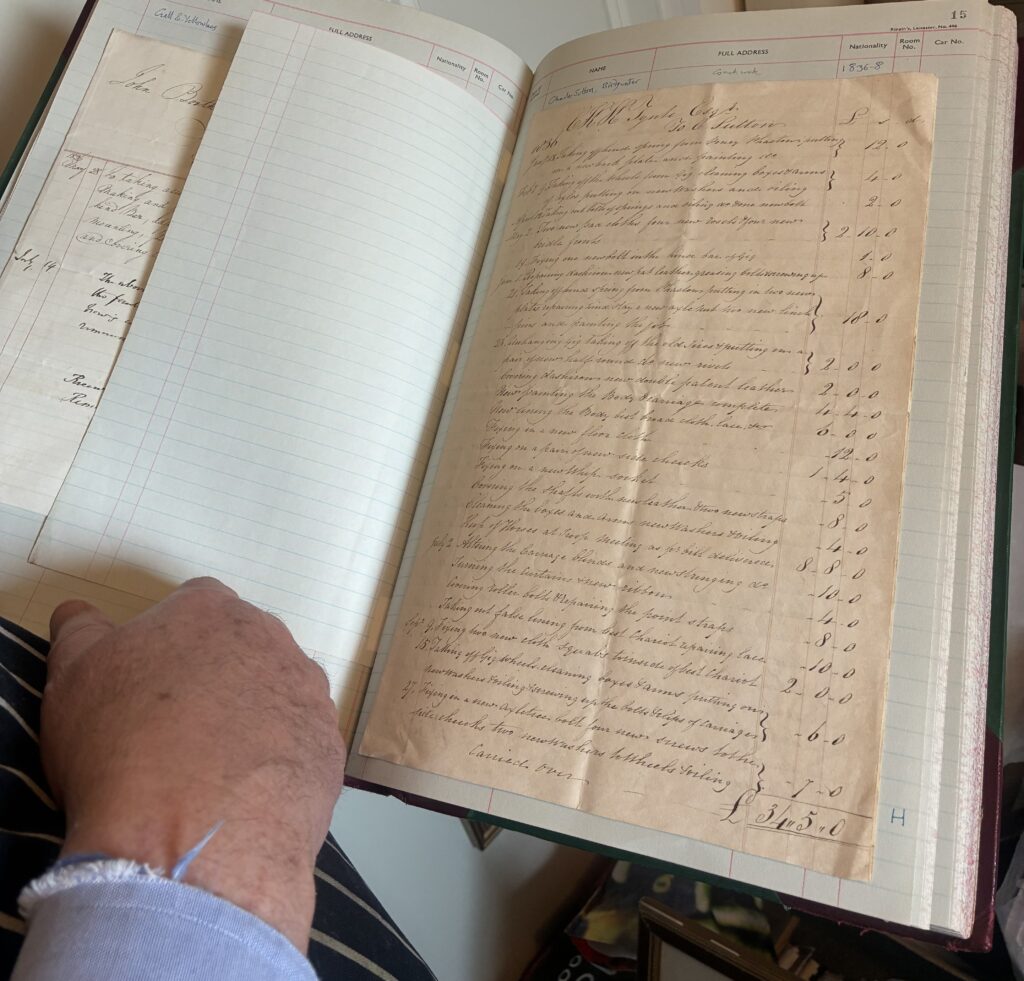
Next to the 15th century will of a barber from Exeter is Julian’s collection of invoices for horse and carriage repairs. Here is a bill from 1836 – a tab was kept and then when you had clocked up a certain amount, the page was removed from the ledger and sent out to be settled.
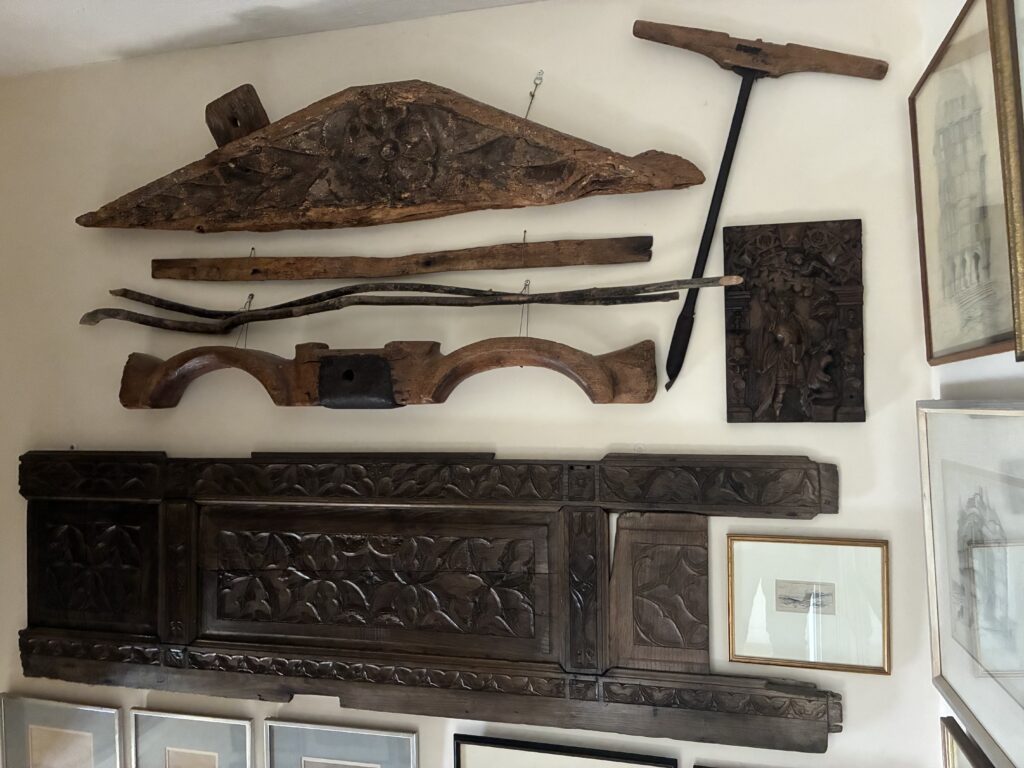
The front of a 16th century chest, an ox yoke from a market in Le Mans, two 15th century hazel rods from a house in Kent (the wattle in wattle and daub), a 14th century stave from Zacs in Cornmarket , and a spandrel with a Tudor rose from a roof, “it still has traces of red and blue paint – found in a skip in Walton Street and saved for me by a friend’s sister.”
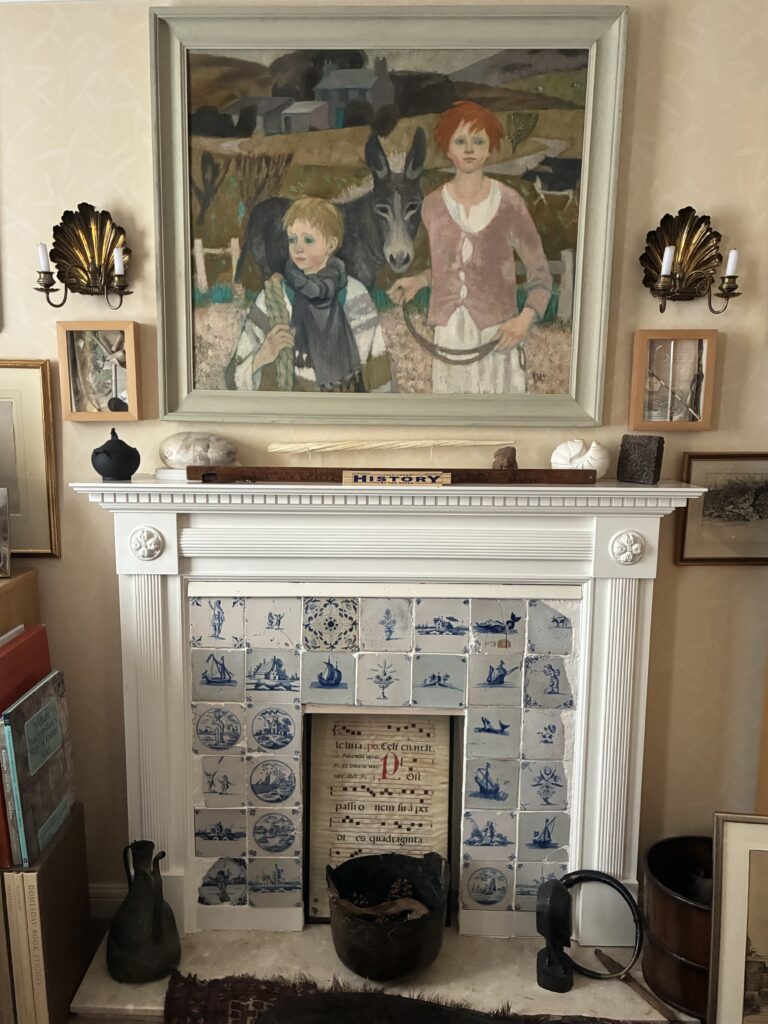
The 17th century Delft tiles around the fireplace were saved from a skip outside Pembroke College. Above the mantlepiece is, he insists a unicorn’s horn (“touch it for luck”), in fact a narwhal horn, protected like ivory (and acquired with a CITES certificate).
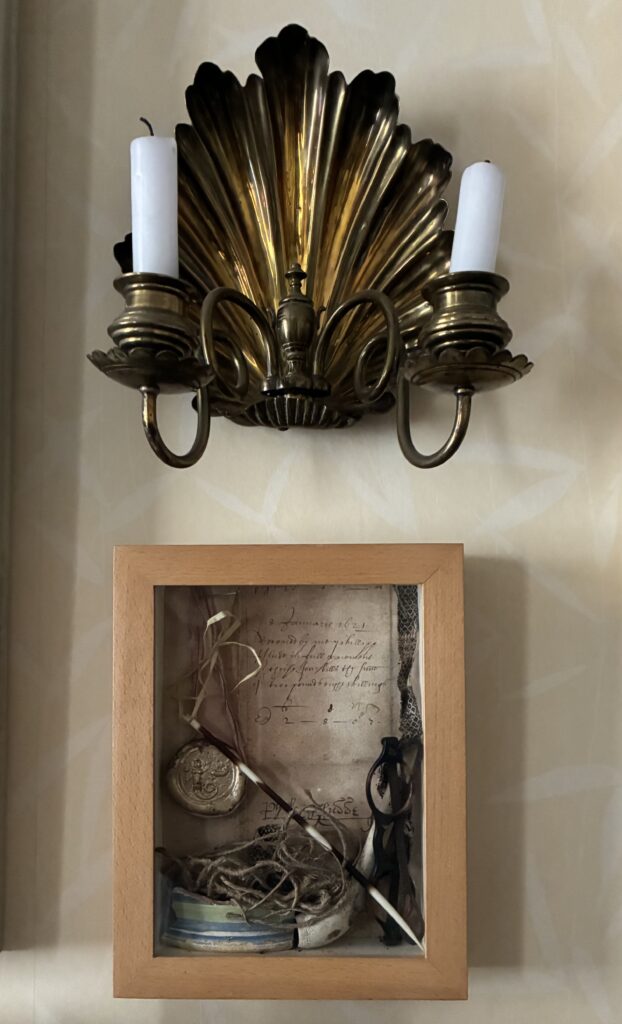
Julian’s 17th century box includes a bottle seal from Oxford’s old Mermaid Tavern, some archival string, a porcupine quill, an old receipt for some cloth, a clay pipe and some slipware from Lambeth.
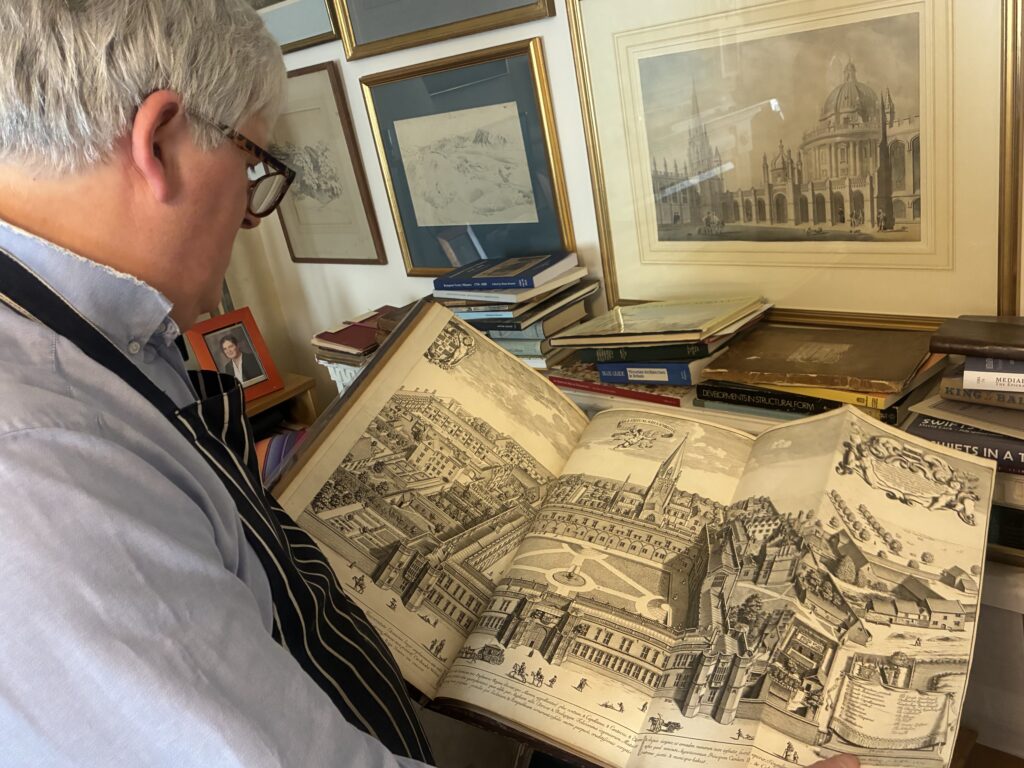
Julian looking at the Loggan print of Christ Church. It is a beautiful thing, filled with detail, inhabited by people, carriages, animals, even wood piles. When Julian purchased the book of Loggan prints, it had a 19th century binding and the pictures were in the wrong order. So he bought an original 1670’s binding with marbled paper from Sanders, and had it rebound in Yarnton by Temple Bookbinders. If I were to choose one thing from Julian’s house to take home with me, this would be it.
You may also like to read:
5 Comments
Join the discussion and tell us your opinion.
What a magnificent collection, like a second Pitt Rivers. Particularly fond of Mrs Showwell. She looks a formidable old thing.
She does indeed
Fascinating place! The old curiousity house!
Surely the equivalent of an invite to Albus Dumbledore’s office. An excellent post about a living Oxford treasure: J Munby.
Wow x 3 … Julian personifies all of us who have a bit of ‘ rat-pack ‘ mentality around the house … only Julian does it with Curatorial accuracy & Museum display splendor.
It’s surprisingly clean! I looked at your pictures with some trepidation, because people who have a lot of ‘stuff’ also tend to have a lot of dust….is Julian a dab hand with a duster, in addition to his talents as a curator and picture hanger?
This has inspired me to dig out some of my accumulated ‘curiosities’ and get them on the wall!