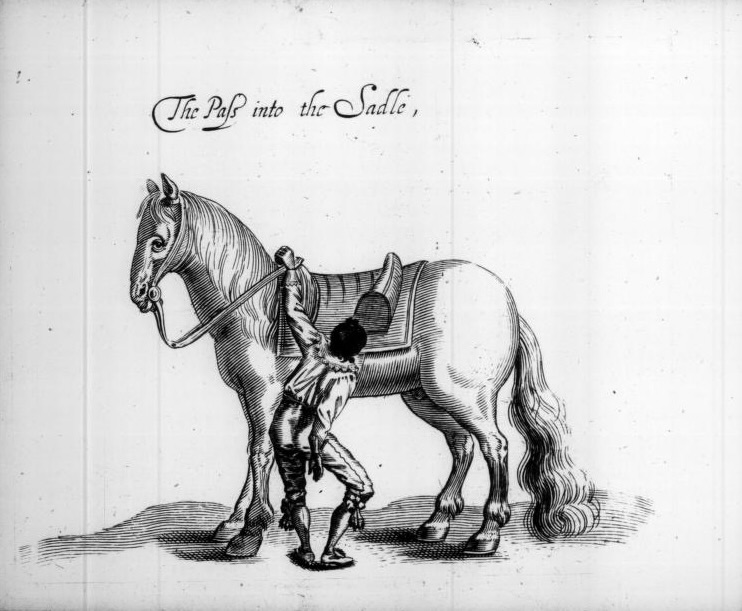
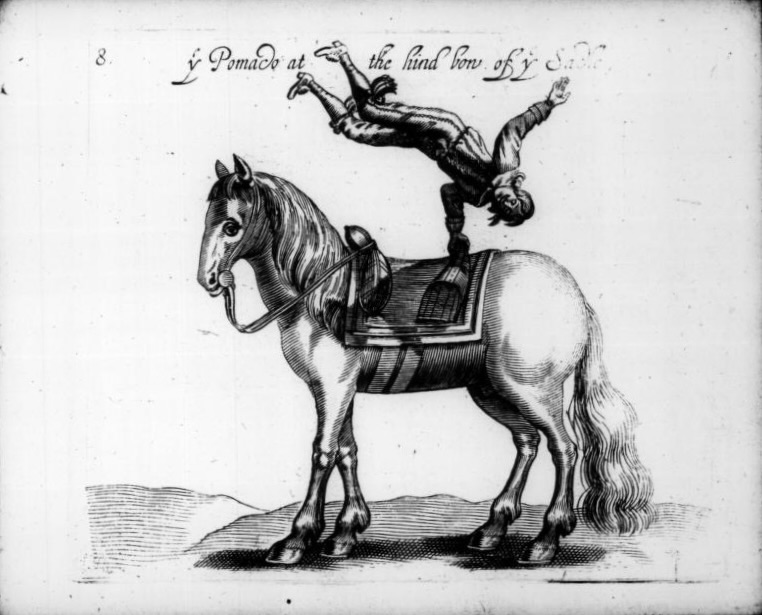
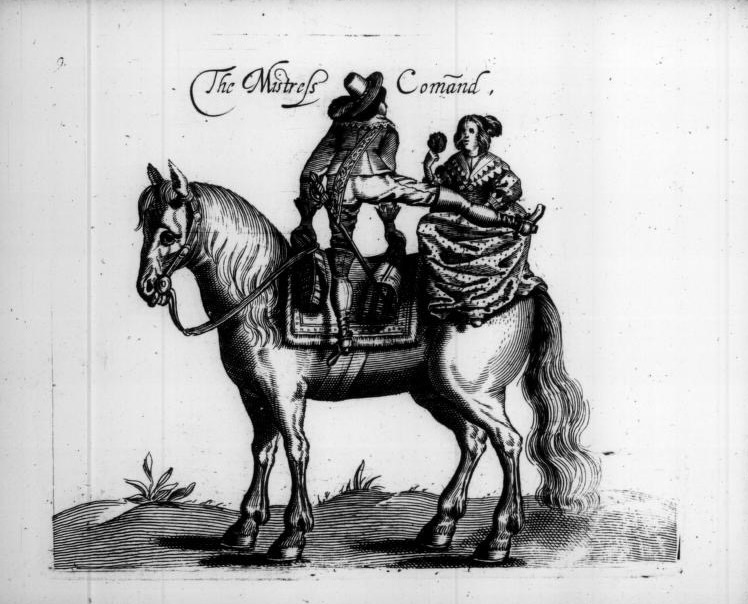
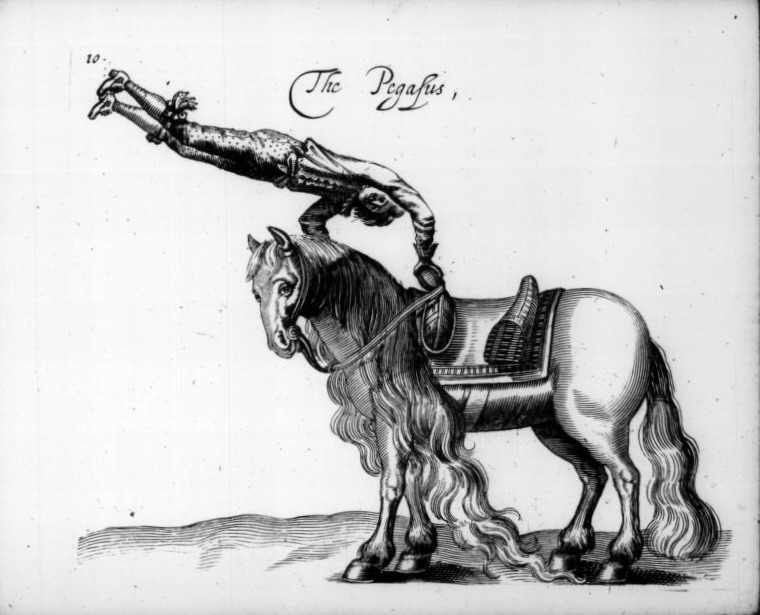
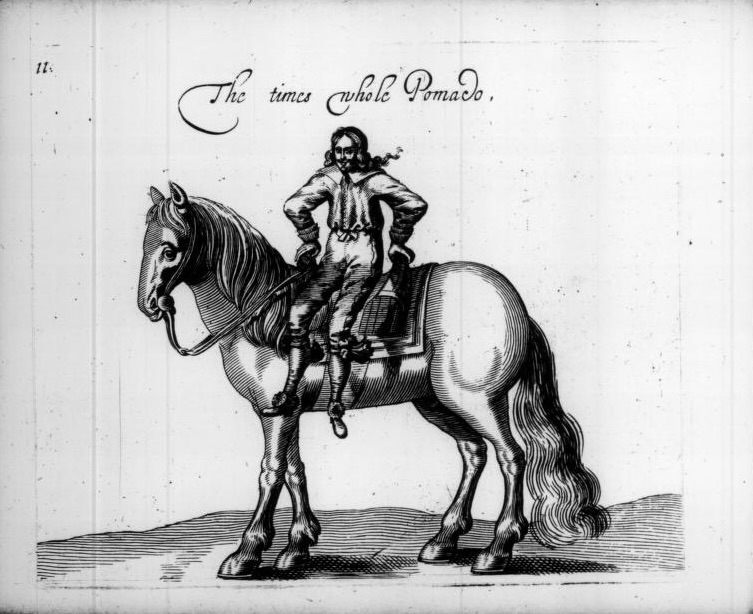
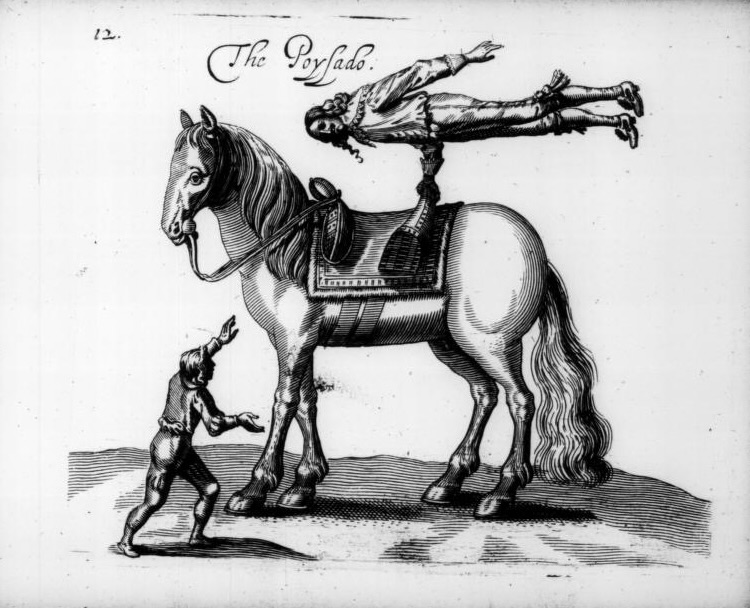
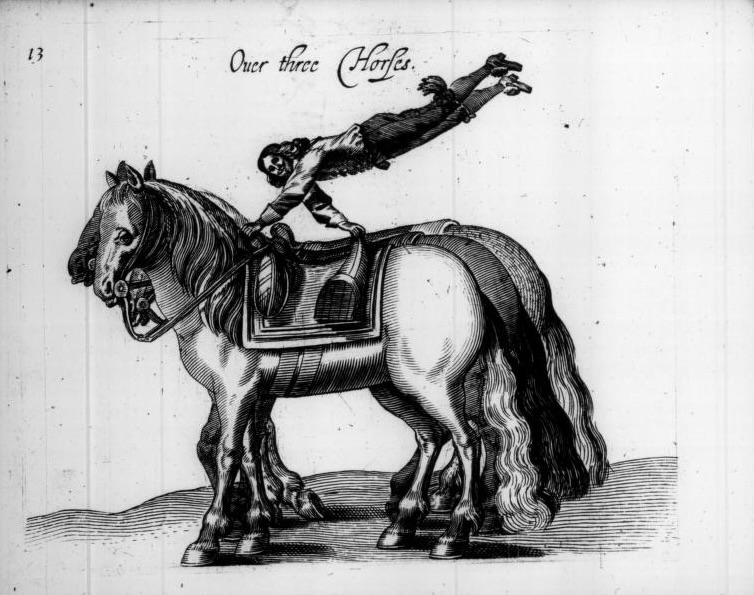
I am delighted to present for your amusement some engravings by George Glover from William Stokes’s book ‘The vaulting master or the art of vaulting’ in the hope that they will amaze and entertain you as much as they have me. One might be excused for thinking this an instruction manual on how to achieve the kind of death-defying acrobatics on horseback that one associates with the circus. A themed circus, for the man modelling the moves is dressed as a cavalier, all long curls and handlebar moustache, tightly cut breeches and buckled shoes.
But the small volume was not meant for fairground tumblers or tightrope walkers. Published in 1641, it was aimed at the educated gentleman of the 17th century, a time when vaulting expertise (the ability to leap on and off a horse with ease and without help) was considered an essential part of his required repertoire. And Oxford was the place where you went to learn.
William Stokes ran a vaulting school called The Bocardo, from the second floor of a house on Cornmarket opposite the Church of St Michael at the Northgate, (dancing and fencing, also essential skills for a man of means, were taught alongside on the same premises by his friend John Bosseley all the while Oxford was being used as the Royalist capital during the Civil War right up until 1661) and there is no doubt his treatise helped give the place some healthy publicity, as well as a national reputation. Counting among his pupils the Prince of Wales (later Charles II), his master of the horse, Henry Percy, and the diarist John Evelyn, (Samuel Pepys had a copy of Stokes’s book in his library) he was adamant in his belief that vaulting embodied the kind of physical prowess and masculinity associated with the heroes from our classical past. Vaulting was not as some believed, as he put it, a ‘dangerous exercise, a device to break one’s neck, or limbs,’ but one that taught strength, athleticism and agility. ‘Vaulters’, claimed Stokes, avoided the decadence that ‘has shrunk men’s sinews, and enfeebled them,’ and became with practice ‘equal to the most active of the beasts.’
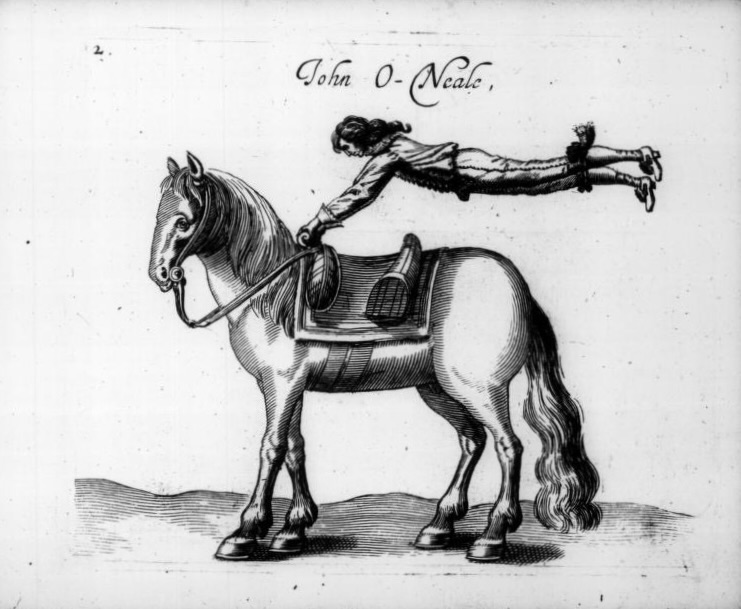
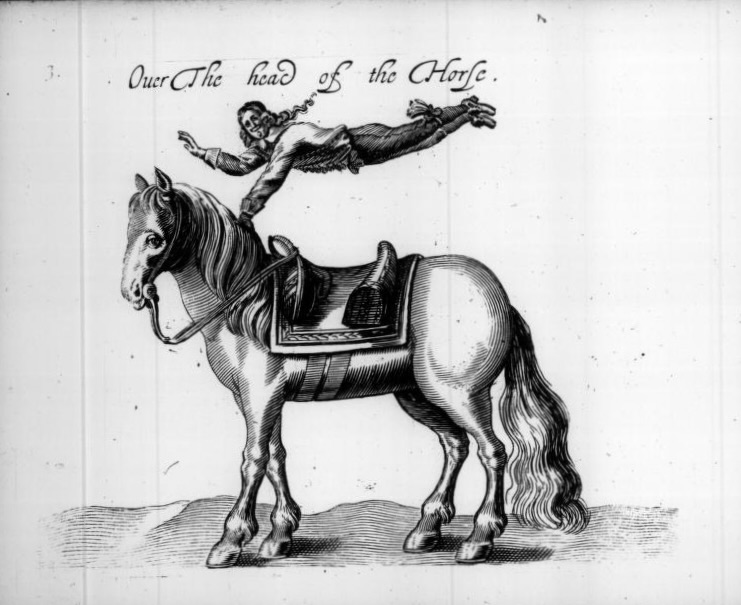
Claiming to have personally engaged in the sport daily for 30 years, Stokes gives step by step instructions on how to perform The Hercules Leap (requiring great strength), The John O-Neale (a spring over the buttocks of the horse), The Pegasus (flinging your body over the horse’s head), and other ‘passes’ as they are called in the trade. Practising at first on a wooden horse, the idea was to progress to the real thing. For the ability to jump from one mount to another was considered a valuable skill should your horse be killed on the battlefield, or you wanted to unhorse an enemy rider.
But I am glad to see they were also designed to excite ‘the admiration of the beholders.’ And this they most surely must have done. One picture shows how to jump three horses at the same time, another how to leap beside a woman ‘without molesting her’. Not to mention the leg swings, jumps and handstands inherited by Simone Biles and other modern gymnasts.
I very much hope they make you smile. However, I suspect to catch the kind of display you see on these pages nowadays, you will need to buy a ticket to the circus.
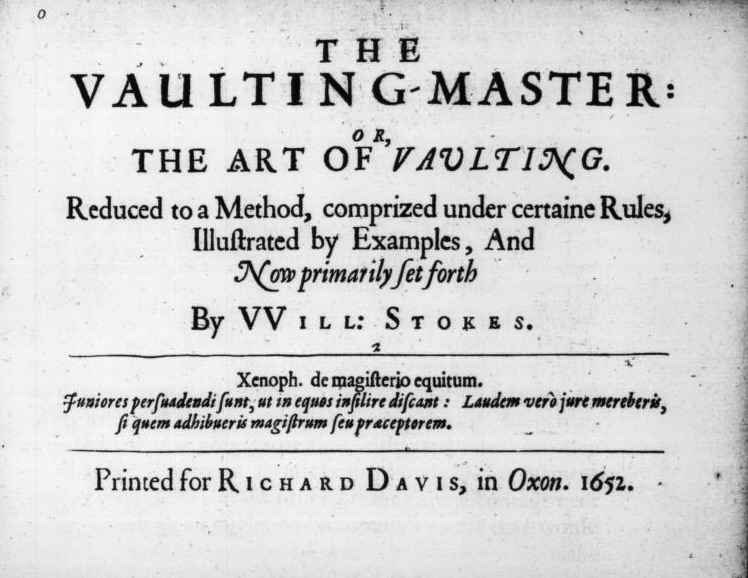
Copies of The Vaulting Master have been digitised by Internet Archive, and it is these pictures which are reproduced here.
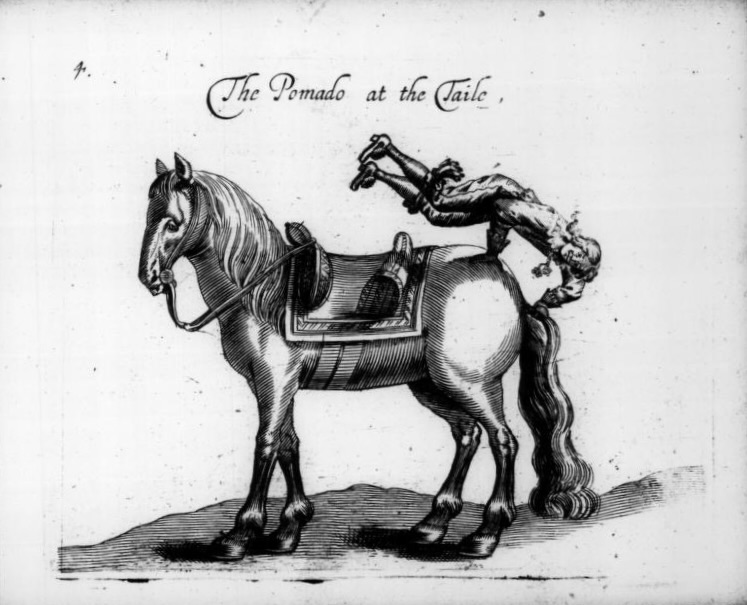
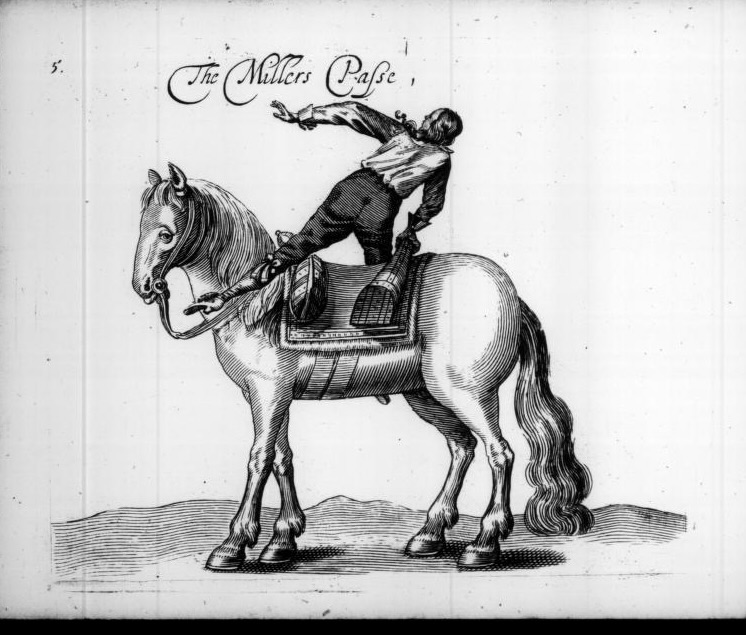
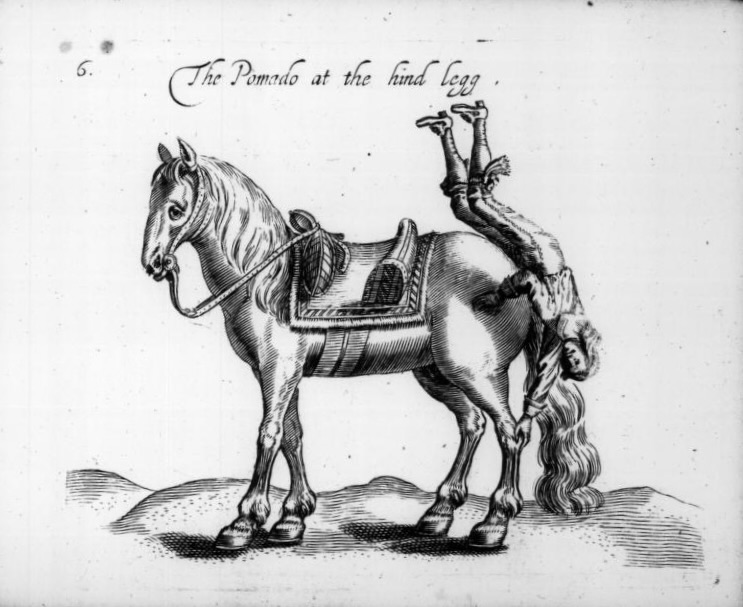
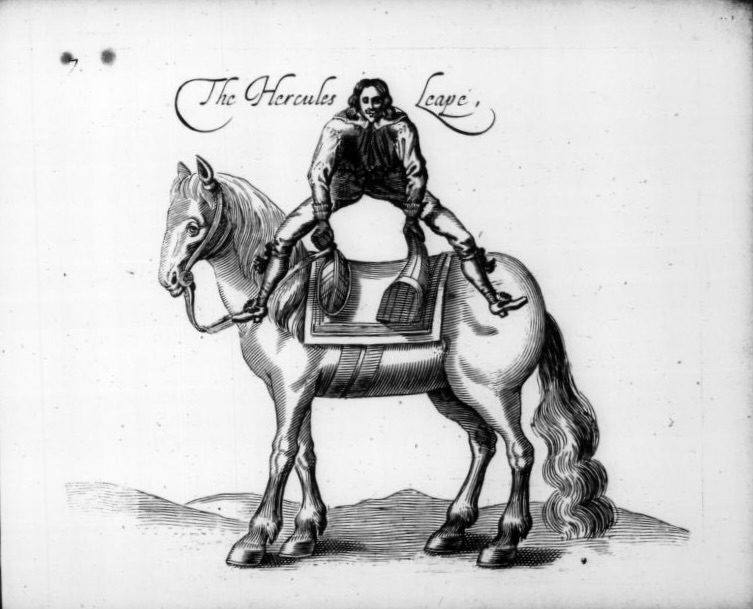
6 Comments
Join the discussion and tell us your opinion.
Vaulting is still practiced today and far from being a circus act, it is one of the horse sports competed under the umbrella of the international equestrian federation, the FEI.
Amazing / must go and take a look.
the other sports for reference are Showjumping, Dressage, Eventing, Driving, Endurance, and vaulting. All have world championships and competitions internationally. Vaulting has individual and team events and it’s quite amazing to see the athleticism in harmony with a cantering horse that makes Vaulting elegant.
https://www.britishequestrian.org.uk/getinvolved/equestrian-sports/vaulting
The drawings or illustrations are definitely helpful. Thanks for sharing this with me.
A tricky Art…for certain.
It’s fascinating.
I notice that there don’t seem to be stirrups, and that the saddle has very high and sturdy pommels, so is this special equipment for this sport ( or art)? I must go and take a look at Mr Bowers reference. Also the horses seem to be very sturdy compared to most modern horse sport participants , and were presumably selected for an equable temperament to put up with some bloke jumping around on their back.