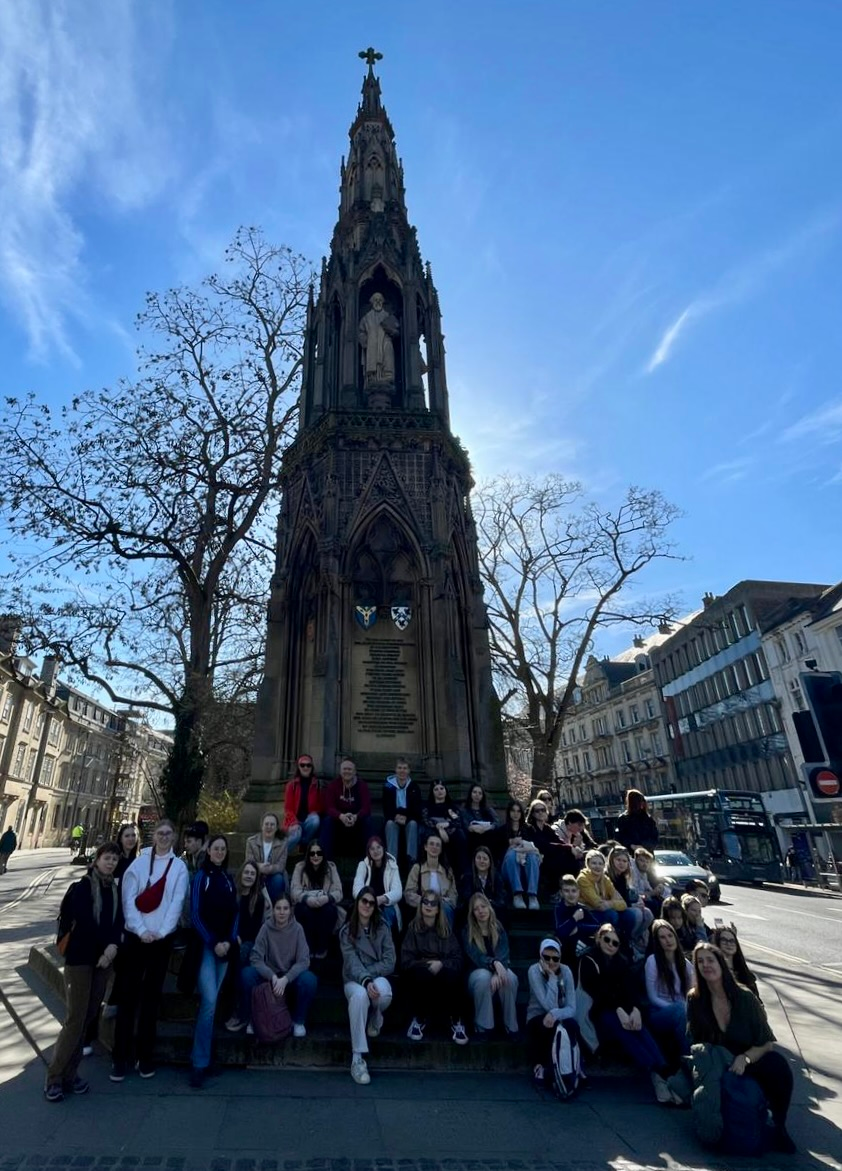
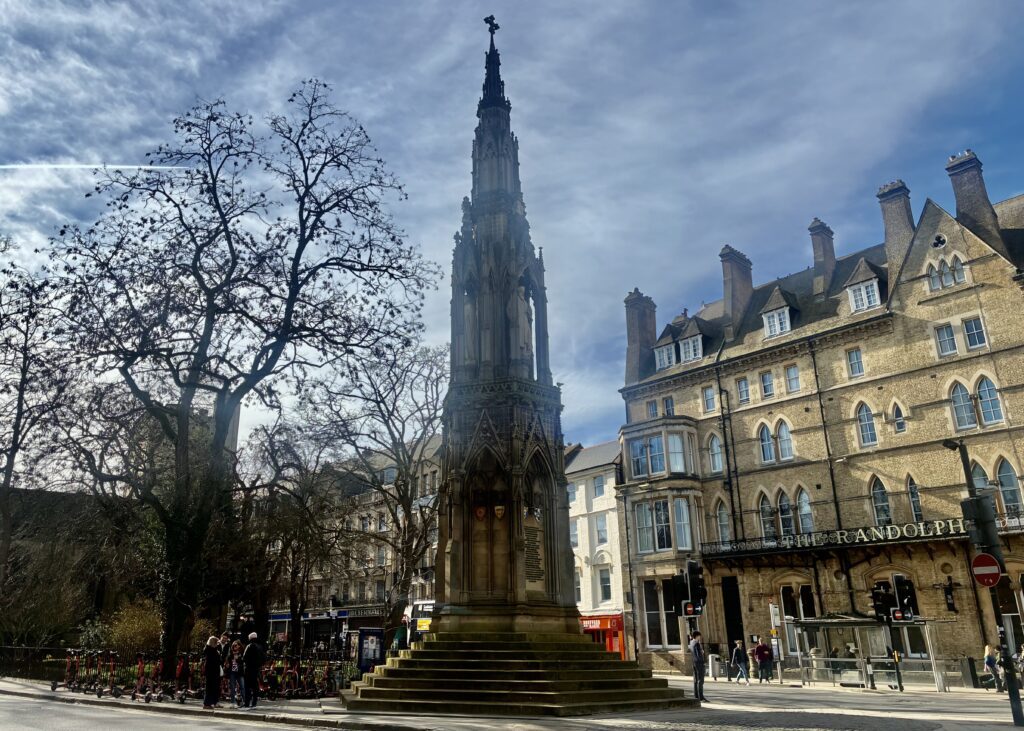
Not far from where I live stands the Martyrs’ Memorial, a tall spire-like edifice crowned with a cross, positioned at the northern gateway into the city centre. It is on what nowadays serves as a busy roundabout for Oxford’s bus services negotiating a route around its partially pedestrianised streets. A traffic island if you like – a piece of prime real estate divided by tarmac from Balliol College to the east and a row of chain stores on the west. A plot that also houses the ancient Church of St Mary Magdalen with its wonderful wild flower filled garden of graves, alongside some of the first ever public lavatories built for women, now open to all. On a sunny day like today, the steep stone steps around the monument’s base attract a healthy stream of visitors attracted by its tiered seating. Students eat their falafel wraps bought from the tiny blue wooden kiosk that is Najar’s Place across the way; tourists from around the globe choose it as a good spot to meet up or take a selfie; a homeless man strewn about with plastic bags of belongings tells me he often comes here to watch the world go by, perched up on the top spot.
But I am here for another reason. For high above the steps, three stone statues are nestled into niches. One folds his arms across his chest, one stares into the distance, the third holds a bible. These are Hugh Latimer (Bishop of Worcester, looking west towards Worcester College), Nicholas Ridley (Bishop of London looking east towards the capital) and Thomas Cranmer (Archbishop of Canterbury in the middle facing north), the martyrs to which the monument’s name refers. Condemned for their religious beliefs and then burned at the stake on a pyre erected around the corner from where I am sitting, Latimer and Ridley died on October 16th 1555. Cranmer five months later. On 21st March 1556. That’s 470 years ago this weekend.
Thomas Cranmer was appointed as Archbishop of Canterbury by Henry VIII in 1533. He was chosen as the man most likely to help the King annul his marriage to his Spanish Catholic Queen Catherine of Aragon (with whom he had one daughter Mary but importantly no male heir). The Pope had refused to help, but Cranmer had reformist leanings. And was a friend of Anne Boleyn the woman with whom Henry had become infatuated and who was already pregnant. In hindsight we know the child was another girl (the later Queen Elizabeth 1). But at the time all that mattered was that the King got what he wanted. And this changed our nation’s history. A break with the Catholic Church in Rome followed, with Henry appointed as Supreme Head of the Church of England in the place of the Pope, and the uptake of a wave of new evangelical doctrines and practices from continental Europe. This was the beginning of the English Reformation, with Cranmer as its architect.
Fourteen years later, and now with the first Protestant monarch on the throne, the nine-year-old King Edward VI, (by Henry’s third wife Jane Seymour) Cranmer was able to push for more radical changes. He introduced a new Book of Common Prayer written in the vernacular, banned Catholic practices and encouraged a simpler form of service. It all seemed to be going rather well for the archbishop. He even did what was strictly forbidden to Catholic clergy, he got married and had children.
But it was not to last. Edward died aged 15, probably of tuberculosis, and after a failed attempt to name the Protestant Lady Jane Grey as his successor, in July 1553 Mary Tudor was sworn in as monarch. A devout Catholic, humiliated by the treatment of her mother, she was determined to wreak revenge on all those who had brought down her religion. Retribution for those responsible was swift. And Cranmer was at the top of her list.
Cranmer, to give him his due did not do a runner to the Low Countries as many did from the old regime. He was sent to the Tower of London along with the prominent bishops Latimer and Ridley where they all pleaded guilty to treason for their support of Lady Jane Grey. But that was not enough for Mary. She wanted to make an example of them by accusing them of heresy. The punishment: death by burning. And for that she sent them to Oxford.
At first they were taken to the Bocardo, the town prison above the Northgate of the city, (you can still see the great oak door to their rooms in the little museum upstairs in the Church of St Michael at the North Gate) where it seems they lived in some comfort. Accounts list roast beef, fresh salmon and oysters amongst their offerings. They were allowed servants, and took regular exercise outside. But it was only a matter of time before they were convicted. Latimer and Ridley went first, Latimer now an old man, bent and fragile. On October 16th 1555 they were taken the short distance to a spot just outside the city walls, in front of Balliol College. And as the flames consumed them Latimer is reported to have shouted out above the noise of the baying onlookers the now famous words, “Be of good comfort, Master Ridley, and play the man; we shall this day light such a candle by God’s grace in England as (I trust) shall never be put out.” Latimer apparently being older went quickly, but Ridley’s death was prolonged and agonising. And all this Cranmer was made to witness from atop the city wall. Tearing off his cap and falling to his knees this was when his inner convictions began to crumble.
It took longer for Cranmer to be brought to trial because as Archbishop of Canterbury under Henry VIII he had been sworn in by the Pope, and for the pious Mary only the Pope could undo this. During the time it took for this to happen Cranmer began to unravel. Six times he signed a statement renouncing the Protestant faith. Stripped of his friends, physically and mentally exhausted he agreed to take mass. He even asked for prayers to be said for him by Catholic priests. But Cranmer must have realised deep down that whatever he said or did Mary was never going to spare him. And when in a degrading spectacle he was made to dress in mocked up versions of archbishop’s robes, placed high up in the loft at Christ Church Cathedral, and then ceremonially unclothed, Cranmer knew his time was up.
On 21st March he ate his last meal. Modest, as it was Lent. Spice cakes, bread, fruit, nuts and a dish of prunes. A stage was set up in the University Church of St Mary the Virgin (you can still see the hole cut into one of the pillars to make room for it). And it was here that Cranmer, with tears streaming down his face in front of a packed congregation of Oxford dignitaries was led to read his final recantation. But at the last minute he threw the written apology aside. And amid scenes of confusion, he denounced the Pope and everything the Catholic Church stood for. Pulled from his perch, Cranmer was hurried out of the church, down what is now Catte Street through the gates of the city to where the bonfire awaited. And then as the blaze took hold, he engaged in one last piece of defiant theatre. Holding his right hand aloft, he then thrust it into the flames so that it might be destroyed first, saying this was the hand that had signed the recantations “contrary to my heart”. Legend has it that when the ashes were cleared away his heart remained untouched.
There is a small cross of cobbles sunk into the street on the Broad to show where the three martyrs were burned. And the once main gate to Balliol College, black and scorched from the fires in front, now hangs just inside the passage past the college library. But the main monument, the Martyrs’ Memorial by which I am standing was not built for another 300 years. And herein lies another story.
For after Mary, under her half-sister Elizabeth, England became a Protestant country. Oxford and the University establishment solidly Anglican. But in the early 1800’s this was seen to be threatened by a group of the city’s theologians who preached a return to high church Catholic practices. The Oxford Movement as it became known. And so it was that the wonderfully named Reverend Charles Golightly, as a riposte to the growing popularity of the Movement, set up a fund to pay for a memorial to remind the world of the three Protestants martyred by Catholics. It was to be designed by Sir George Gilbert Scott, ironically a big player in the revival of early Gothic Catholic architecture but all the fashion at the time. And placed in the most public of spots, then an expansive and wide-open space. At the very entrance to the city from the north. For everyone to see.
The Memorial is less visible today than it was when it was first built in 1843. Advancing foliage, lines of electric scooters, a plethora of ugly street furniture and the constant bus traffic now shield it from a clear view. And times have changed. The spacious treelined thoroughfare that is St Giles and over which it presides, offers up in the 21st century a far more broadminded church. For the street holds a record number of establishments aligned to different Christian denominations; from Catholics to Quakers, Baptists to Christian Scientists. Standing side by side. All equally tolerated. And for that I am hugely grateful.
More details about Cranmer’s life can be found in his biography: Thomas Cranmer by Diarmaid MacCulloch
Main image: Students from the Czech Republic gather at the Martyrs’ Memorial. The design of the monument was modelled on the Eleanor Crosses erected by Edward 1 in memory of his wife Eleanor.
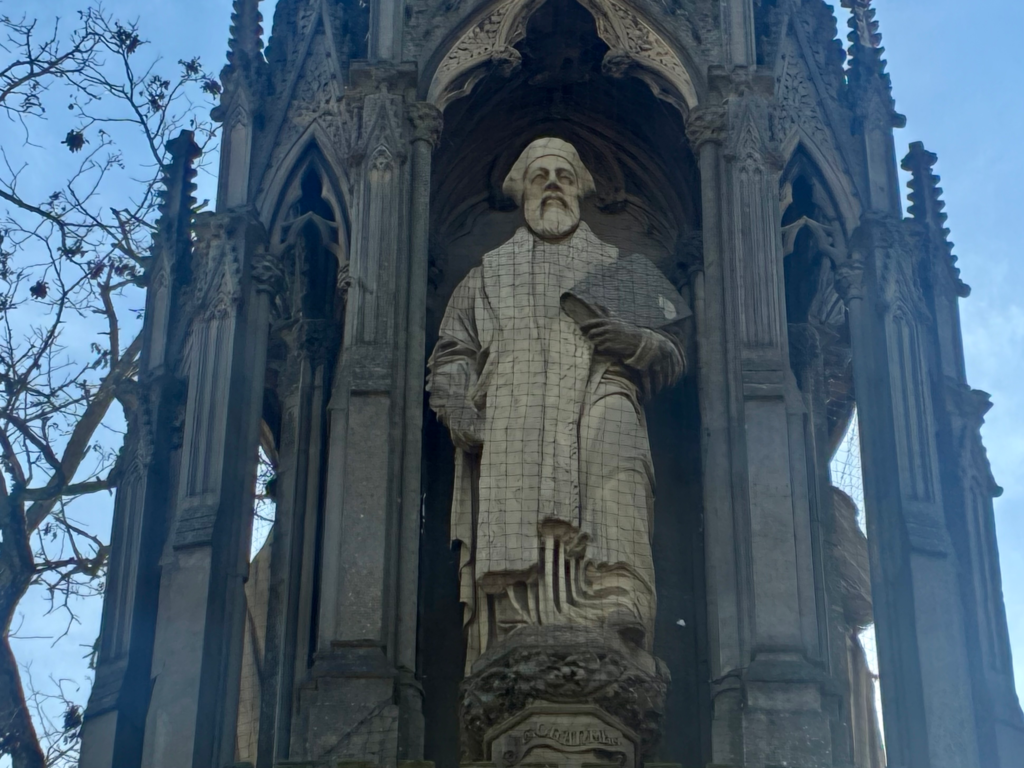
Archbishop Cranmer faces north which means he gets little to no sun at this time of year. The statues of the three martyrs were sculpted by Henry Weekes out of Caen stone to make them stand out from the magnesium limestone used for the rest of the monument.
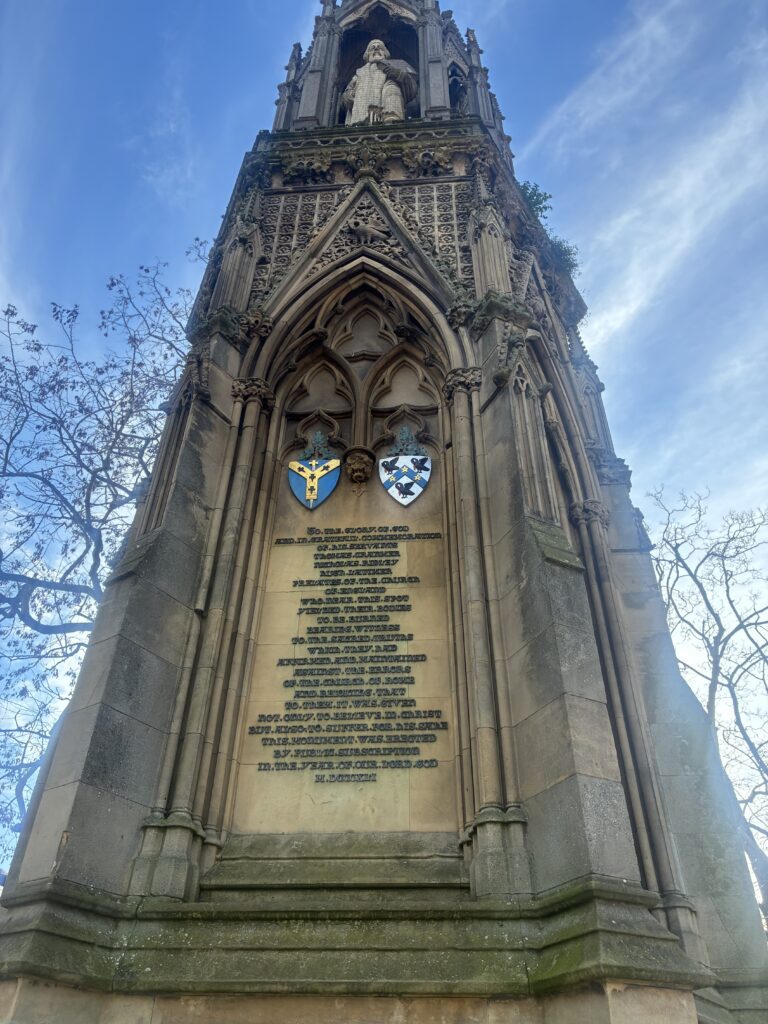
The Coats of Arms under Cranmer are those of the Archbishop of Canterbury (on the left) and Cranmer’s own (on the right). The birds were originally cranes, a pun on his name, later changed to pelicans (it was believed pelican mothers would pierce their own breast to revive their young with blood, symbolising the passion of Christ.)
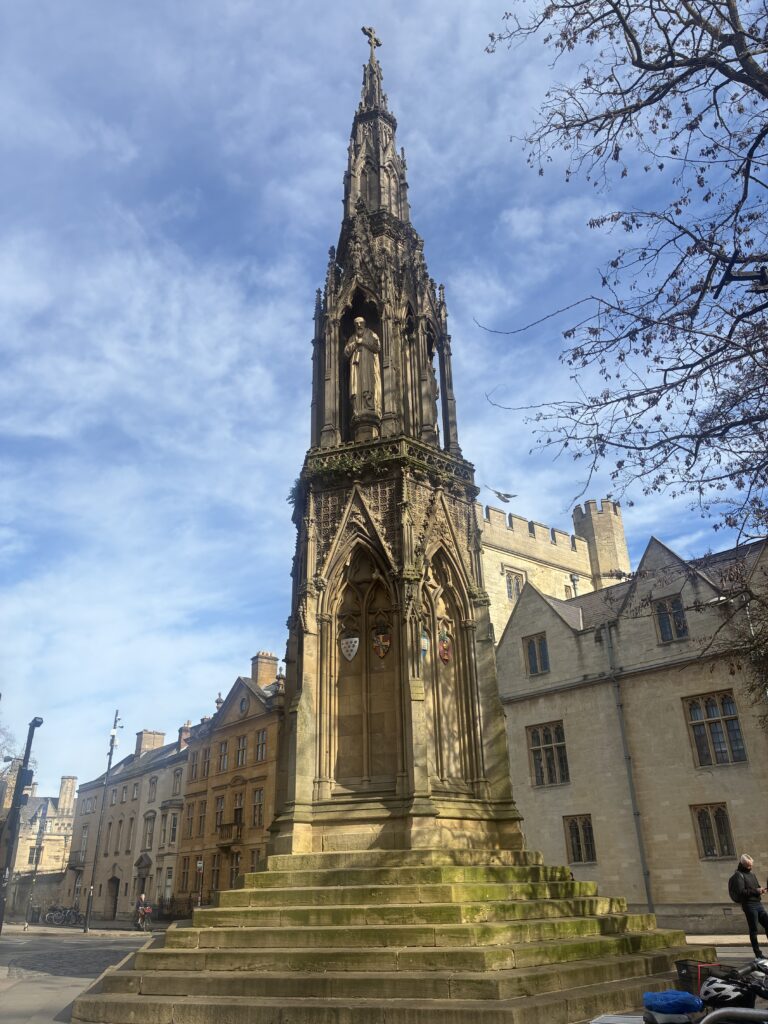
Hugh Latimer, Bishop of Worcester looks west towards Worcester College.
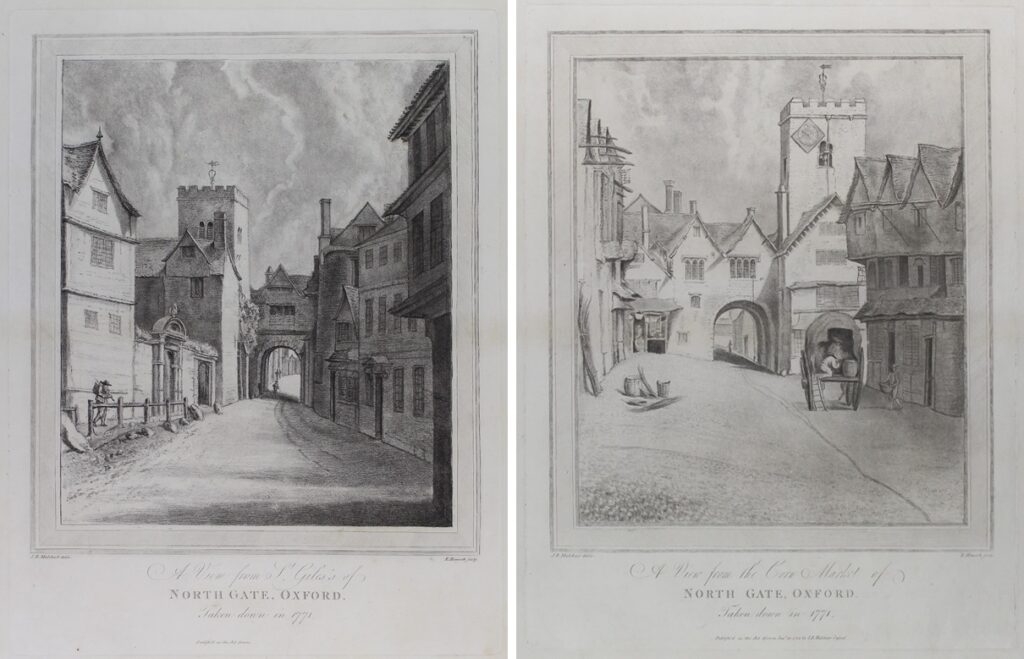
The Bocardo prison above the Northgate of the city,(here seen in engravings from the north and south side) where Cranmer, Latimer and Ridley were all held. The place was demolished to make way for increased traffic in 1771.
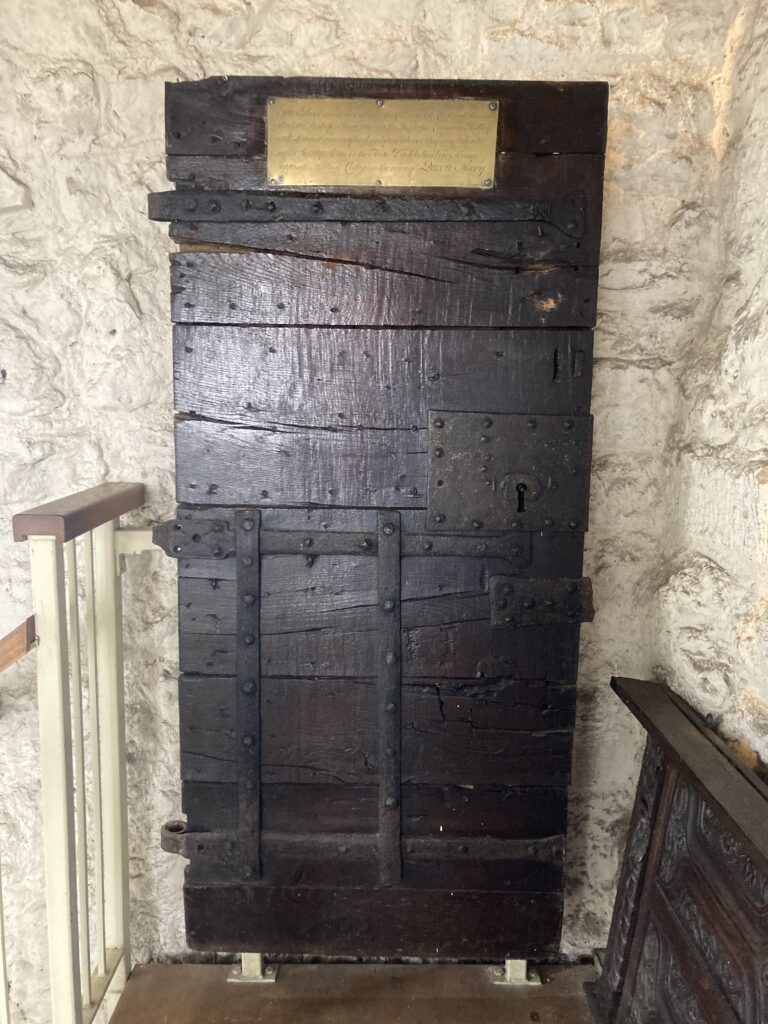
The door to their rooms now in the Church of St Michael at the Northgate
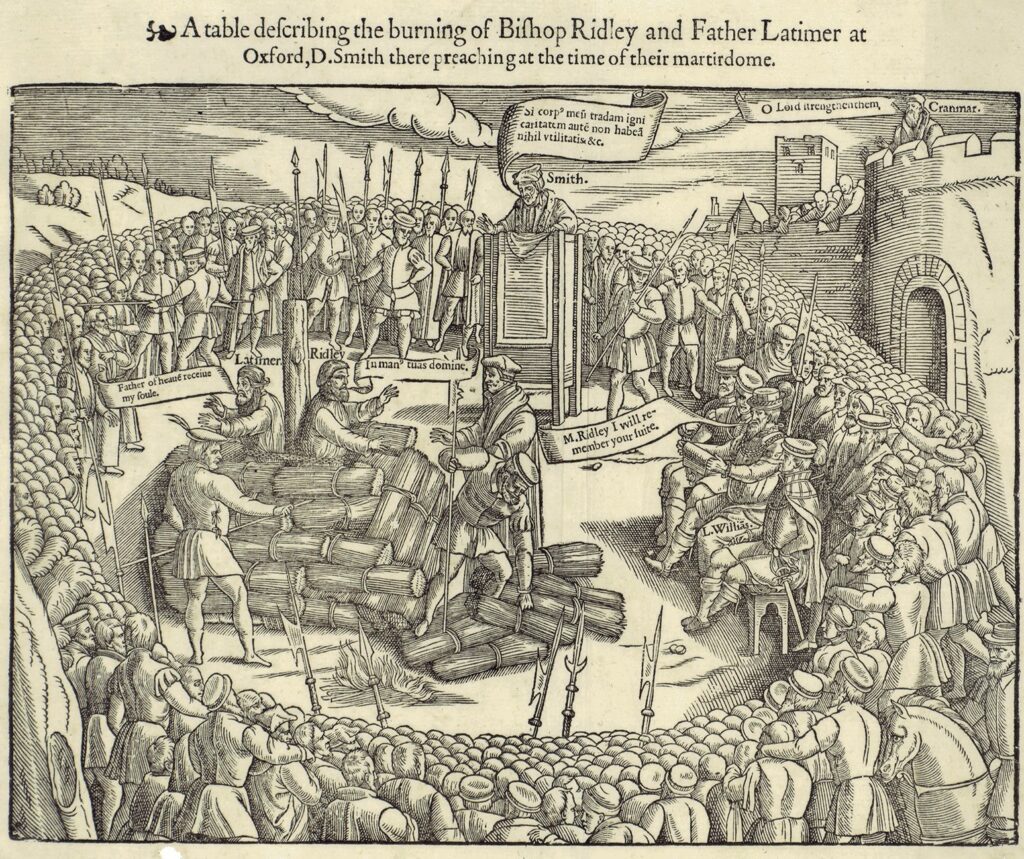
The burning of Latimer and Ridley from Foxe’s Book of Martyrs. You can see Cranmer looking on from the city wall.
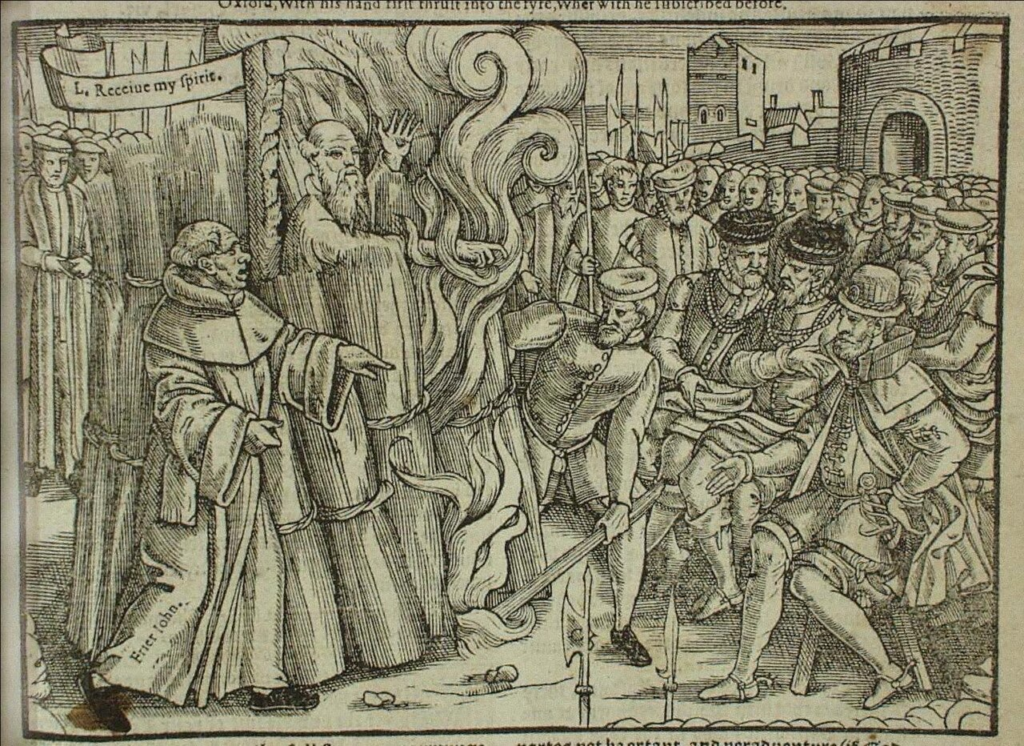
The burning of Thomas Cranmer.
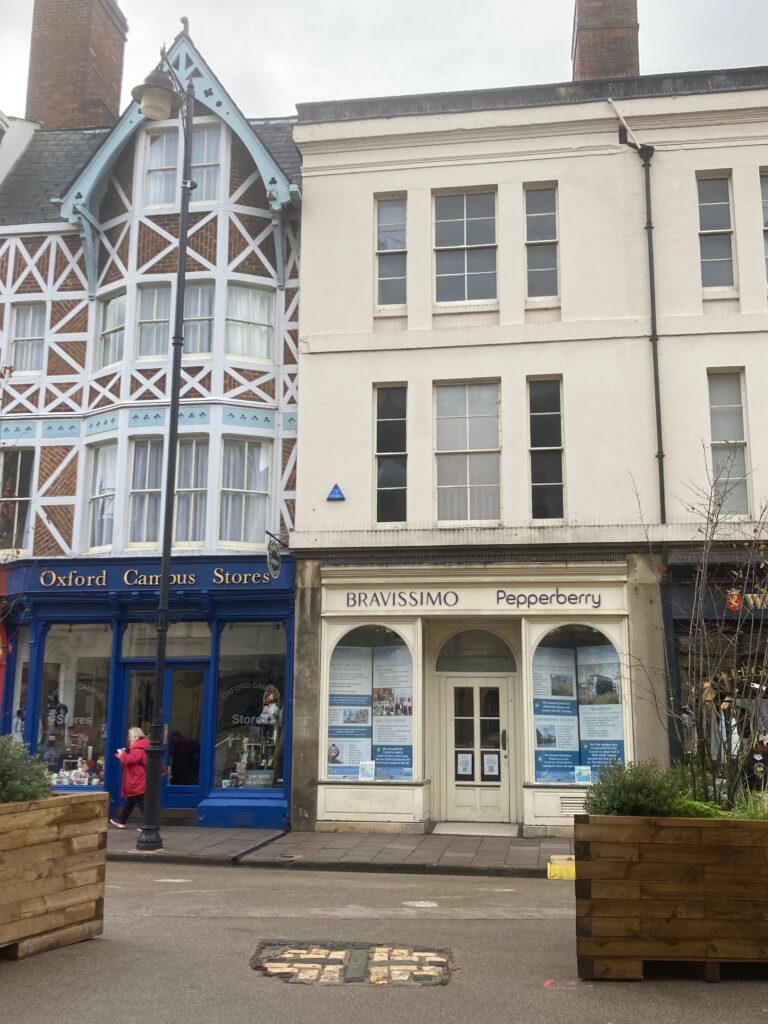
The martyrs’ cross on Broad Street.
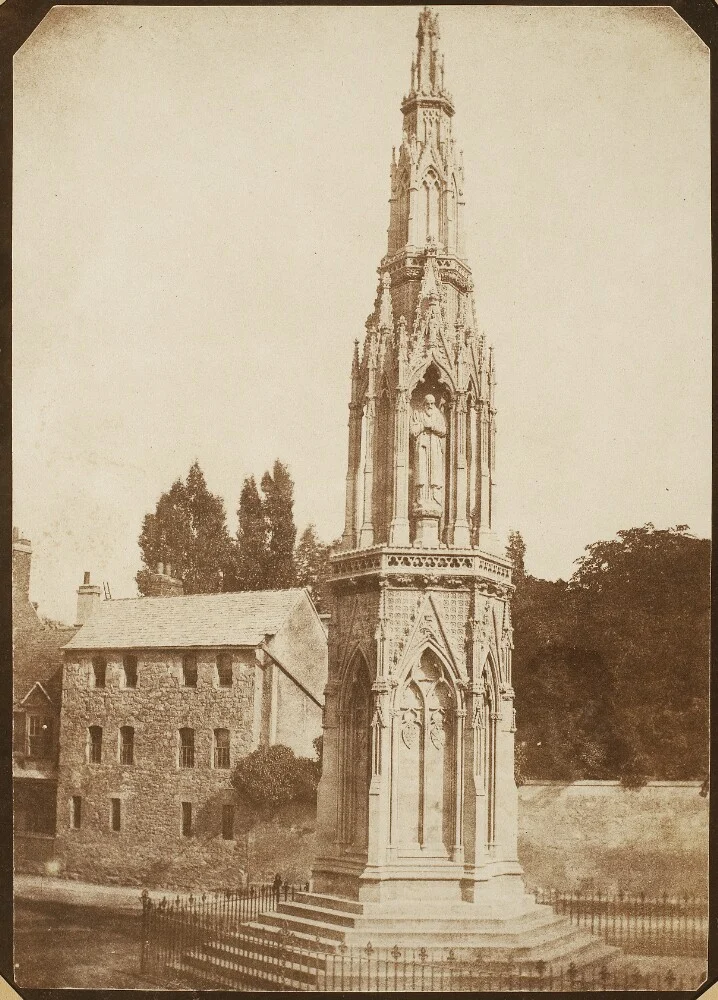
The Martyrs’ Memorial photographed by Henry Fox Talbot soon after it was first erected. In Talbot’s photograph you can see the side of Balliol College, but without the ‘medieval’ gateway that we see today . This gateway was part of an extension built later in the 1800s. At the time the memorial was built there was no Randolph Hotel, and the Ashmolean was just beginning to be constructed.
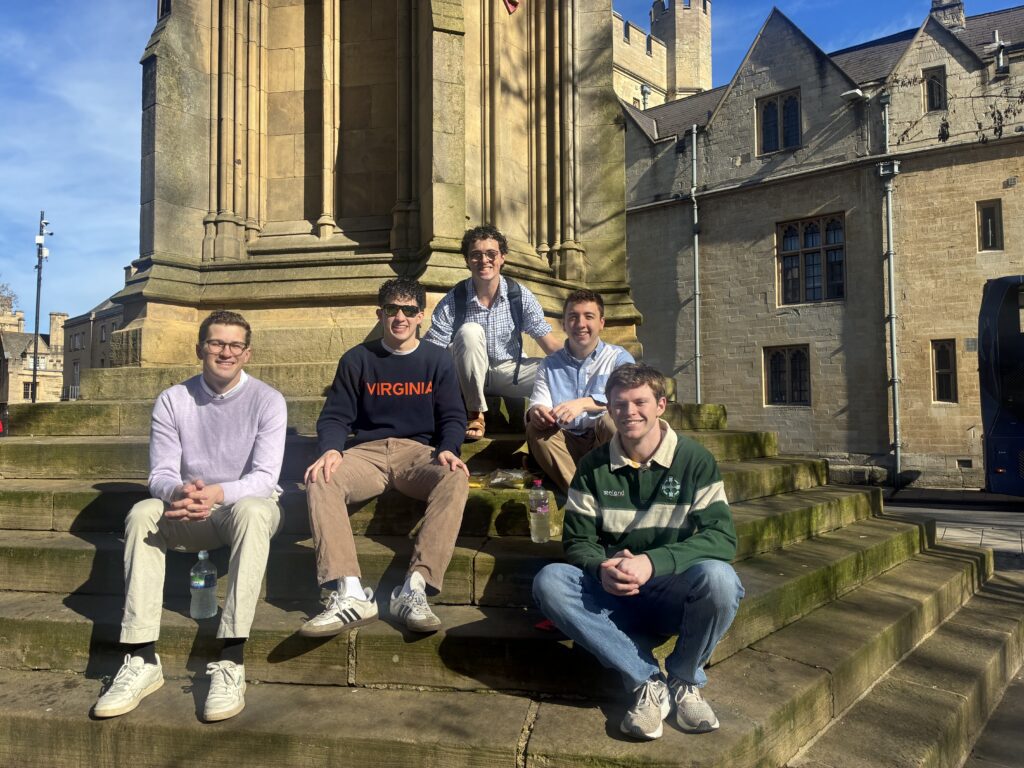
Jack, Eli, Shane, Carson and Ed. Shane (third in) is studying at Wolfson College and was showing his brothers and friends visiting from Virginia around the city. They all went to Catholic high school together.
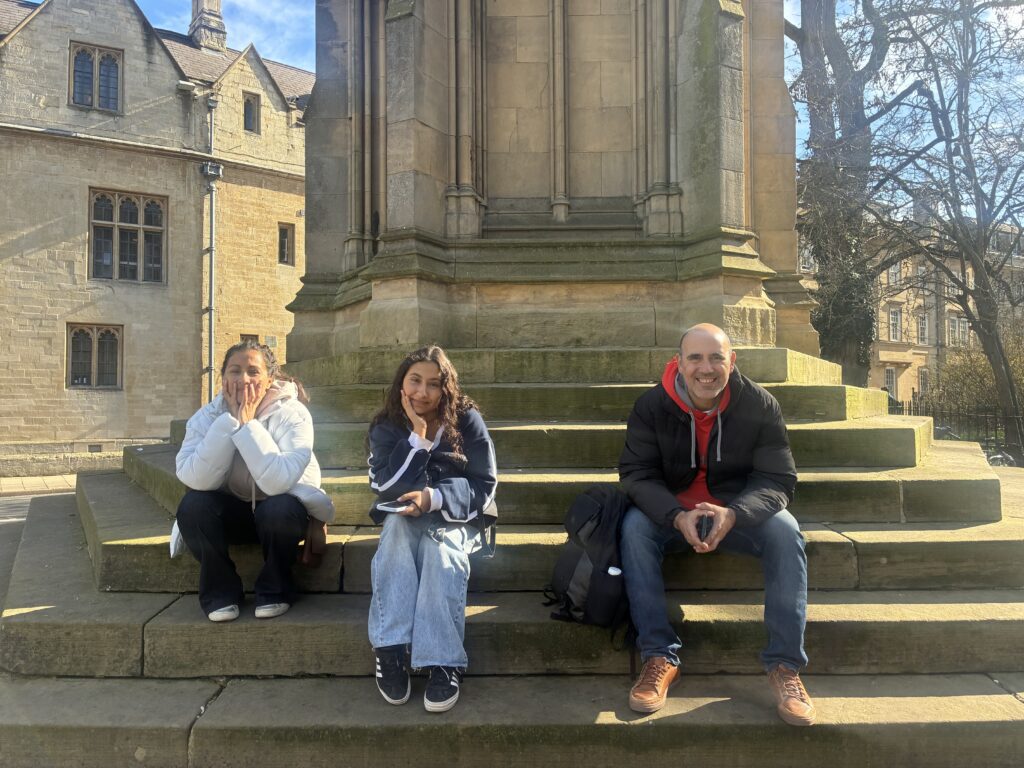
Claudia, Milagros and Ulysses on a visit to Oxford from Argentina. Next stop the Harry Potter studios.
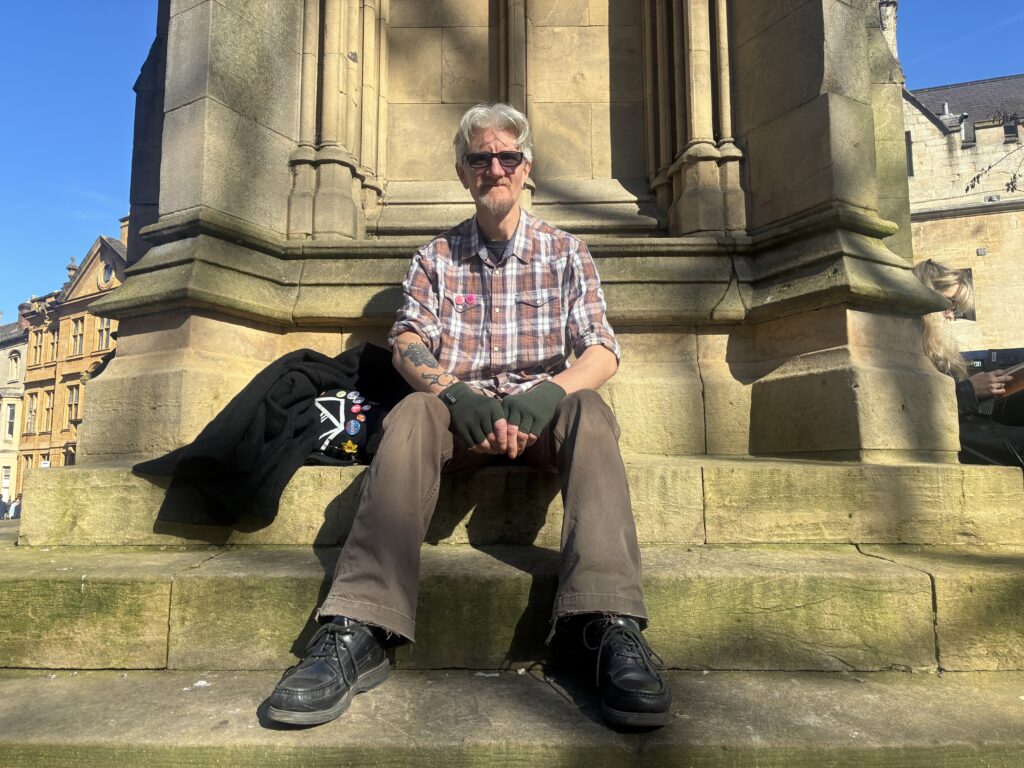
Rob from Weston the Green using the steps to wait for a bus home.
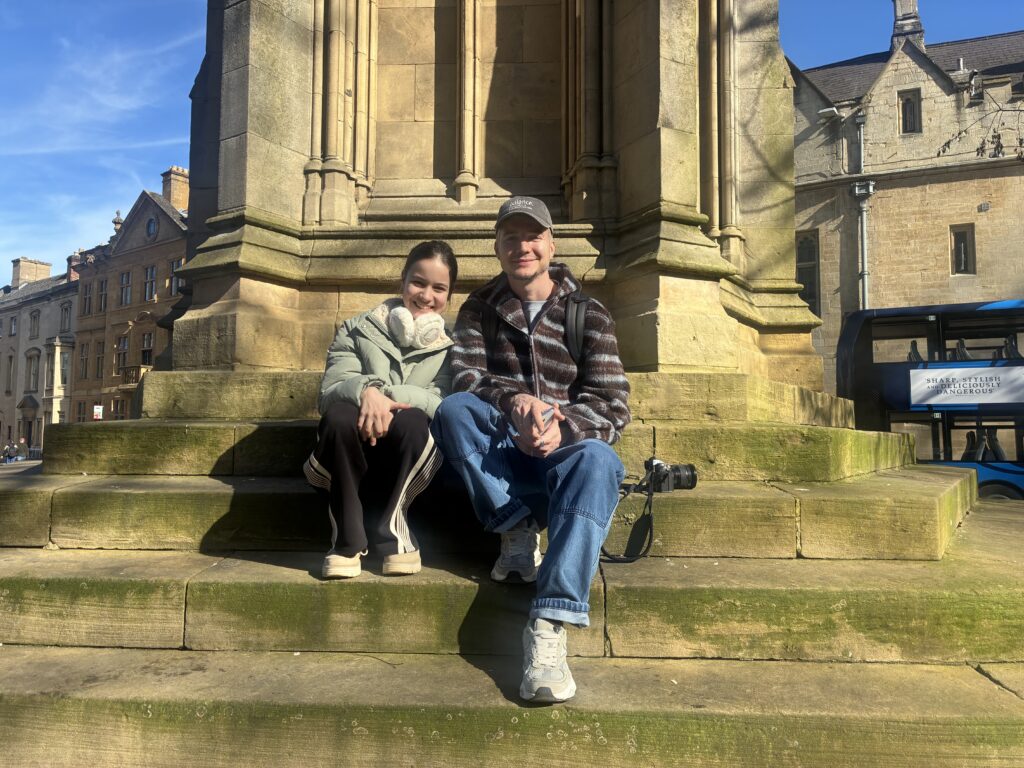
Sophie and her dad Lev from Bulgaria. Sophie aged 12, hopes she will return to study here some day.
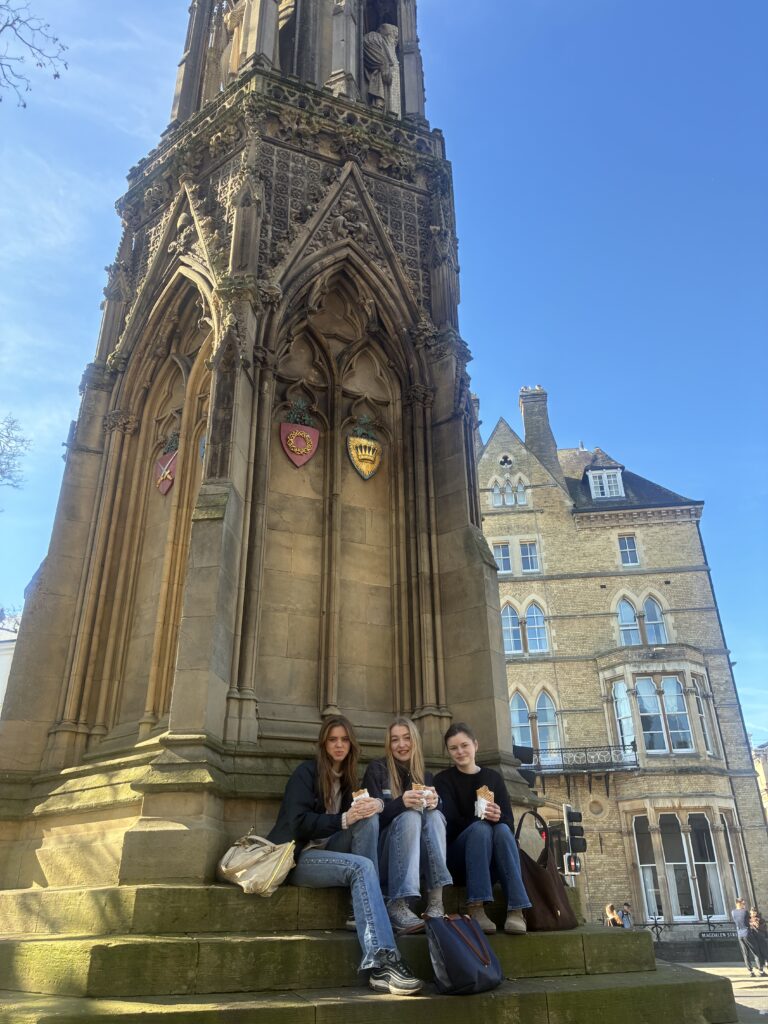
Like these students Agnes, Sylvie and Annabel, all studying History of Art. They have come here to eat their falafel wraps after lectures in the new Schwarzman Centre for the Humanities nearby.
6 Comments
Join the discussion and tell us your opinion.
A beautifully written piece which brings out the tragedies and worst human excesses behind this rather splendid Gilbert Scott monument. I tend to rush past it, more mindful of the buses, crowds and electric scooters littering the area, robbing it of its charm. This blog brings it back to life. I do particularly like your signature human touch in the photos of visitors with their names and a brief glimpse of who they are. When I was a student we used to convince hapless tourists that the Martyr’s Memorial was the last visible vestige of Oxford’s Sunken Cathedral.
It was a pleasure to participate in this blog, the women who interviewed us was wonderful and I hope to be back in Oxford as soon as I can, thank you ❤️
It was a pleasure to meet you Mili – come back soon
I really enjoyed this week’s Sausage, particularly because I went to part of Saturday’s commemoration by The Prayer Book Society of the 470th anniversary of Cranmer’s execution. They had various events in the morning but I just went to a play they did in the University Church, which was written by Anne Ridler, poet and member of the congregation, in 1956. They had carefully used the blocking of the trial. It was good, and very moving. Such a ghastly story!
Good morning. Another first class story.
Wonderful, as always. Thank you.