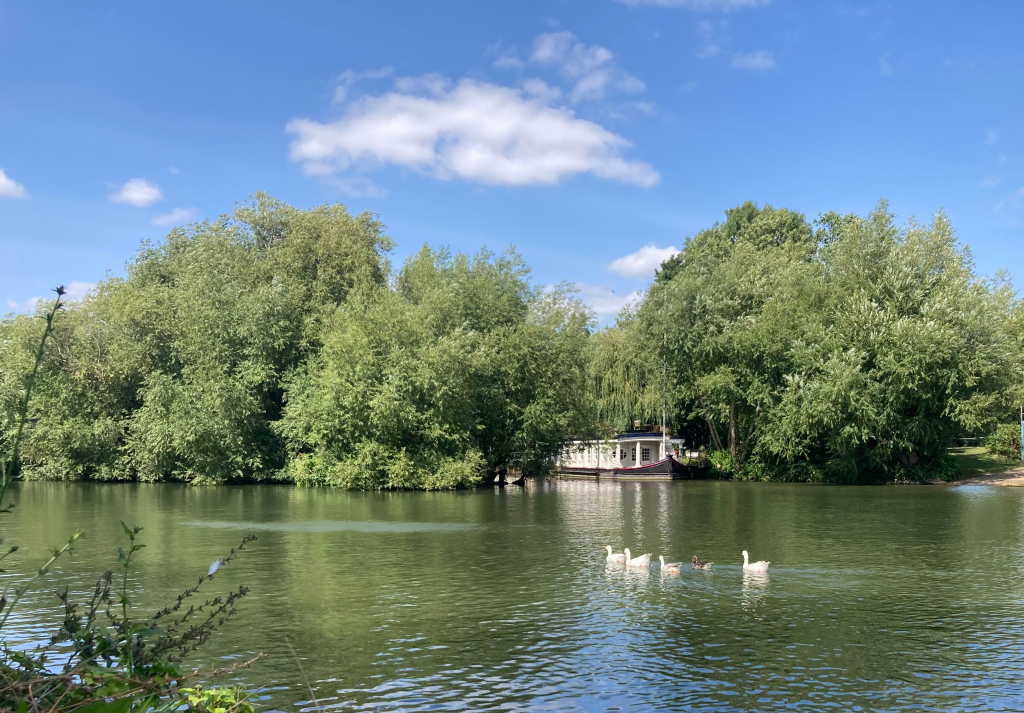
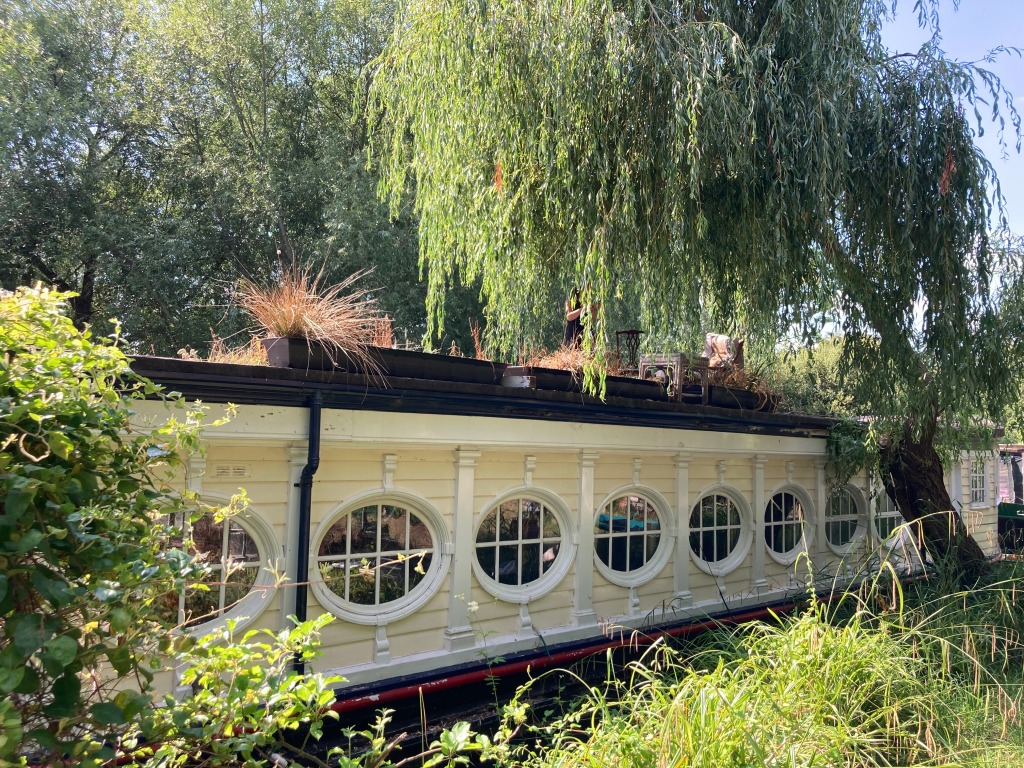
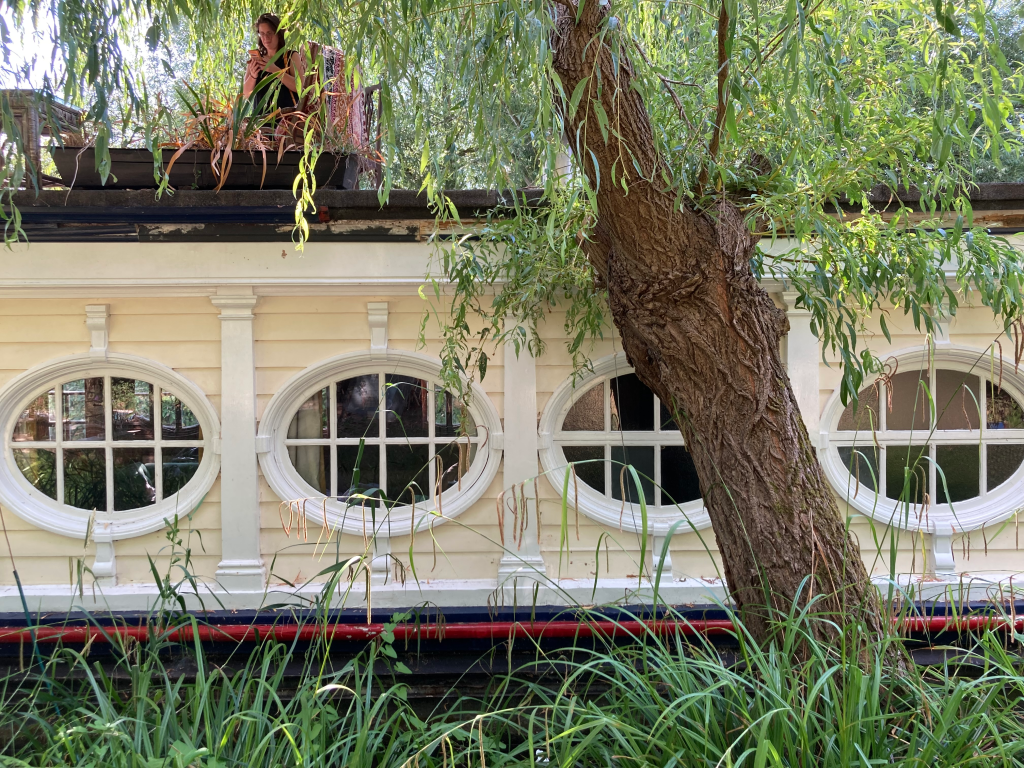
I’ve often spotted it on my walk along the towpath from Folly Bridge to Iffley. Across on the east bank of the Isis, nestled into the Kidney Stream, an old cut leading to the Cherwell from the Thames just before you reach Donnington Bridge. A fanciful floating pavilion rising from the water, its curved prow reminiscent of classical longboats, flagpole erect, pilasters framing the door to a whimsical white wooden cabin with hobbit like oval windows. There’s an external staircase leading to a raised rooftop garden overhung with willow, a tall chimney in the middle from which on colder days white plumes of smoke announce that there are occupants below. It all looks very romantic.
It turns out that this is the Corpus Christi College barge. The last of its kind to be built in 1930 as a clubhouse and changing room for the Corpus rowing team, the roof at that time enclosed by balustrades, and used as a viewing platform during the intercollegiate regattas. It must have looked quite something lined up on the bank of Christ Church Meadows alongside the 26 or so other ornately decorated college barges, rammed so full of excited spectators following their teams progress that they were wont to lurch forward dangerously.
I’d discovered this during the Summer Eights races this year, the old wooden barges replaced by a line of more practical brick boathouses, now built on dry land their roofs still serving as packed Pimm’s fuelled grandstands, but with large underbellies able to accommodate the modern racks of racing shells, rowing equipment and more hygienic sanitation their forbears couldn’t. (The crew of St Cats called themselves the Bucket and Blade Club in view of what served as lavatories in their barge as late as the 1960’s.)
It was here that a pamphlet was thrust into my hand alerting to me to an organisation called Oxford College Barges Preservation Trust. They were the custodians of this unique piece of Oxford history. And as the Corpus Christi College barge nears its 100th birthday, this group of campaigners were keen to tell the story of this remarkable piece of sporting fancy in the hopes of raising the money needed to restore it to its former glory. For this is one of the very last of its genre. Still afloat against all the odds. I thought it a tale worth the telling.
The first barges used in Oxford as floating college boathouses were bought from the London Livery Companies in the early 1800s; lavishly decorated vessels inspired by ancient naval architecture, used by the grand guilds to show off at ceremonial occasions but increasingly obsolete. Six were towed upstream to Oxford, (the six taken by sea to Cambridge all sank) their splendid theatrical exteriors lending themselves nicely to the sense of pageantry and fun so beloved of Victorian and Edwardian society and to the college sporting rivalries burgeoning in Oxford rowing at that time. As they decayed the colleges built their own barges, vying with each other to employ the most famous architects of their day to design them. They resembled each other in that all had an upper viewing platform and grand entrances leading to interiors set up to look like gentleman’s clubs. But each was unique; flamboyant edifices, some gothic, others classical, with a mix of identifying additions, ionic capitals, carved angels, garlands of fruit, colours, flags and coats of arms. Some even had figureheads. Queens (one of the other barges still extant and residing on Port Meadow) had an eagle. Our Corpus barge once had a pelican (no longer) the symbol of the college founder Bishop Richard Foxe.
That it has survived, here in the quiet of the Kidney Stream, surrounded by willows and wildlife, is something of a miracle. When so many of these barges have sunk, been broken up or destroyed by arson. It was first saved by the creation of The Oxford College Barges Trust in 1966, a group including Hugh Casson and Sir John Betjeman. They raised the money to buy it, secured a mooring for a minimal rent from the Oxford Preservation Trust, and popped lodgers in it to help with its maintenance and to keep an eye on the place. It was also lucky enough to have its rotten wooden hull fitted with a steel shoe by a remarkable American ship building engineer called Robert Maccoun, who had arrived in Oxford in search of a steam boiler, fallen in love with the barges and spent the rest of his life trying to save them.
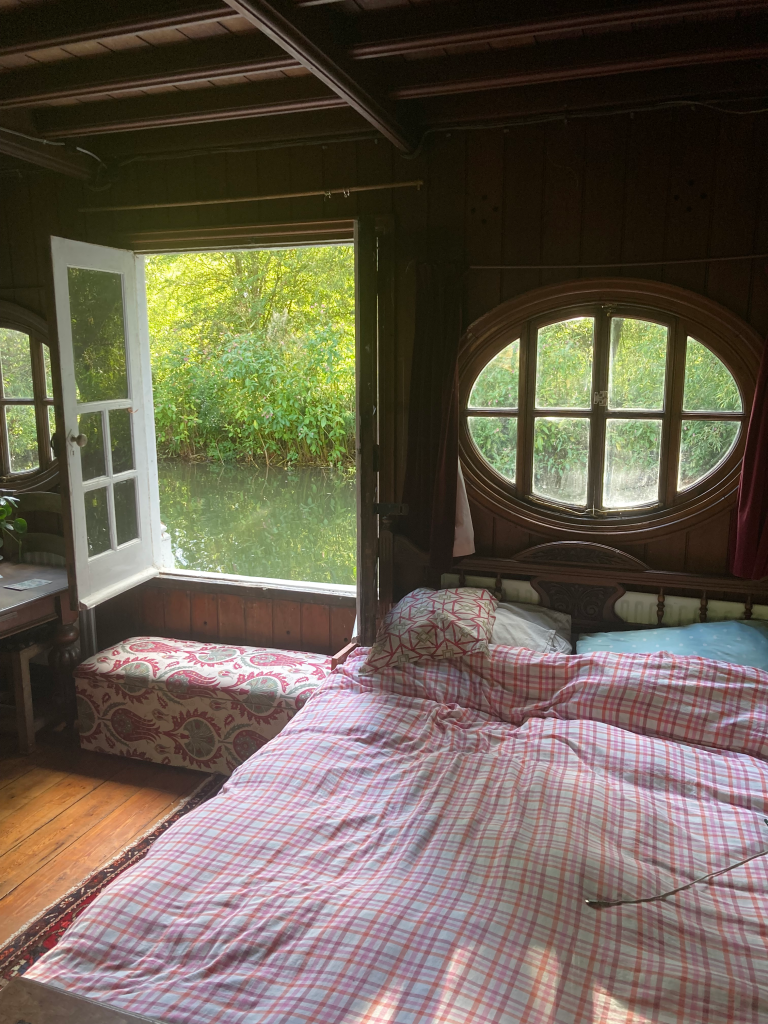
Today I’ve come to meet a few of its most recent champions, Zanna and Jonny Hoskins and Peter Austin. Peter and Zanna were friends when they first rented the place back in 1992. Despite the dodgy wiring, and a colony of mink that greeted them, they also fell for the place. I can see why. The way the light from the water dances on the ceiling of the inside wooden panelling. The views of geese landing on the river through the open oval windows. And apparently there’s a resident kingfisher. There is good fishing around here. I’d love to see that.
They also have history.
“We had some brilliant parties,” smiles Zanna. Not she hastens to add the infamous ‘wear nothing but a hat party’ attended by some who later became high court judges. “That was before our time.”
But this is where she married Jonny arriving to celebrate on a flotilla of boats. And now, only a week ago, after a while living away, they have moved back in with their teenage children. And Zanna is falling in love with it all over again. “The view is astonishing, the mist on the river, it feels like coming home.”
Peter was a tenant for a while longer. In the early 2000’s. His eldest son Herbie was born at home on the barge. I meet him briefly. He is just off to take up a rowing scholarship at Harvard. So living by the water must have rubbed off a little. And today Peter lives in his own houseboat, one he built himself, moored just behind. So he hasn’t gone far. It must feel like old times.
And it is Zanna and Peter who now help to run the Trust, with a group of other boat dwellers and like-minded conservationists. They make for worthy successors. Knowledgeable, practical and passionate in all the right ways. They have set up a website and a fundraising target. “The rent covers the basics but not the structural stuff,” says Zanna. “It really needs a complete overhaul. And for that we will need to get it out of the water. The aim is to restore it to how it once was, with the balustrades and the pelican at the front.”
“We’d like to get it back to being a place where you can watch the rowing from,” adds Peter. “All the action happens right here – this is the spot where the boats either get bumped or they row over during Eights Week. That’s why it was built and that’s what it was used for.”
Now wouldn’t that be wonderful.
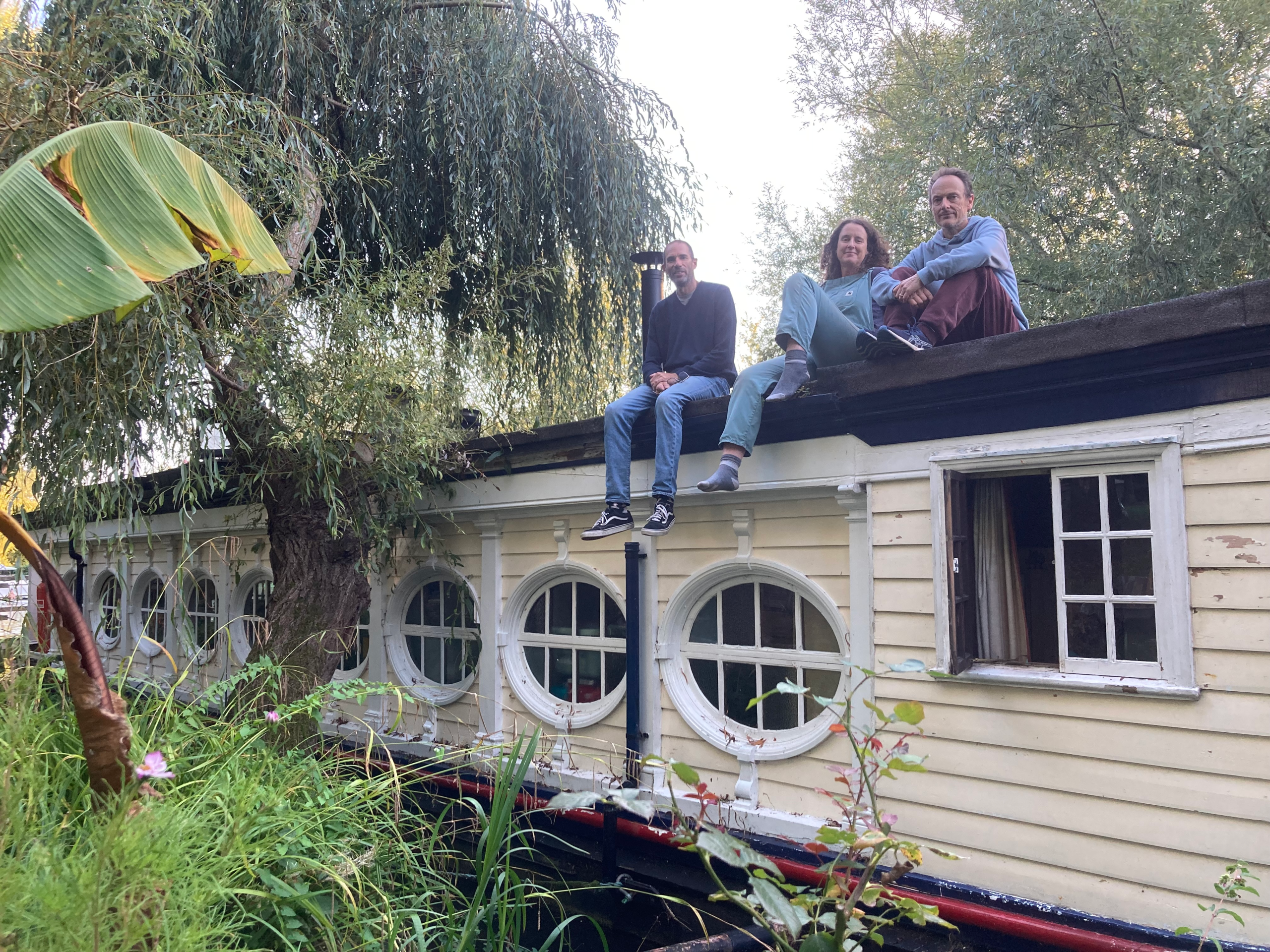
Main image: Peter Austin, Zanna and Jonny Hoskins on the roof of the Corpus Christi College barge.
The Corpus Christi College Barge can be visited this weekend as part of The Oxford Preservation Trust’s Open Doors – 13th and 14th September. Details of its location and opening times can be found here.
For more history and lots of old photographs of Oxford’s college barges, as well as a link to their fundraising campaign you can visit Oxford College Barges Trust website here.
All black and white images courtesy of Oxford College Barges Preservation Trust
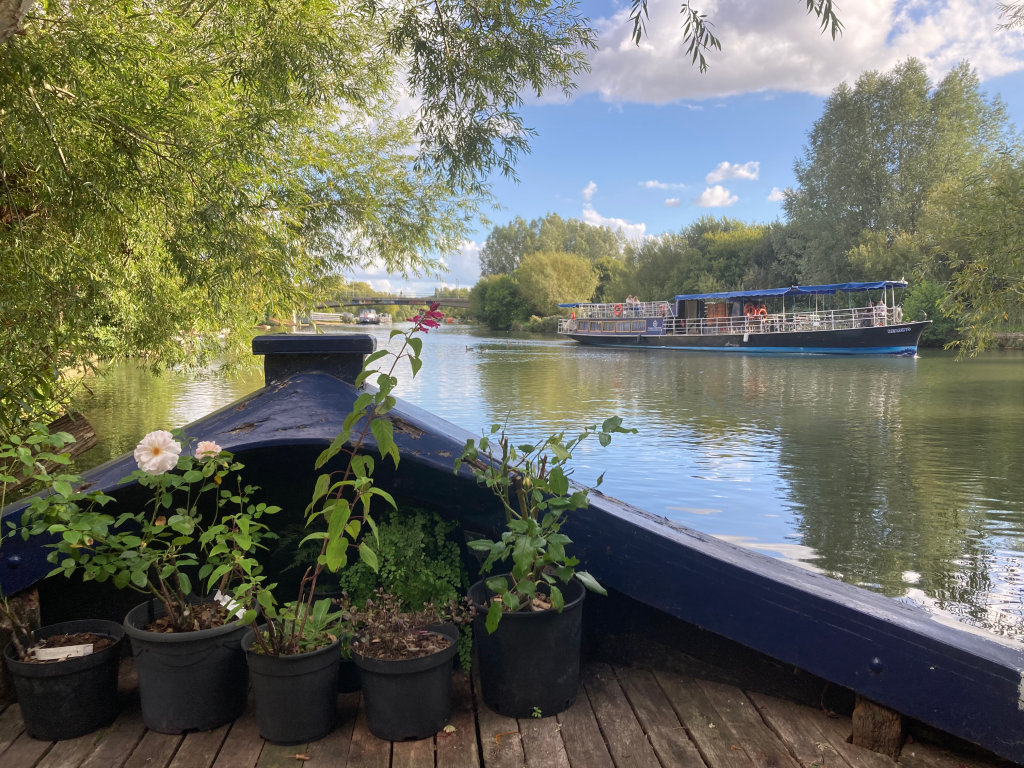
Looking out from the prow at the passing Salter’s Steamer passenger boat. Salters built the barge in 1930.
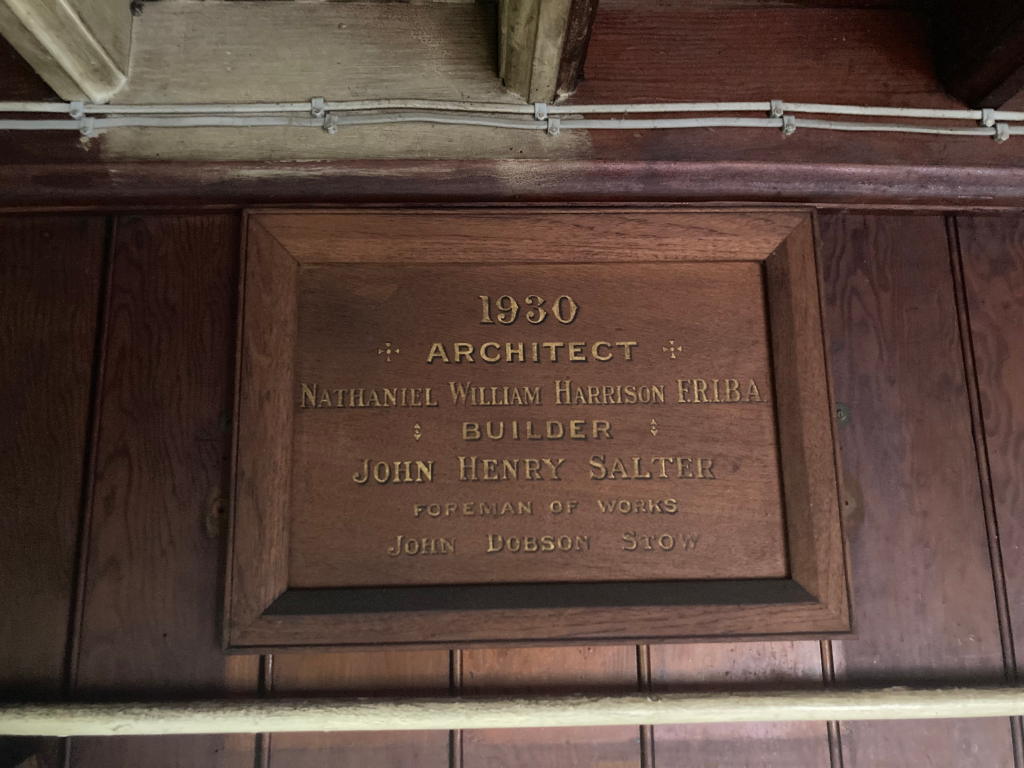
The plaque inside – Nathaniel Harrison was a celebrated architect in his day.
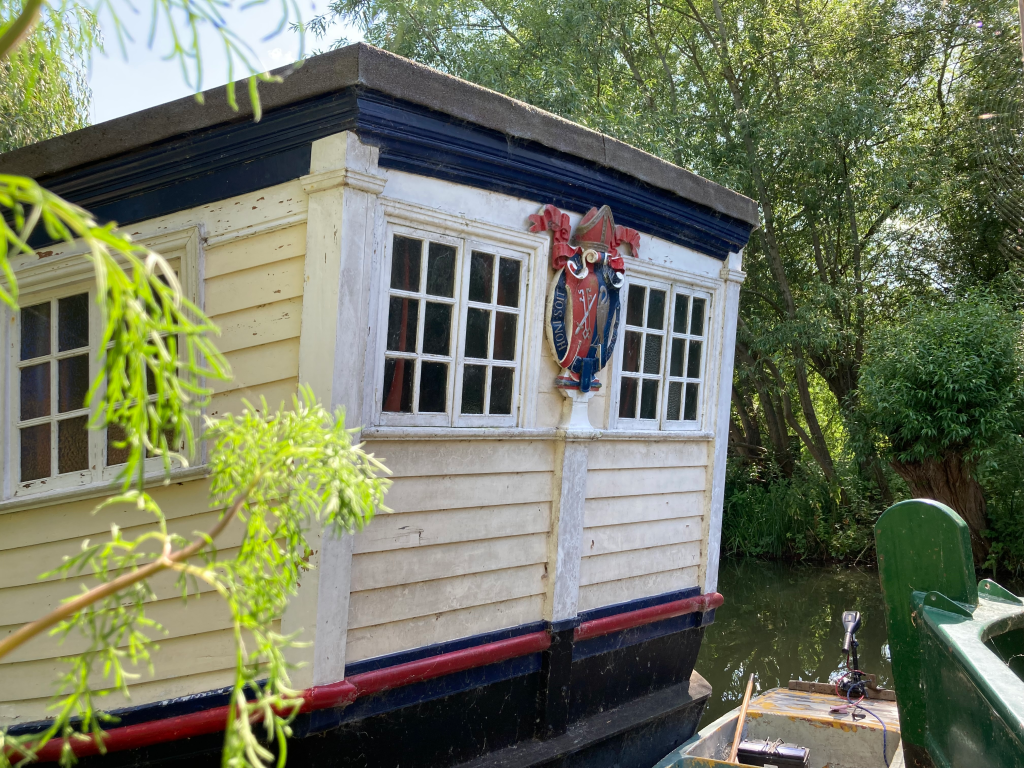
The stern of the boat with the Corpus Christi College Arms alongside those from the Maude family. The construction of the barge was paid for by the family as a memorial to Reverend Joseph Maude and his only son Louis, both Corpus alumni, and both killed at the Battle of the Somme in 1916.
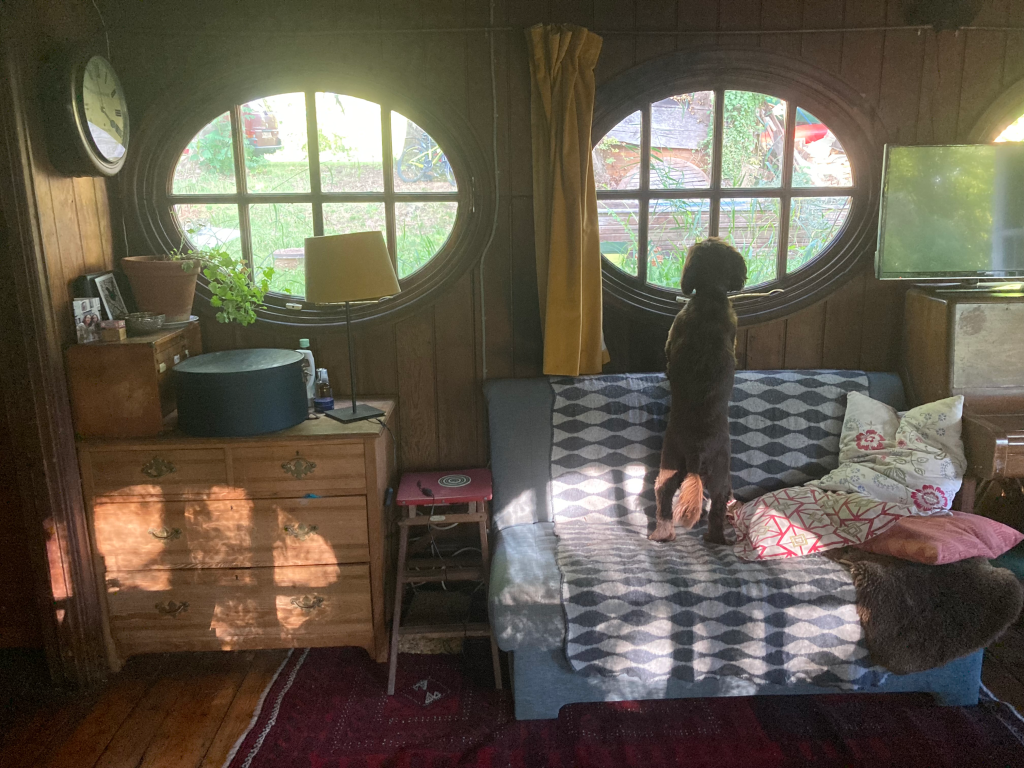
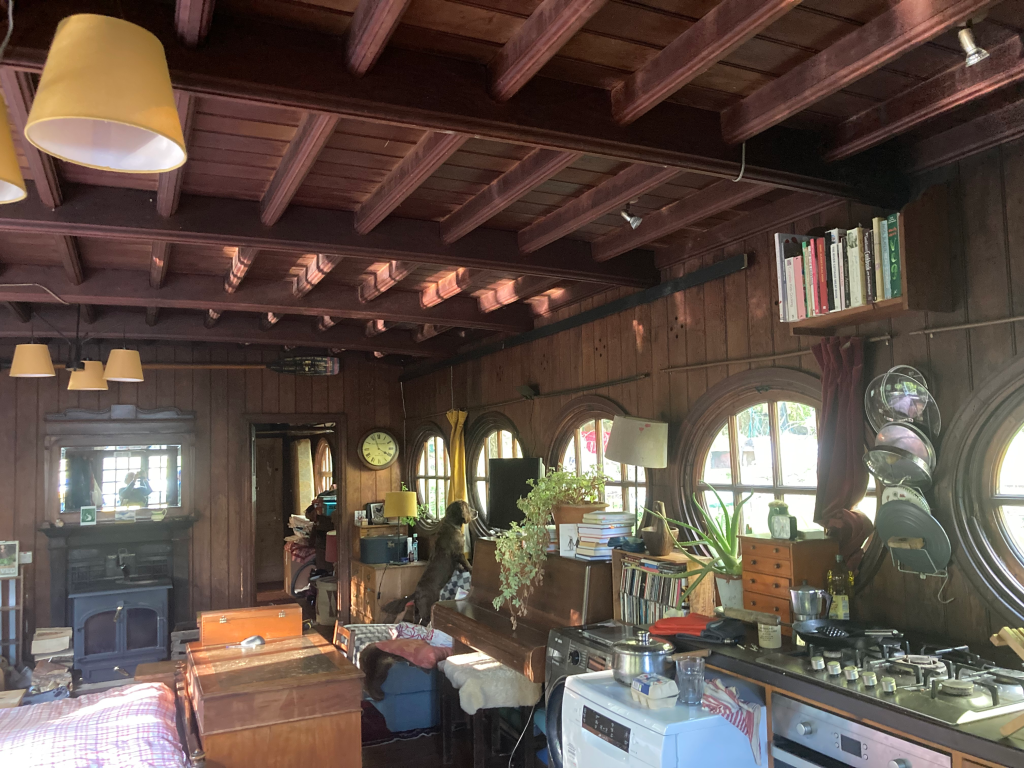
Zanna and Jonny’s dog Olive looking for squirrels.
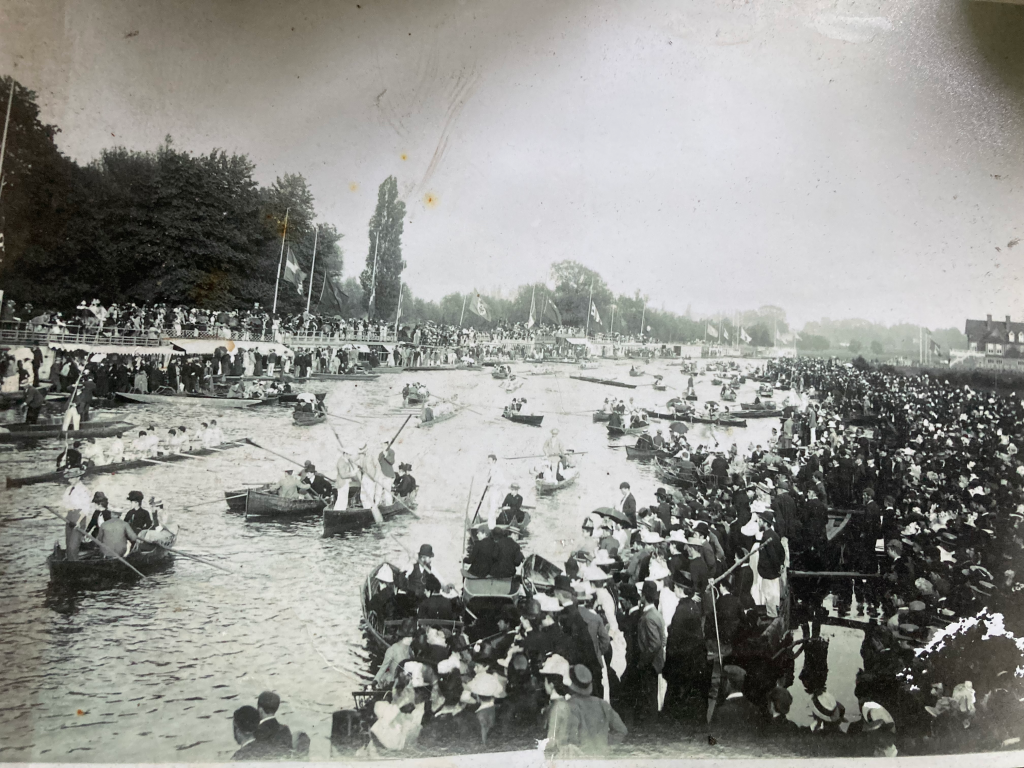
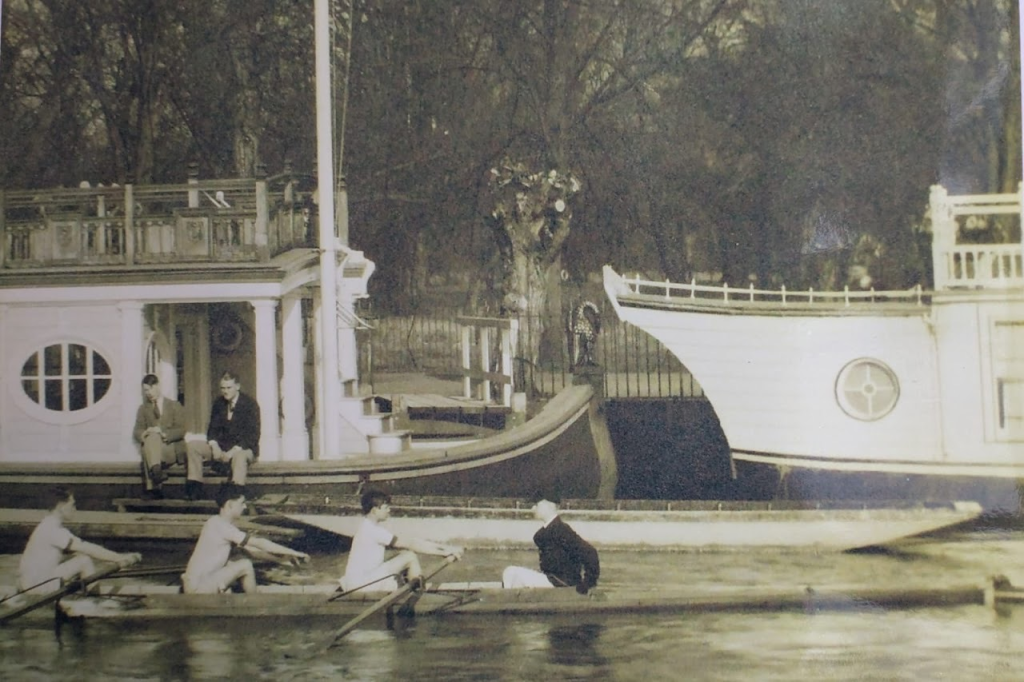
Back in the days when the college barges lined Christ Church Meadows.

The pelican figurehead that once graced the bow of the boat.
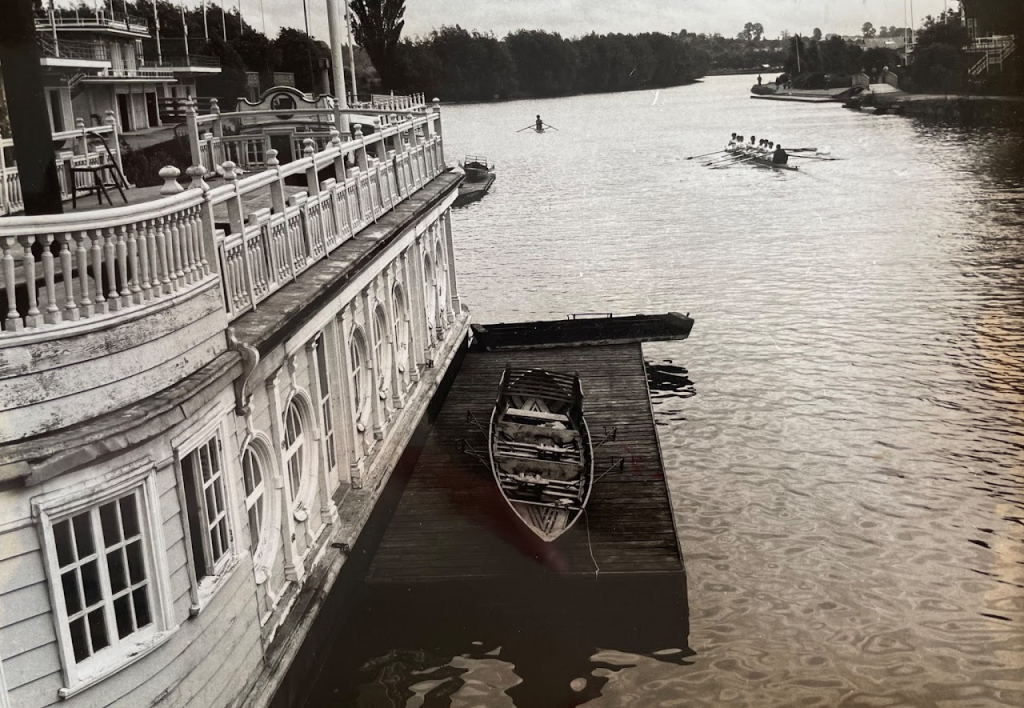
The barges couldn’t accommodate the rowing boats so each had a raft so they could tie up alongside.
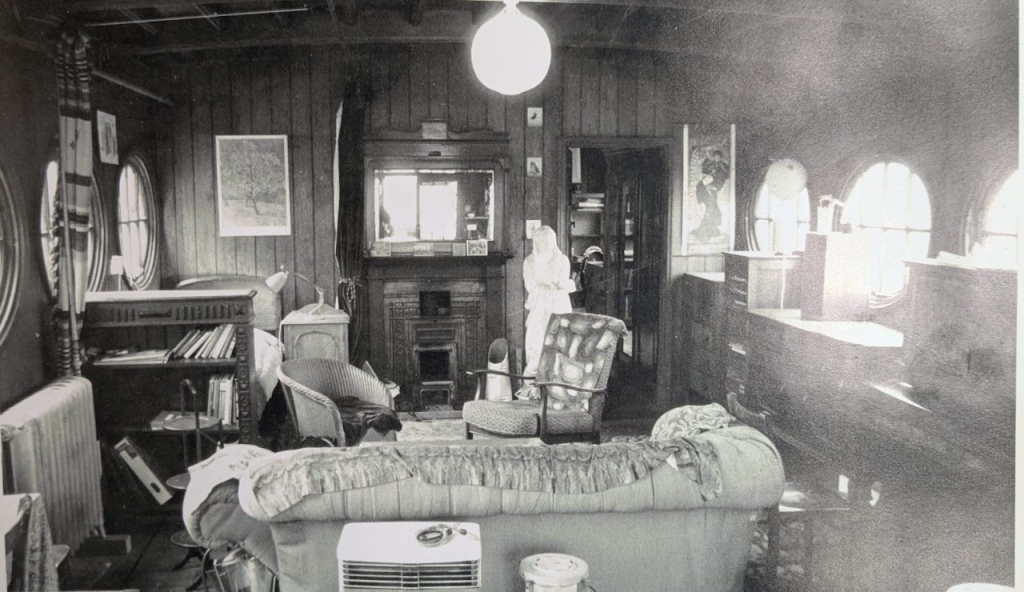
The interior when lived in by students in the 1980’s.
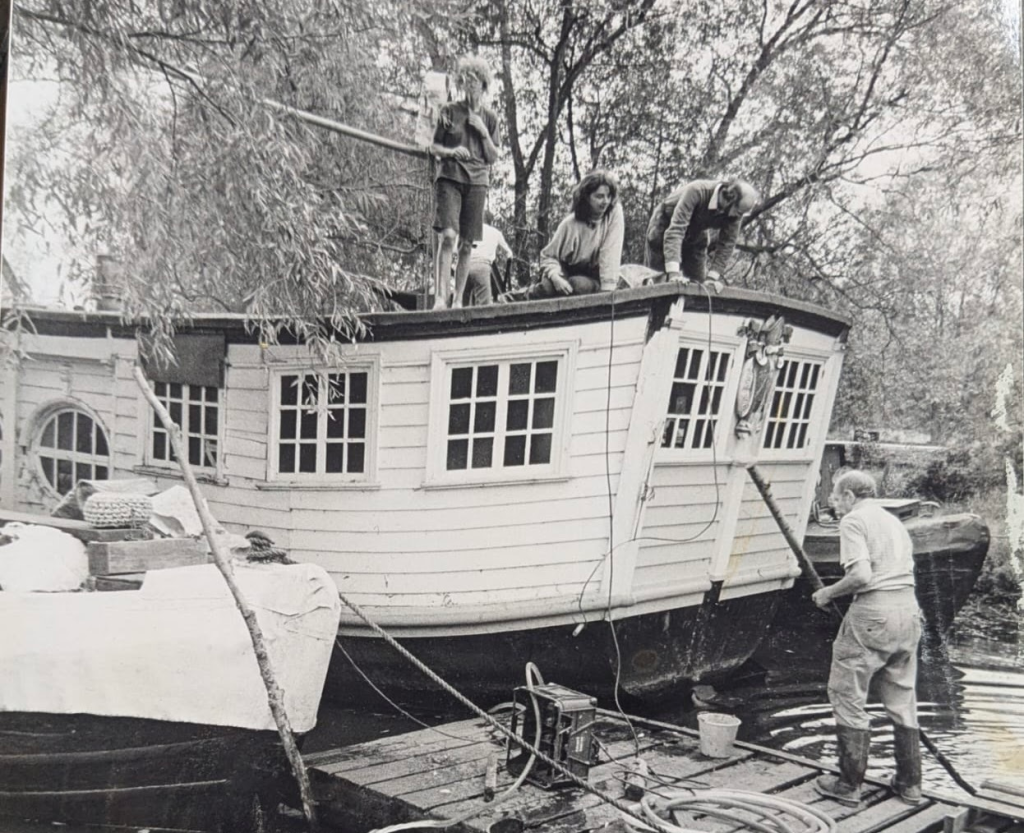
Here are some of them with Robert Maccoun. He hoped to set up a rowing museum in the Jesus College barge which he had helped to beautifully restore. But it was set alight and burned by vandals.
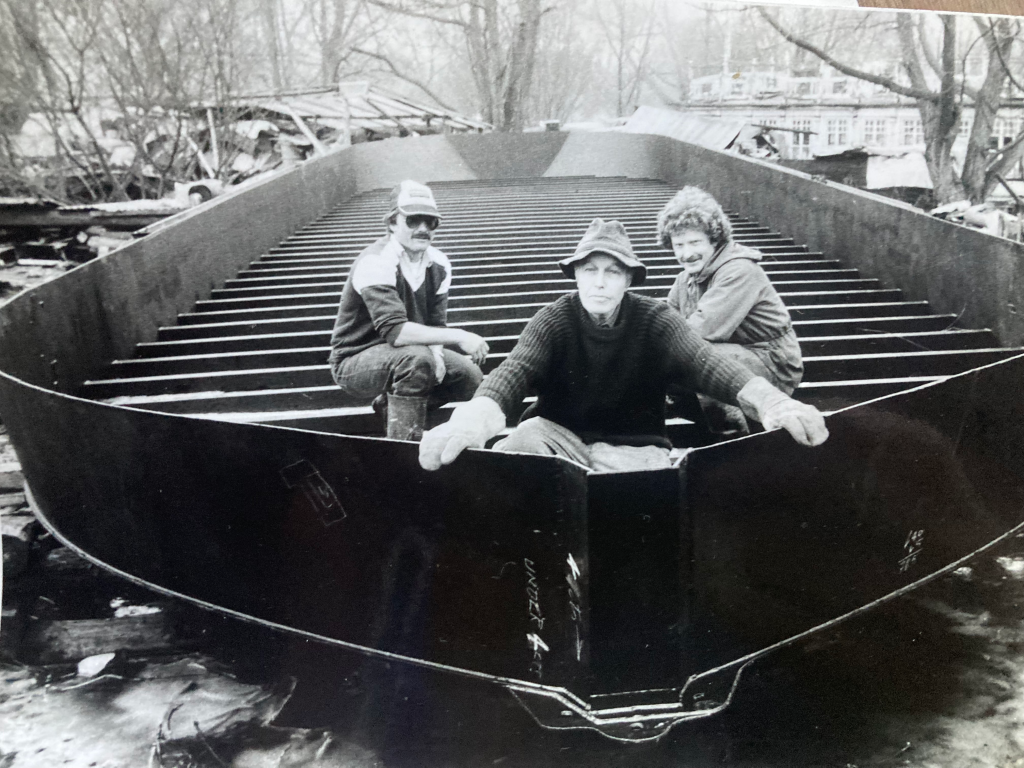
Robert Maccoun (in hat) showing off one of the steel shoes that were fitted under some of the college barges including Corpus. Instrumental in keeping them watertight.
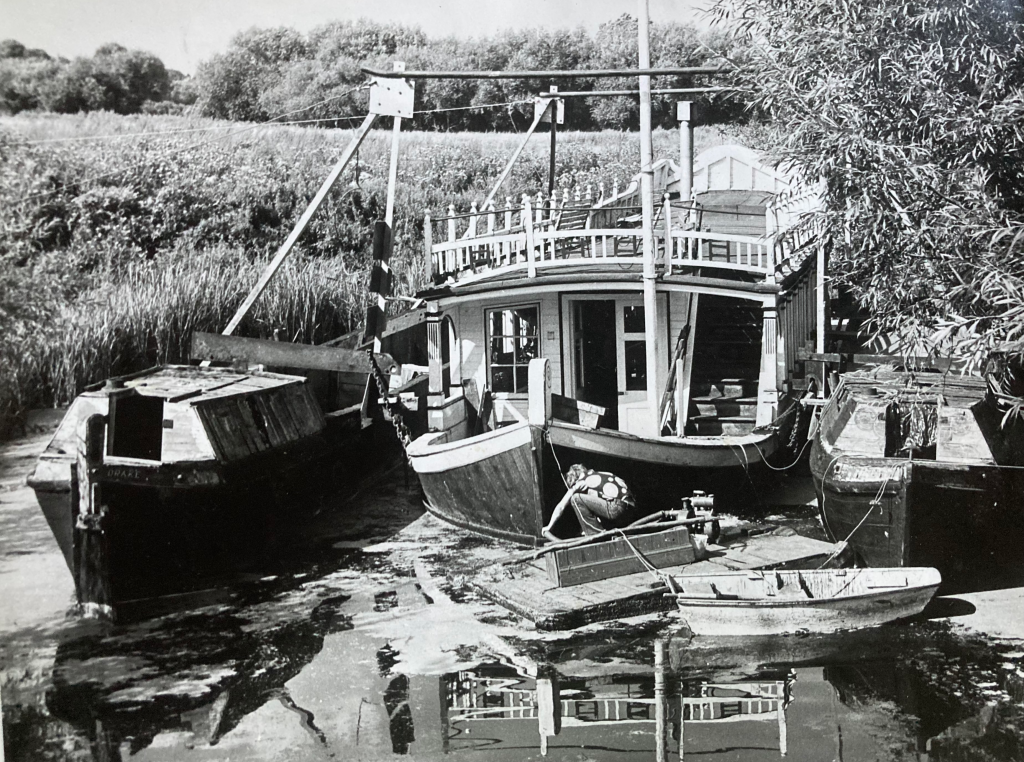
He did this by docking two narrowboats one on on either side of the barge, and then filling them with water. Wooden beams were then secured through the windows of the barge. When they pumped the narrowboats out, and they surfaced the beams lifted the barge out of the water, allowing Maccoun to fit his steel hull. Ingenious.
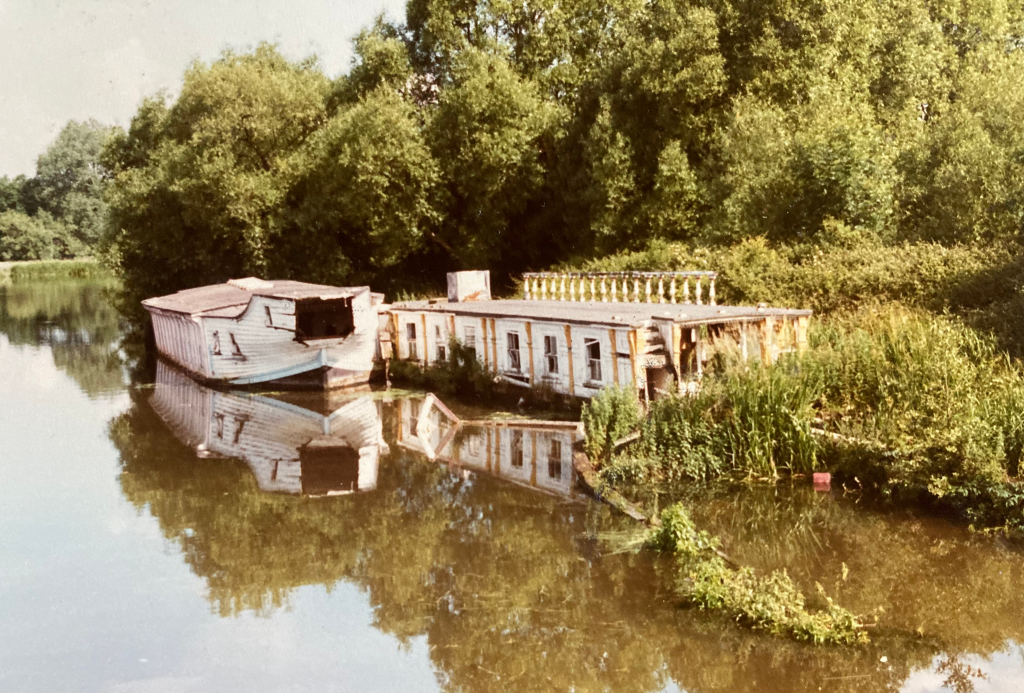
A sad picture of one that didn’t make it..
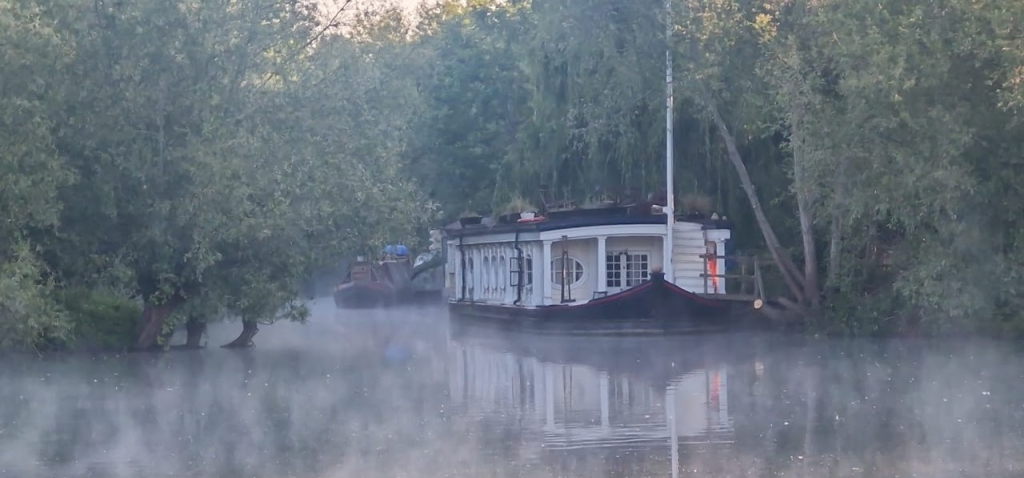
Image courtesy of Oxford College Barges Preservation Trust
You may like to read A Night Walk in Old Oxford which also mentions the remarkable Robert Maccoun.
5 Comments
Join the discussion and tell us your opinion.
I have fond memories of the Corpus barge, since my father was a Corpuscle and he used to take my siblings and I for picnics on it when I was a schoolboy. I myself was a freshman at Corpus in the acamedic year 1962/3. Although I had not rowed at school I was press ganged into the second eight. The college boats were kept in the old Oxford University Boat Club building on the other side of the river, but the barge was still used as a glorious grandstand at Eights Week. The replacement boat house was completed after I was promoted to the first and then schools eight (making 4 bumps and gaining an inscribed blade). The boathouse has provided luxurious facilities for boat club members and spectators alike eversince, but as your article shows it has never been able to compete with the barge for character.
I never even knew of its existence, until my second year at CCC!
I love boats, so this article caught my eye and as usual Arabella you’ve painted a perfect picture of delight, charm and Oxford eccentricity. Thank you!
[…] Aboard the Corpus Christi Barge September 12, 2025 […]
In September 1966 I bought St. Edmund Hall barge (previously called ‘Wanderlust’, named ‘Ataraxia’ by me, and subsequently ‘Tedders’ more recently), in 1966 from Arthur Salter. I then lived on it for 6 years, first in Littlemore (where I met my late wife, who was living next-door on Brasenose barge), then at Hart’s Boatyard in Surbiton. My wife and I kept up our interest in the College Barges and the Thames – particularly its 200+ islands – for nearly 60 years, and have kept in touch with all the owners of ‘Ataraxia’ since we sold it in 1972. In fact the man we sold it to, who lived on it for several years, is coming to lunch next week! We were lucky enough to have known Robert Maccoun, Clare Sherriff, and a number of others with close connections with the barges and the River. Well done to you all for keeping the interest alight! (I’d be happy to be contacted by email if any of my (many!) recollections would be of interest).