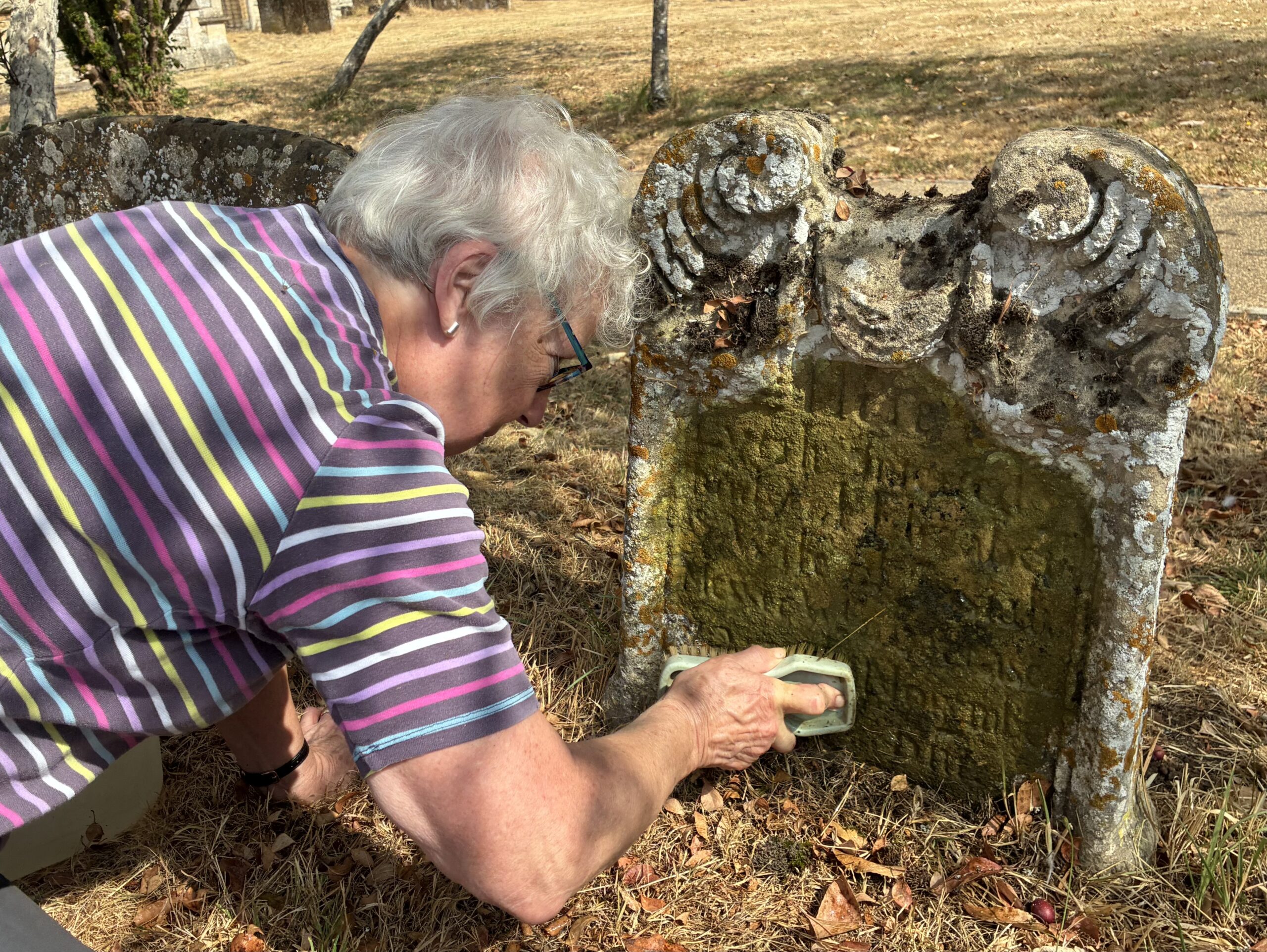
Mary Whitehead is kneeling in front of a part buried gravestone thick with yellow lichen when she calls me over to take a look. We are in the churchyard of the 12th century St Michael and All Angels Church in Fringford, just north of Bicester, and the decorative carving on the stone’s crown as well as its positioning on the main pathway tells her that this might be one of the oldest here. Carefully she takes her trowel and pulls back the inch or so of turf that has grown up around it. Then using a brush, she gently starts to scrub, splashing on a little water to help, exposing bit by bit the first unreadable inscription. Like those painting books we had as children in which, as if by magic, a wet brush swept across the paper suddenly reveals a hidden picture beneath. ‘Here lyeth interred ye body of Elizabeth, wife of …” Mary pauses as the writing becomes too weathered to read. “Possibly Isiah, something ..siah and then there’s an Me…maybe Messer.” The last two lines are easier, “who deceased 25 November, An Dom 1694.” The year in which the Bank of England was founded. William and Mary had not long taken the throne. This is the grave of woman who lived and died over 300 years ago. It is all rather thrilling.
Mary and the other volunteers here today – Peter, Lynn and Chris – are all members of the Monumental Inscriptions team, a group that operates under the umbrella of the Oxfordshire Family History Society. They celebrate their 50th anniversary this year. Armed with secateurs and shears, brushes and water bottles, notebooks and pencils, depending on the weather they are out once a week, from April to October. Working their way through our county’s churches, exposing, photographing, mapping and transcribing the inscriptions on not just the gravestones but also windows, benches, plaques, anything that commemorates a person. So the information survives for those that come later. All those who are here today have come to it by means of researching their own family histories. And become hooked.
“I love it when you pull up at a church for the first time, and you wonder what you are going to find,” says Chris.
Imagine, for instance, coming across this delightful rhyme from an early feminist with a sense of humour. Recorded from the gravestone of Charlotte Benfield, who died aged 20 in 1855 and is buried in the Church of St Michaels in Leafield.
‘Stand on your guard you females all
Prepare for the time that God do call
It was a sudden call of mine
And the new one of them may be thine.’
Or this heartwarming one from the headstone of John Adams discovered in the churchyard in Stoke Lyne, one of the sites our group has just recently completed.
“A farmer who spent his entire life in the village and enjoyed every moment.”
Such contentment.
Marble and slate are the most long-lasting memorial materials apparently; local stone crumbles too easily making the words impossible to decipher. Inscriptions before the 19th century tend to be carved in fine, curly script, and at less depth than those that came later meaning they fade quicker. 3’s 5’s and 8’s can be difficult to distinguish.
Lynn says she is most touched by the memorials to the children who died young. I know what she means. There’s one near me in Oxford on the wall inside the Church of St Cross in Holywell. A brass plaque to Elizabeth Franklin, wife to the landlord of the King’s Arms, who died in 1622 giving birth to her fourth child, who lies beside her. The brass shows a picture of her sitting up in bed, her hands folded in prayer, the bodies of her three other children wrapped in swaddling clothes, before her on the bed. Every one of them died in infancy. I shall never forget it.
At the end of each session Mary types up their findings and adds any relevant information that she can find from the parish burial records. An occupation like shoemaker helps build a character. Sometimes the cause of death will be included. Dropsy (heart failure) is a common one or small pox. Half a page of deaths registered around from the same date usually means that an epidemic of measles or something similar had swept through the village. It all adds to the history. Occasionally the records reveal a death that has never made it to the grave yard. Like the young man who shot himself not far from here and is buried alongside the road to Bicester. Before 1823 suicides were not allowed to be interred in hallowed ground.
The church at Fringford is one of ten from the Sheswell group of parishes in the North Eastern corner of Oxfordshire that are on the current list our team are hoping to complete. This is Flora Thompson country, the author of Lark Rise to Candleford, the semi-autobiographical trilogy about late 19th century rural life. Flora was born near here in Juniper Hill, (Lark Rise,) went to school in Cottisford, (Fordlow,) before moving to Fringford, (Candleford Green,) to work for Kezia Whitton the village postmistress. Kezia’s husband John was one of the resident blacksmiths, his forge was next door to the post office. Both are buried here along with their children. Another couple whose offspring all died in infancy.
I learned a lot during the morning I spent with the Monumental Inscription team. Headstones, like buildings, can I am told be listed, though there are none today. Five dots or circles on a grave or monument represent the wounds of Christ’s crucifixion and often appear with no name. They signify the burial of a Catholic in the age after the Reformation when their religion had been outlawed and they feared desecration of the grave and persecution for the remaining household (there were lots of Catholic families who lived around here). And one has to remember that those who have headstones, are are the ones who left money behind to pay for them. Most, generations of bodies, lie under our feet, once marked with a wooden cross, long since consumed into the earth. It is all rather humbling.
Later that evening I receive an email from Mary informing me that she has found reference to the Elizabeth whose inscription she had uncovered earlier in the Parish Burial Records. Her name was in fact Mercer not Messer, and her husband was Josiah not Isaiah, baptised at Fringford on 5 May 1661. The place where their five children, Stephen, Elizabeth, Phillis, Thomas and Samuel were also christened. The older Elizabeth, however, is the only member of her family to be buried here.
I wonder why? Did they move away only to predecease her, leaving the widow to return to where they had first made their marital home? Or did she die first, her husband so grief stricken he moved away to make a living elsewhere?
These are never ending questions, says Mary. And though it doesn’t stop her imagining the lives of the individuals she comes across, this in not in her remit. For in the 50 years that the inscriptions team have been going, only just over half of Oxfordshire’s parishes have been recorded.
“It won’t be completed in our lifetime,” says Mary.
What a sobering thought.
The Monumental Inscriptions team are always looking for new volunteers. If you are interested please email Oxfordshire Family History Society at help@ofhs.uk
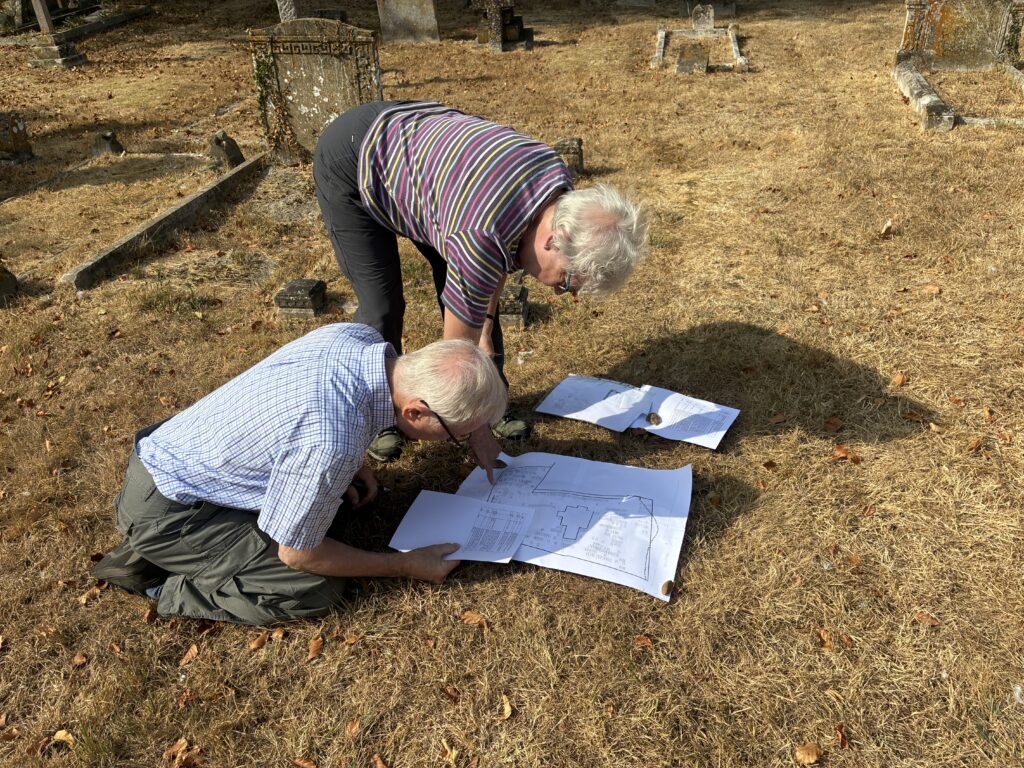
A map of the churchyard is made first. Each stone or monument is given its own number.
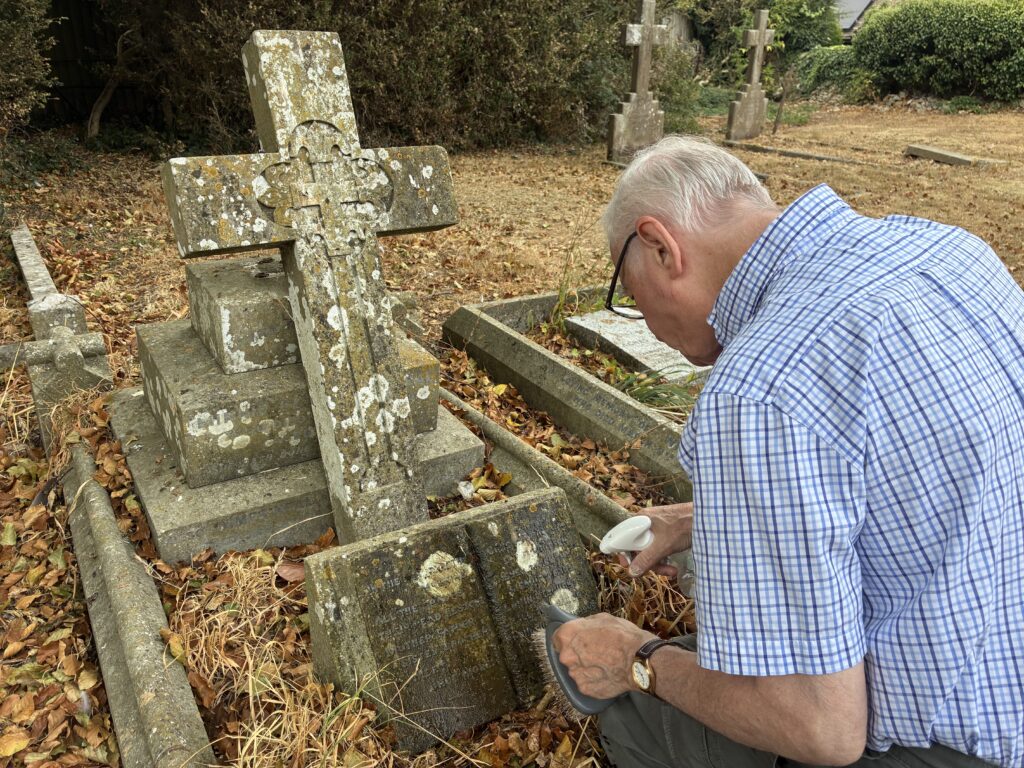
Peter was interested in finding his own family history before joining the team. He is a retired Classics teacher, which comes in handy when they need translations for the inscriptions written in Latin.
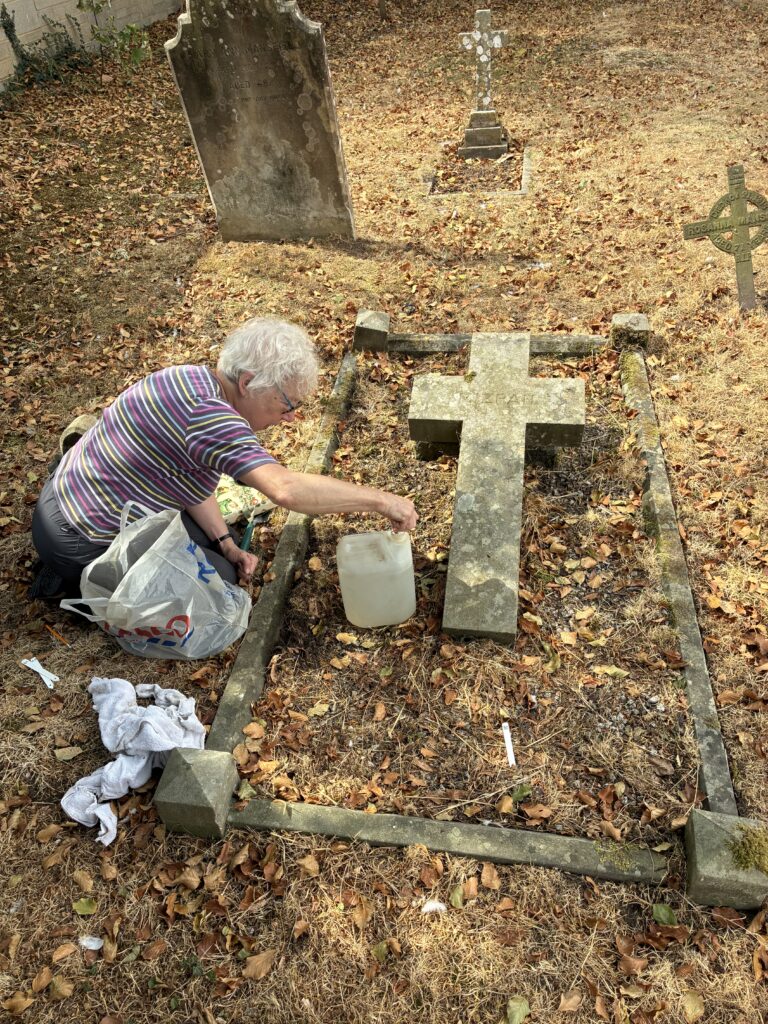
A white numbered marker is set in each grave. These are turned around when the inscriptions have been transcribed, and checked over for mistakes the following week. Mary has found the inscription on this grave buried on the inside of the surround, so digging and cleaning is required. Once everything has been checked Mary types everything up at home to be entered on to a central database.
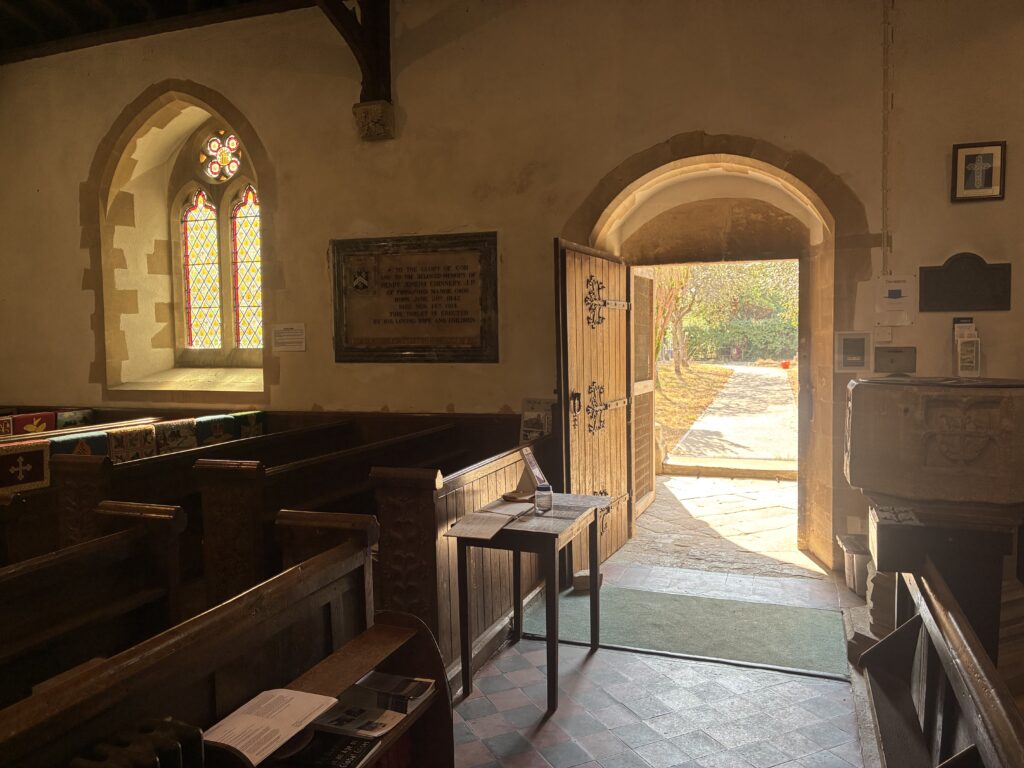
There are lots of monumental inscriptions inside the church too.
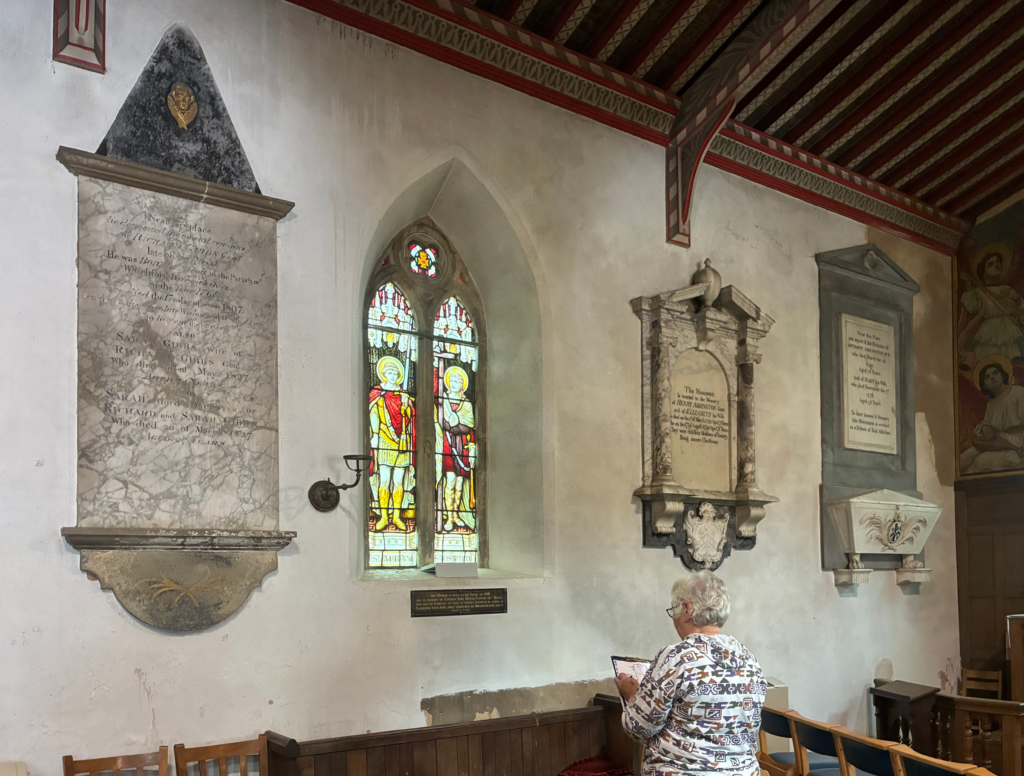
Chris is checking the dedication at the base of this stained glass window.
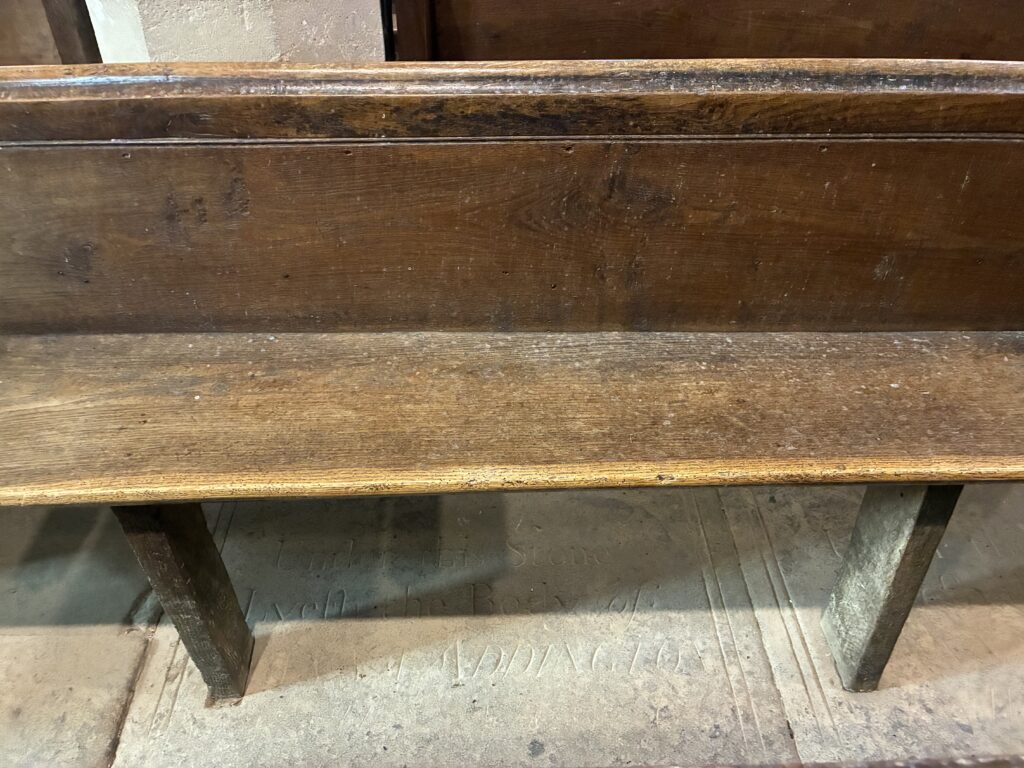
The body of physician to King George III, Anthony Addington (1730 – 1790) is interred in the main church under the pews. He is credited with helping the monarch through his years of madness.
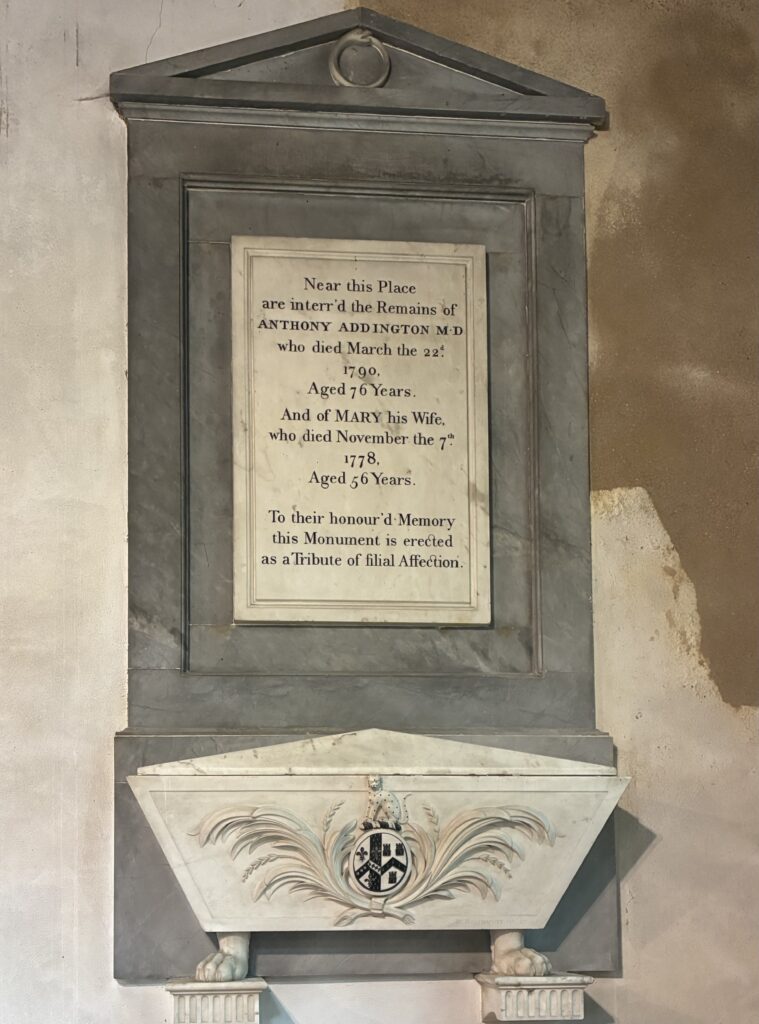
He also has a memorial. Anthony Addington’s son, Henry, served as Prime Minister 1801-1804.
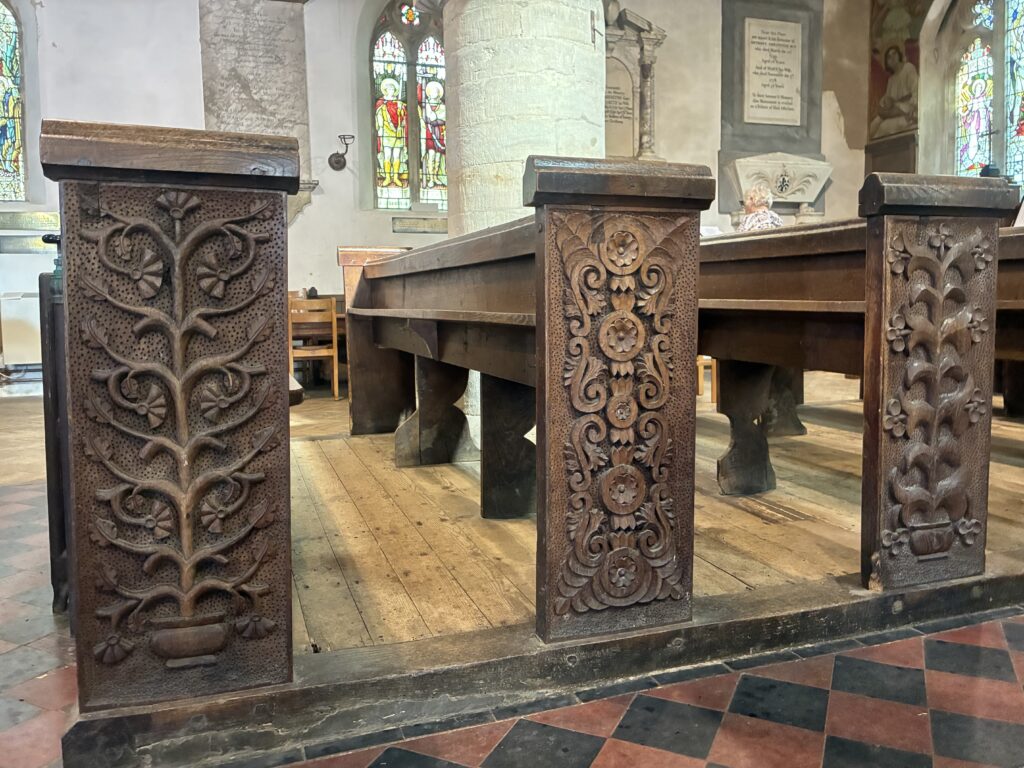
The decorative carvings around the church were made by Charles Freeman who was born and died in the village. Losing the use of his legs after suffering from frostbite while working in Canada, he would haul himself here on crutches. The pew ends, the front of the altar table and the wooden screen enclosing the vestry were all worked on by him from a lying position.
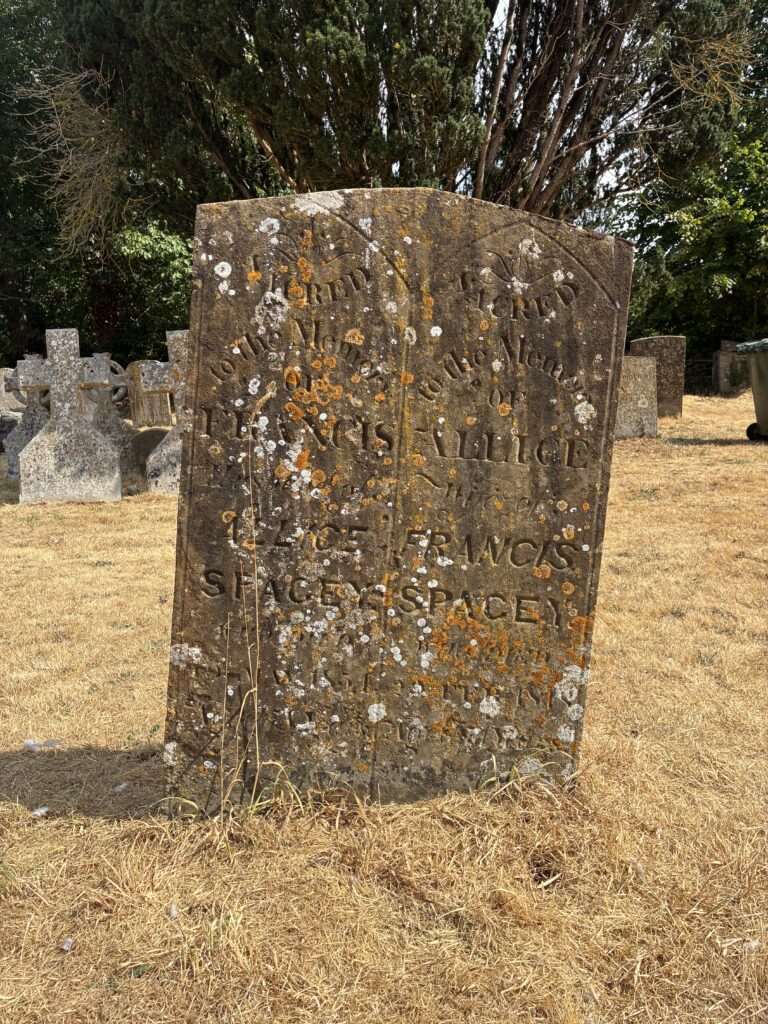
An unusual inscription in that the details of the husband and wife are written next to each other, rather that directly underneath each other.
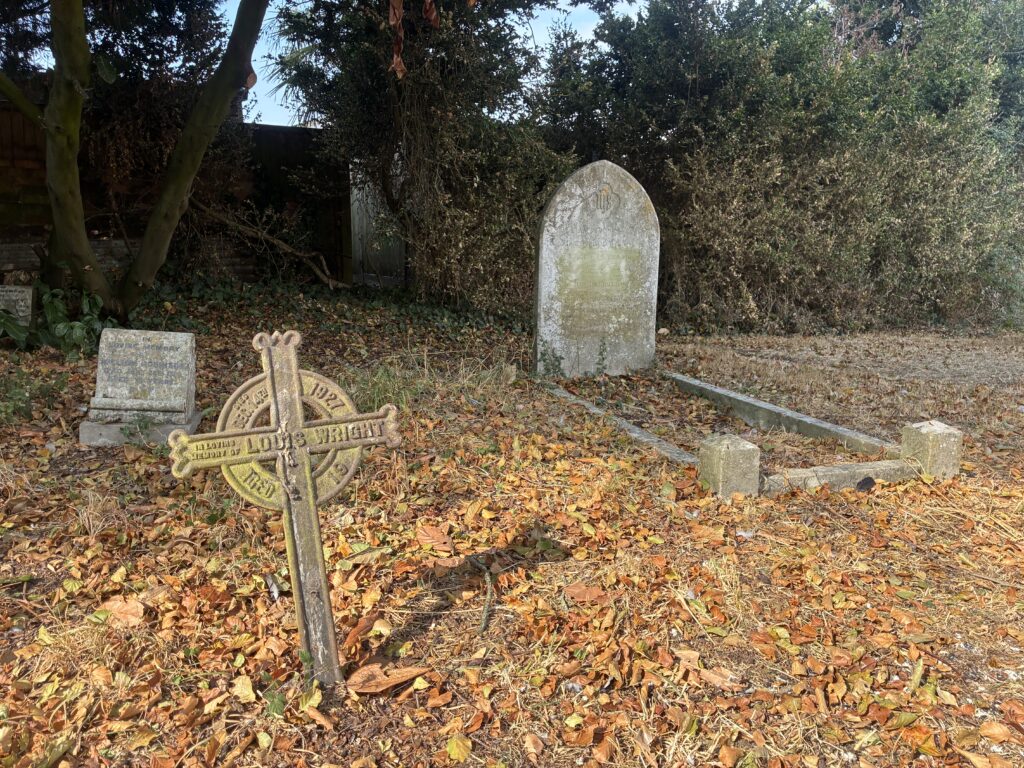
These metal crosses are also interesting. We know that there were five blacksmiths in the village in the late 19th century. Maybe they were all made in Fringford.
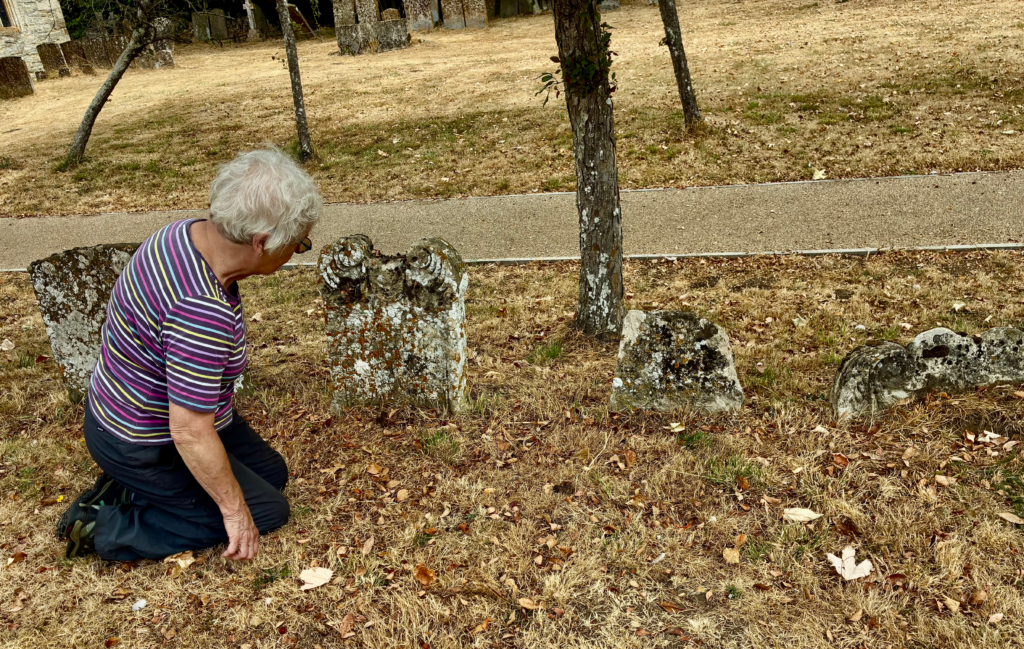
Mary looking at Elizabeth’s headstone before starting to clean it up. The two neighbouring headstones have almost completely sunk into the ground.
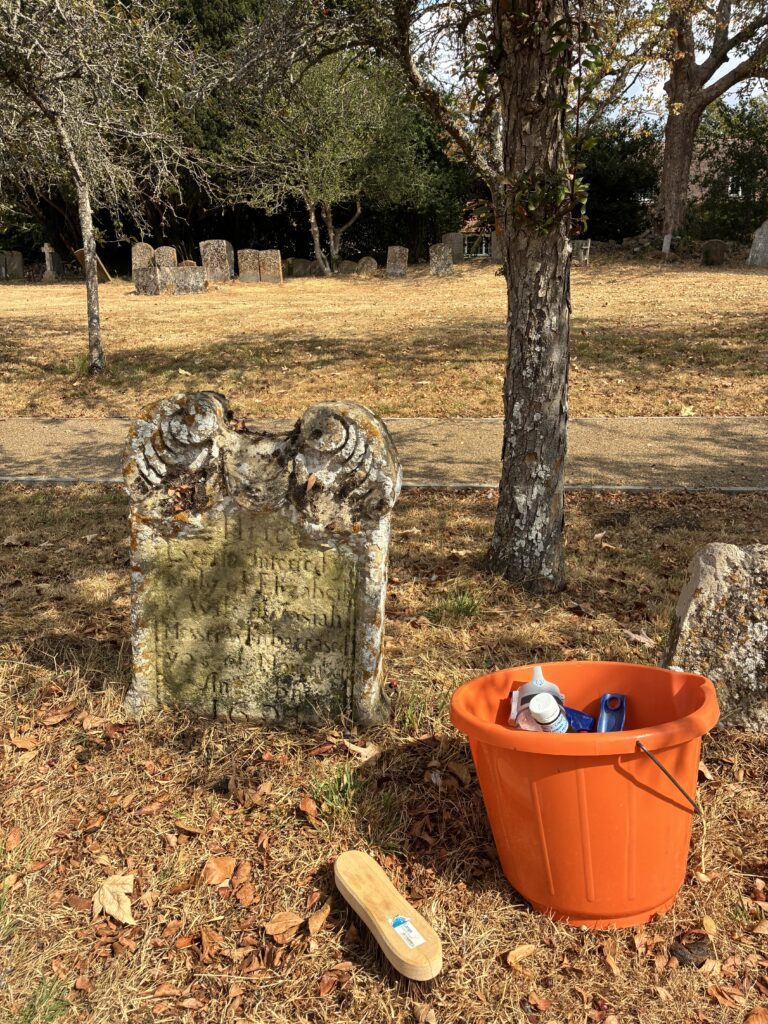
After cleaning and transcription.
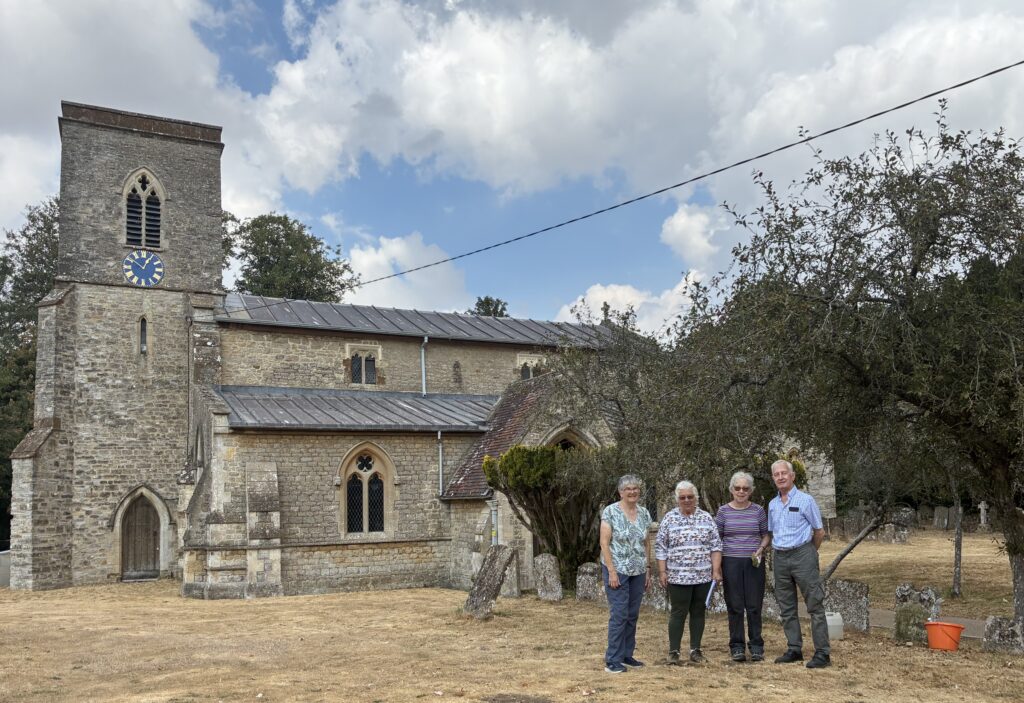
(From left to right) Lynn, Chris, Mary and Peter outside the Church of St Michael and All Angels, Fringford.
You may also want to read: