Autumnal squalls of winds have suddenly arrived this week sending the windows chattering, the fallen leaves into great billowing swirls, and the students back to the city. I am aways pleased to see them return after the long summer break. For they bring a welcome injection of youthful energy, and optimistic enthusiasm. And they herald in another season of college chapel choral services free and open to all. Hallelujah!
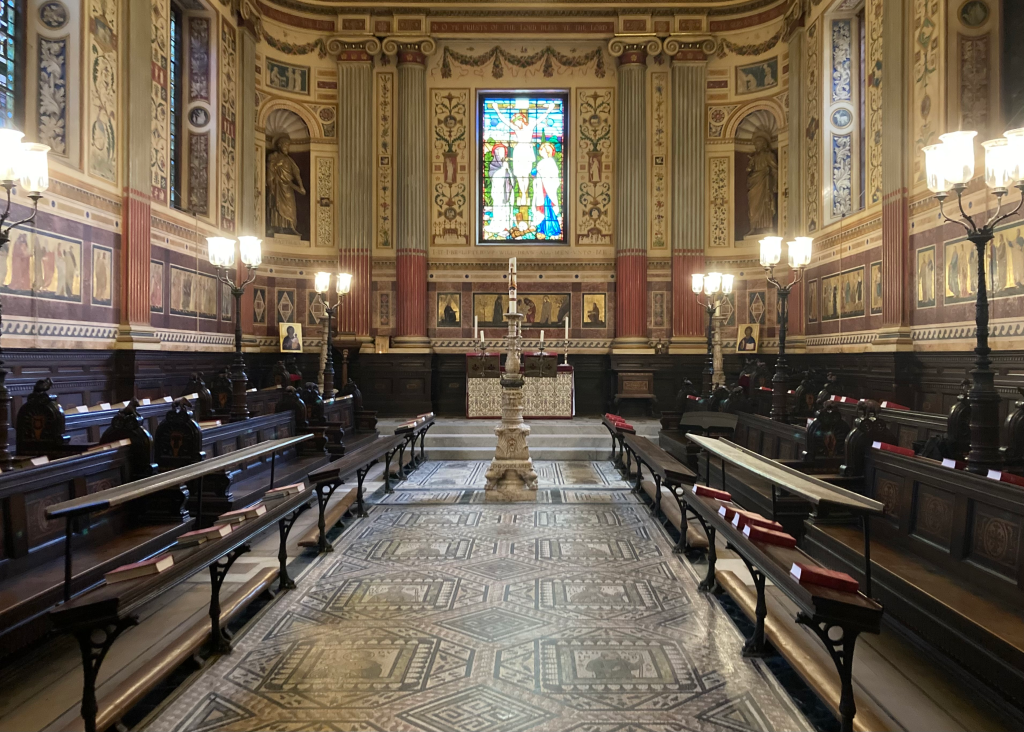
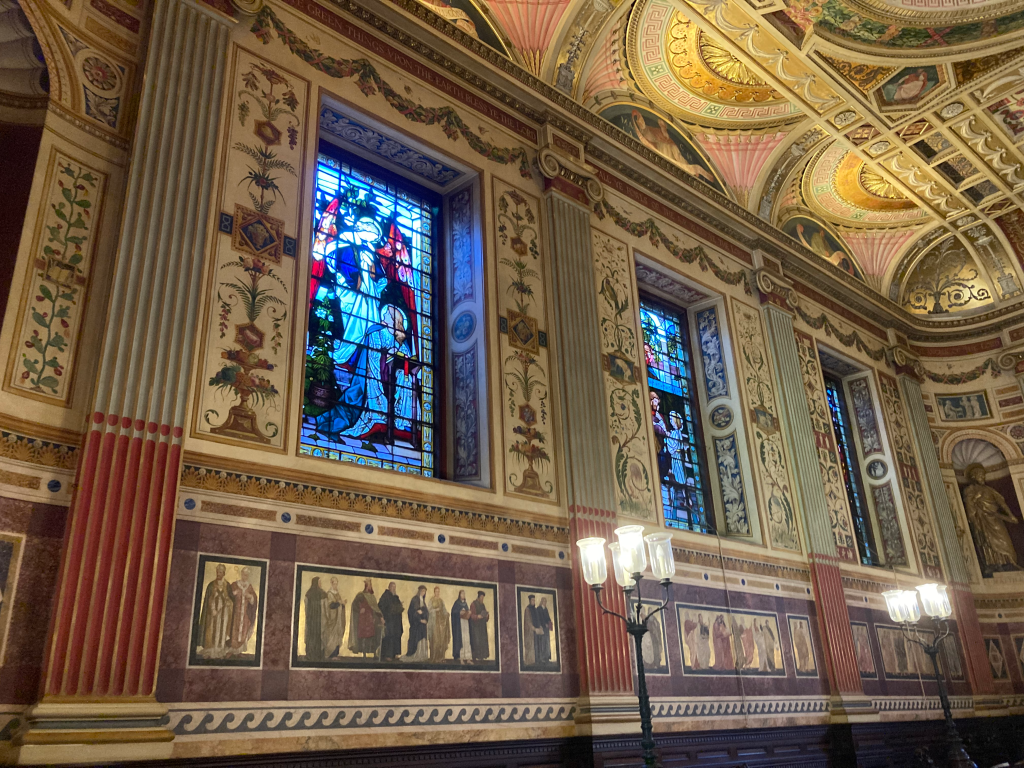
My local chapel is at Worcester College, close by to where Beaumont Palace once stood and where two Kings of England were born. It doesn’t look much from the outside. But once through the doors, you cannot fail to be moved by the magnificence of it all, every nook and cranny dripping with elaborate decoration. At once you are hit by a riot of colour, blues, greens, reds, purples, and gold. Lots of gold. It’s used on the mosaic floors, as backing for the wall paintings, for the glass windows, to gild the statues, fill the domed ceiling.
“As a piece of simple decorative and beautiful art it is perfect,” wrote Oscar Wilde about the place. I have to agree.
It is the work of the Victorian art-architect William Burges. He who provided the gothic extravaganza that is the interior design at Cardiff Castle, and whose own residence in Holland Park, Tower House, included wash basins inlaid with silver fish and taps shaped as oxen, along with highly decorated drawing room furniture like his Zodiac settle, the Dog Cabinet and the Great Bookcase, (built for the Medieval Court of London’s International Exhibition, completed in 1862 just before he started work at Worcester, and now displayed down the road at the Ashmolean Museum.) Liberace was a fan, so you get the idea.
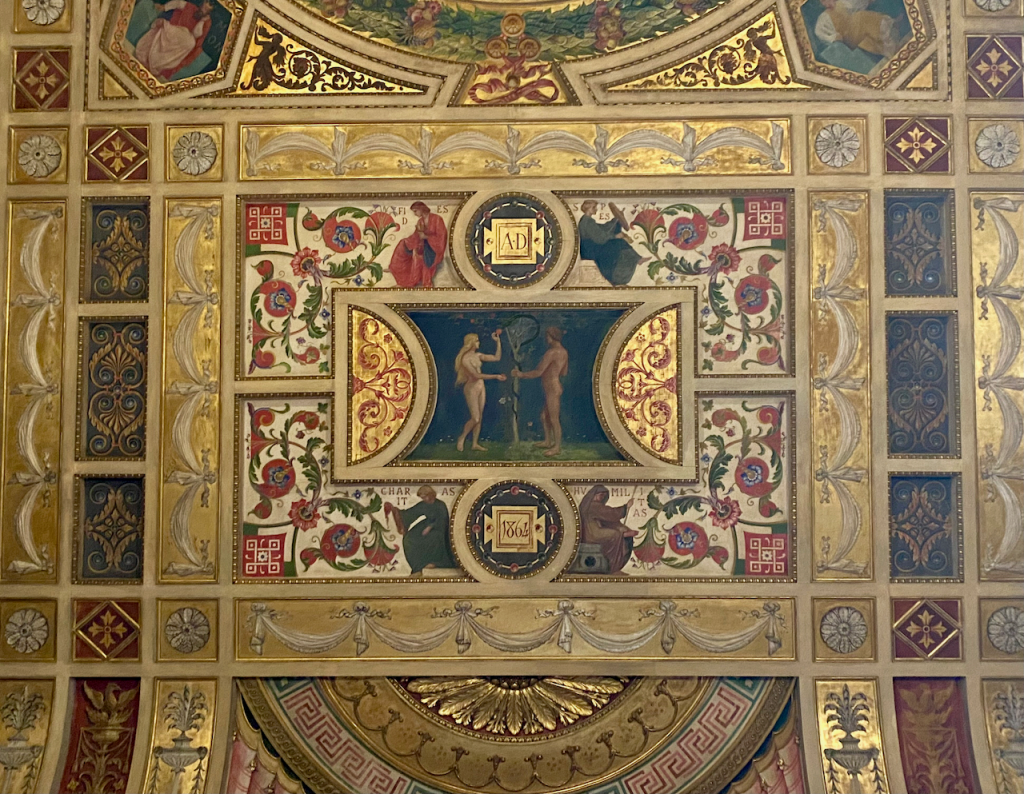
Burges believed in the power of decorative storytelling. And this is important in the timing of his Worcester chapel work. You can’t miss the date. 1864. It’s there on the lacquered backs of the pews and painted high up on the ceiling. Five years after the publication of Darwin’s ‘On the Origin of Species’, and four years after Oxford’s Great Debate between ‘science’ and ‘religion’ Burges believed that the idea of God as ‘the Great Architect of the Universe’ was under attack. Indeed, it comes as no great surprise to learn that it was Samuel Wilberforce, Bishop of Oxford, the very man who argued for creationism in the debate, was the man chosen to officiate at the chapel’s reopening.
And it is the theme that dominates the décor.
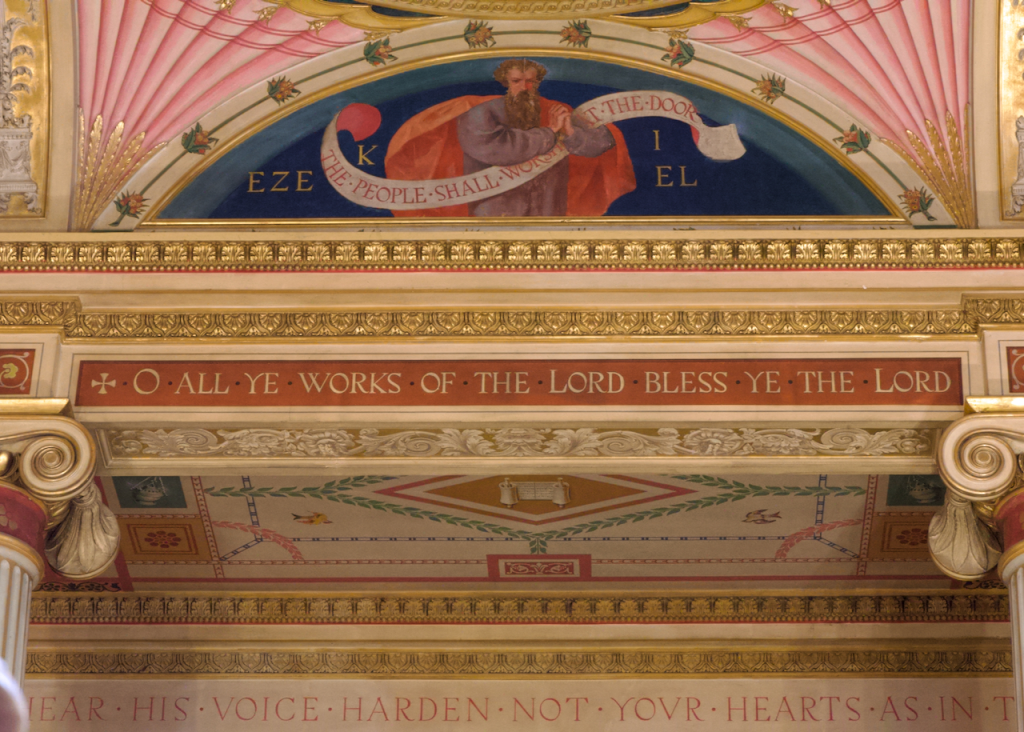
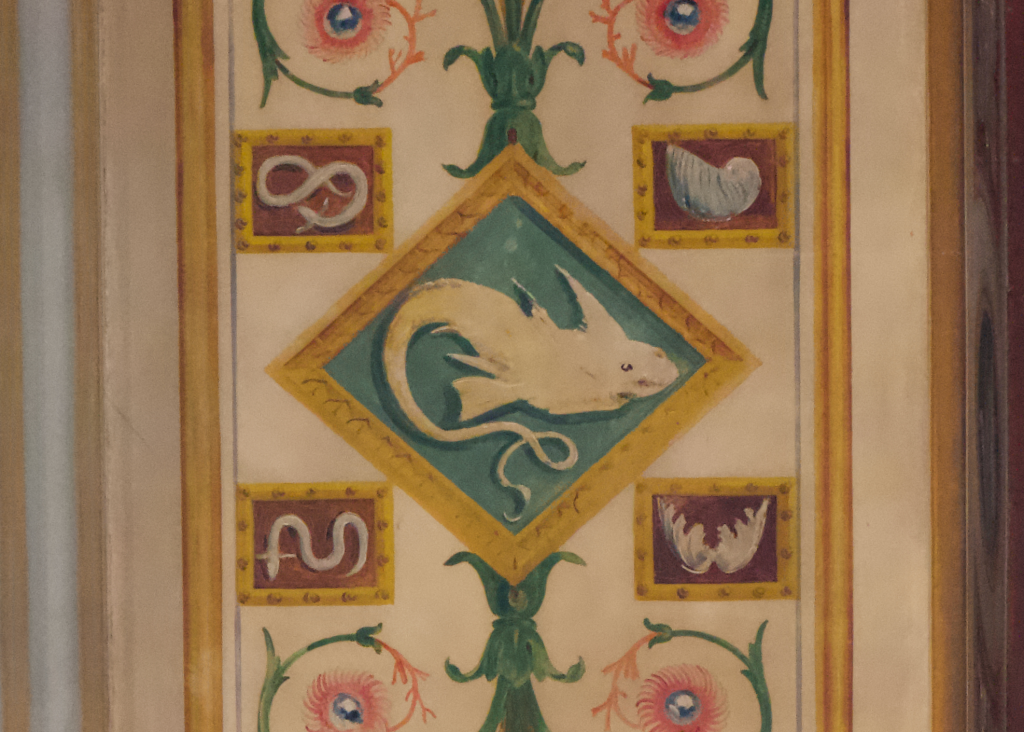
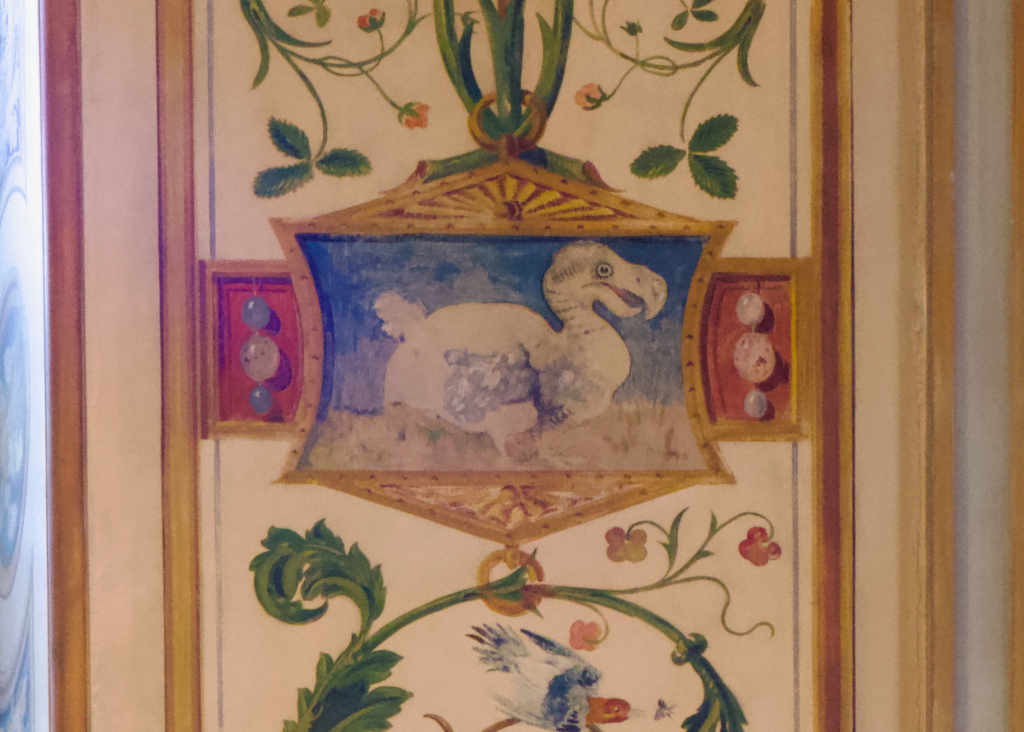
Around the top of the chapel in gold letters on red, is text from the ‘Benedicite’ a morning prayer calling on all of creation to give praise to God. These were the days when daily attendance by students at 8am matins was compulsory, and Burges, one of the great iconographers of his day has certainly given them something to look at. Frescoes filled with giant urns overflowing with fruit, trailing foliage awash with flowers on which perch flamingos, parrots, there’s even a dodo. There are creatures from the sea, including the great monster from the deep, Leviathan. And from the land; I spotted a zebra and a tiger, but I am sure there are many more. I feel an I Spy book in the making.
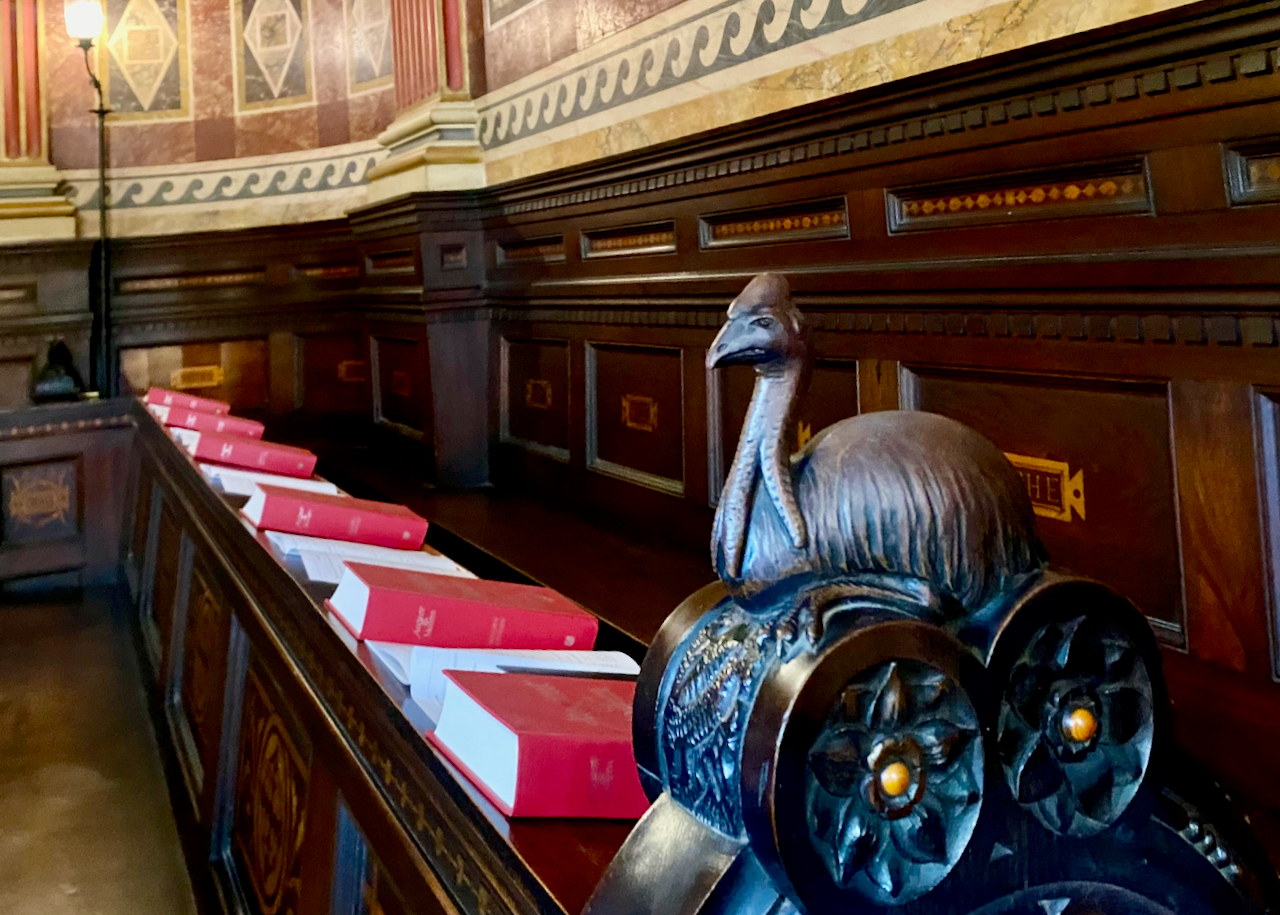
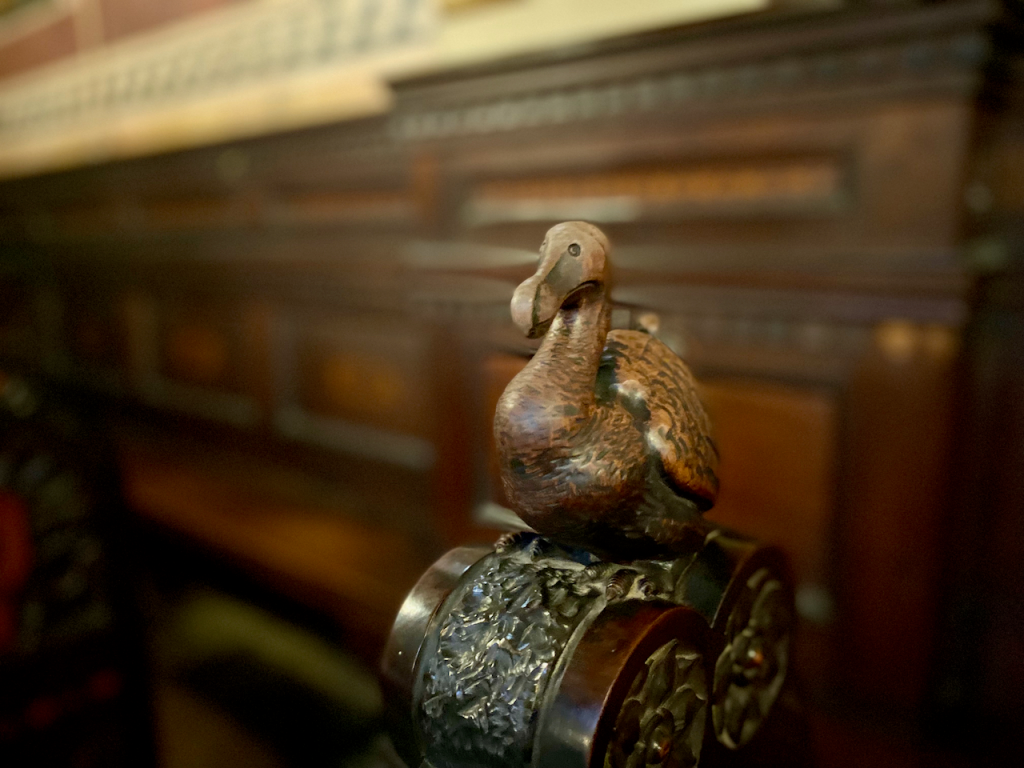
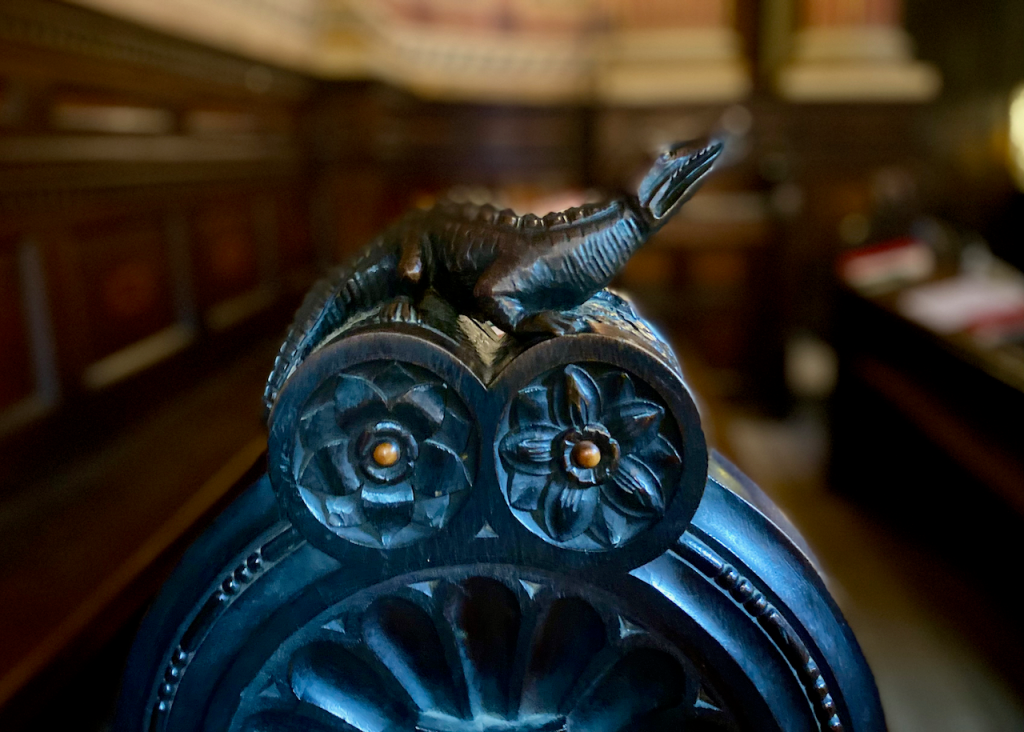
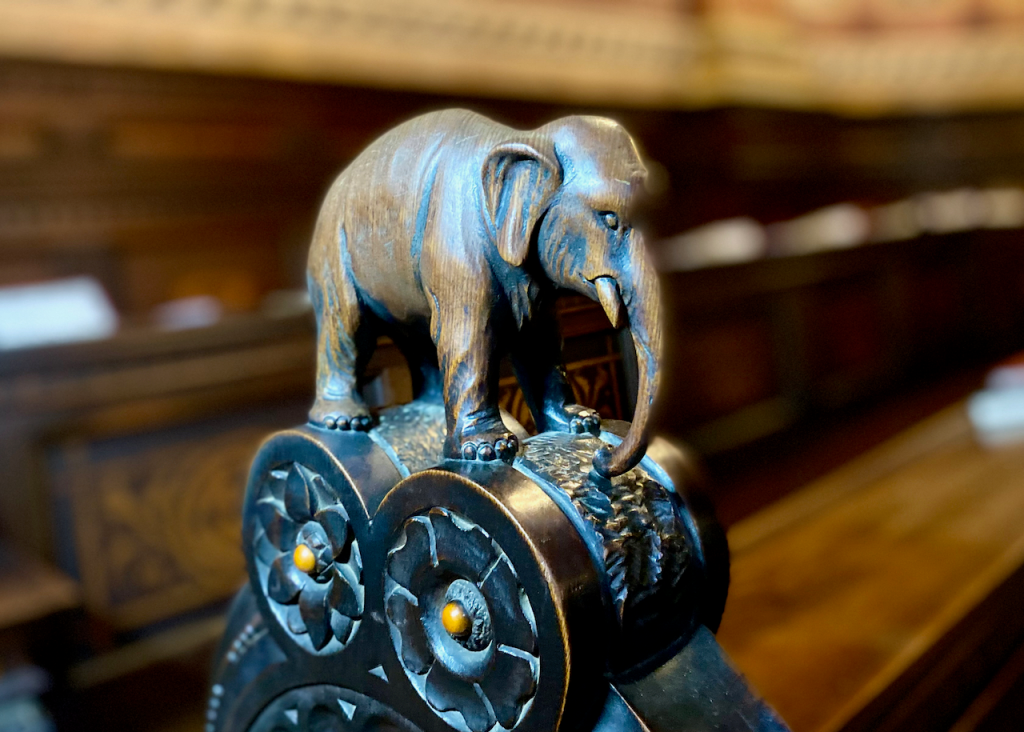
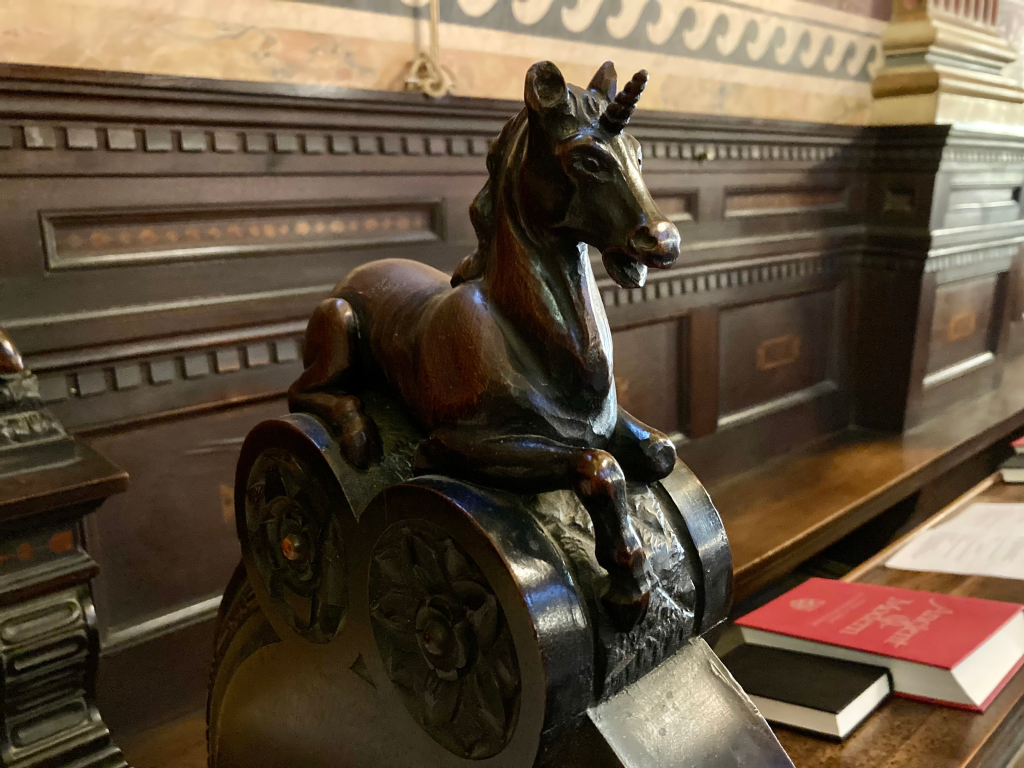
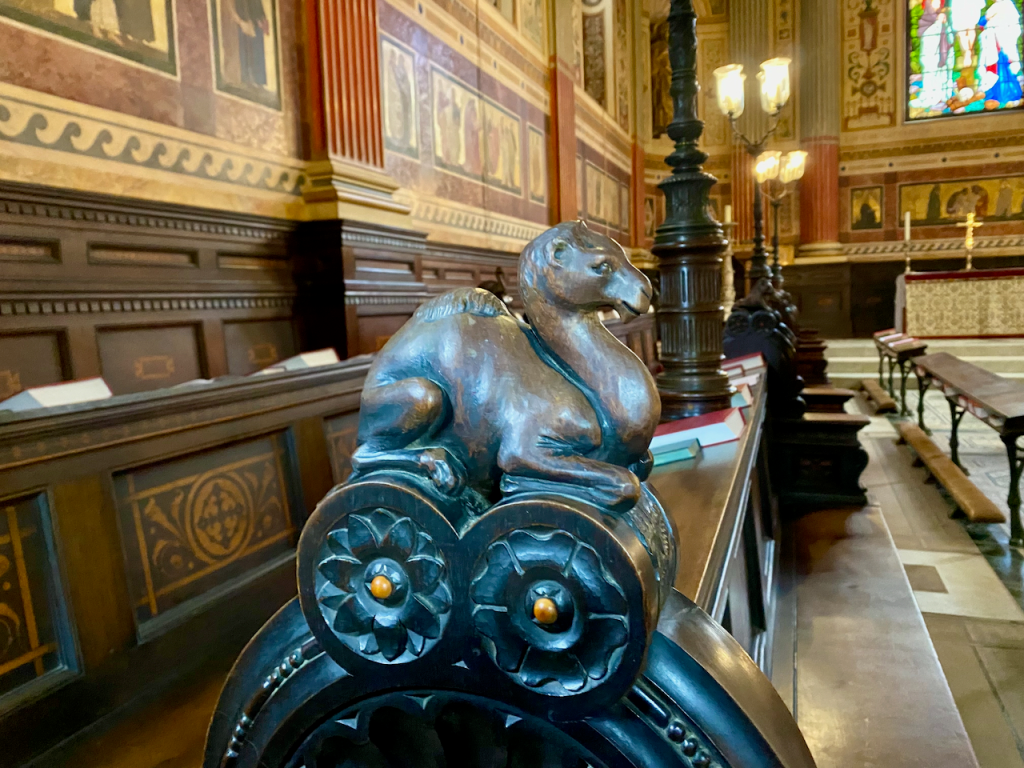
But my favourite are the walnut animal carvings on the end of the pews. Some are clearly chosen for their symbolism. In front of the Chaplain’s seat sits a cockerel, the first harbinger of dawn and the resurrection, and a unicorn, an animal in medieval bestiary only seen by pure virgins – the Virgin Mary one can assume in this case. Nearby stands a pelican feeding its young with its own blood, the ultimate symbol of self-sacrifice. There are others too, an elegant elephant, a riotous rhino, a coy camel, a worrisome warthog.
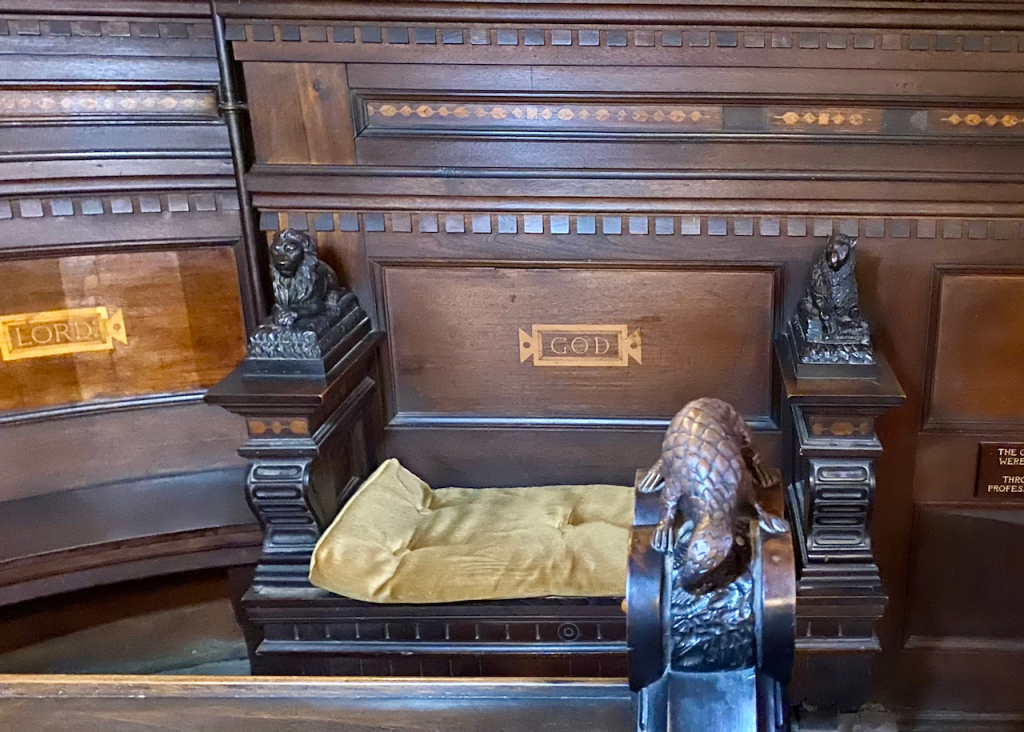
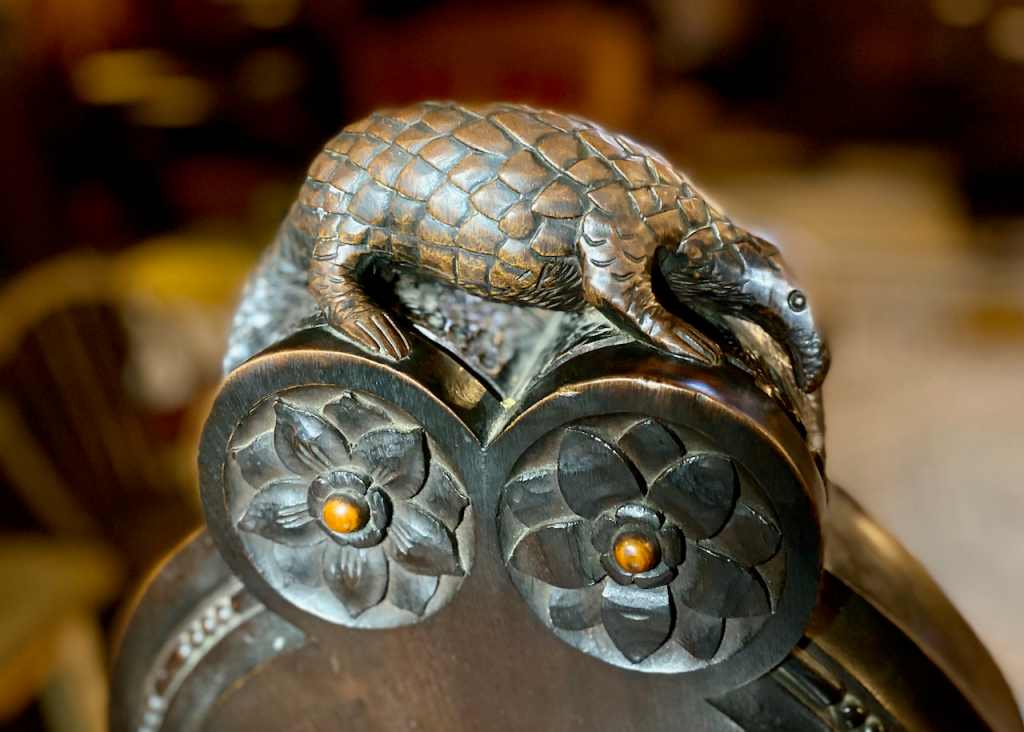
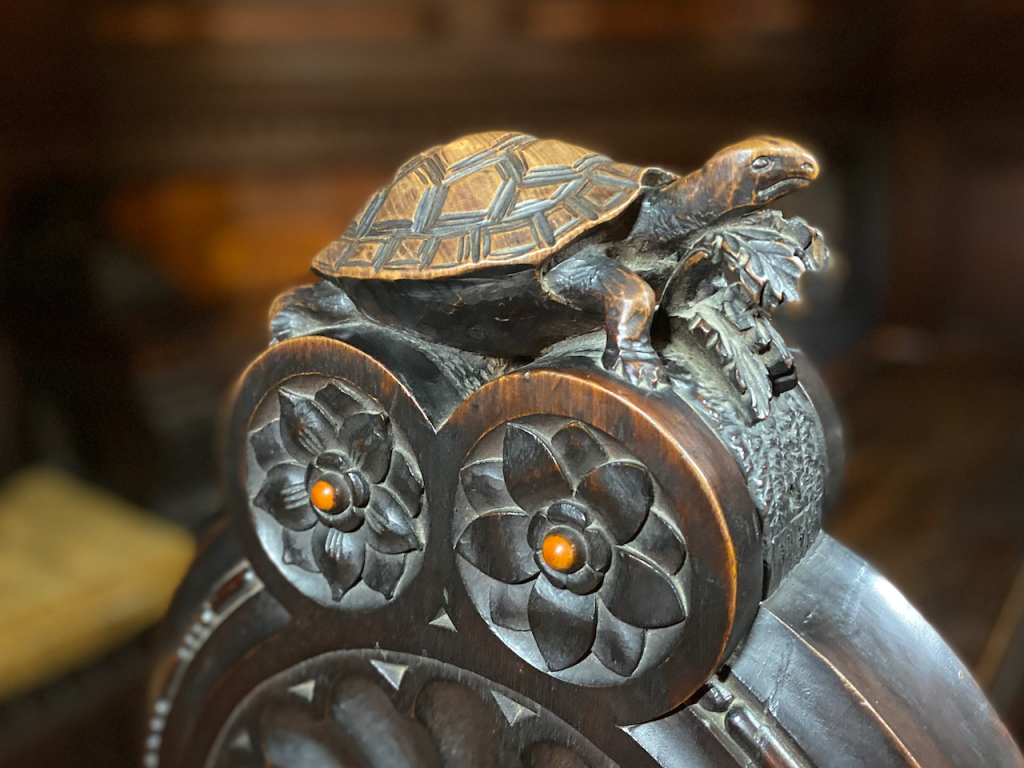
And then there are the ones that show that Burges had a sense of humour. At the back of the chapel sits a tortoise chewing on a piece of lettuce, the slow and steady nature of the creature a worthy attribute for the stall of the Vice Provost. And across the aisle, guarding the seat of the Provost, sits a pangolin, whose thick skin and long nose for sniffing out dissent would come in handy for any Head of College.
And there’s another joke here too. For Burges has inserted the words of another morning prayer, the Te Deum into the very seats of the worshippers. Along the dado rail at the back, the words are jumbled and scattered – you have to concentrate to see that ‘wep’ followed by ‘raise’ is ‘we praise’. But stick with it and follow the puzzle around the chapel, and there is no mistaking the word inscribed at the end. On the chair of the Provost. God. You can’t argue with that.
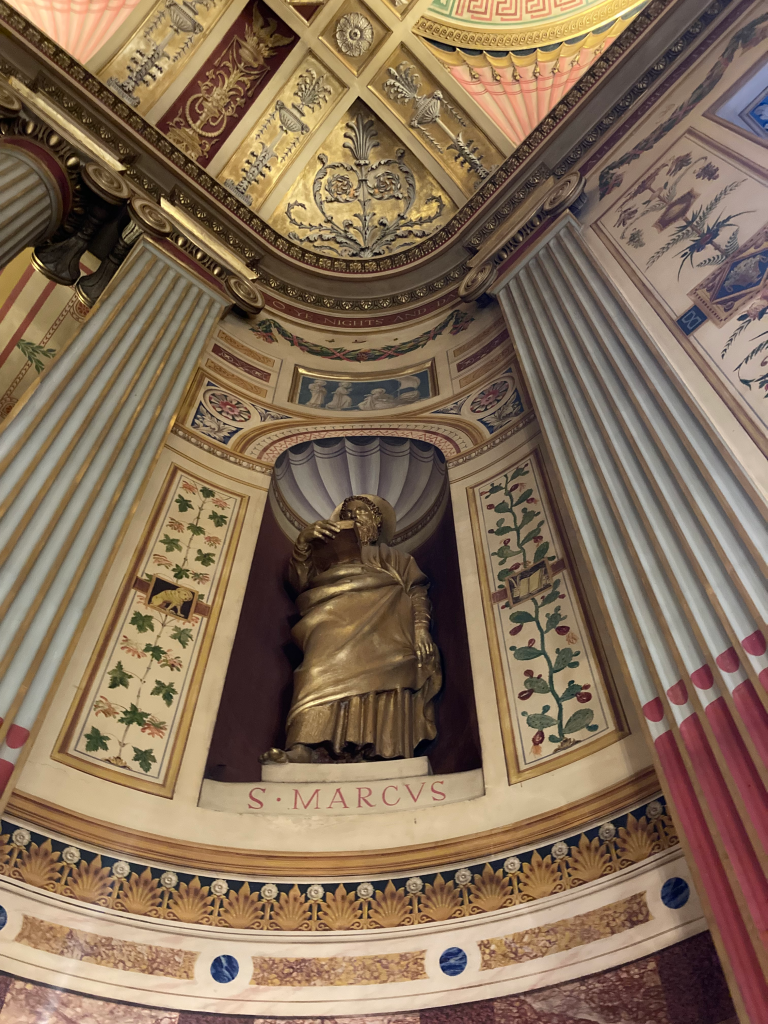
Burges’s master storytelling and childish sense of humour to my mind made him the Disney of his day. He’s great fun. But what he did at Worcester didn’t please everyone. When he popped statues of the four evangelists into the corner niches of the chapel, some thought he had gone too far. Labelled ‘idolatrous’, or too ‘Catholic’, the matter was even taken to the High Court. Where I am pleased to say it got not further.
So the place remains pretty much as he left it. When I visited last week the Director of Music was auditioning for choral scholarships. On Monday and Tuesday during term time we get to hear the angelic voices of choristers from the Christ Church Cathedral School. So much to look forward to. I might even attend matins.
Main picture: A cassowary – one of the walnut animal carvings created by the sculptor Thomas Nicholls, the same sculptor who also worked with Burges on Castell Coch and Cardiff Castle.
Grateful thanks for the chaplain Revd Marcus Green for his illuminating tour of the chapel.
Contributing photographer John Milnes.
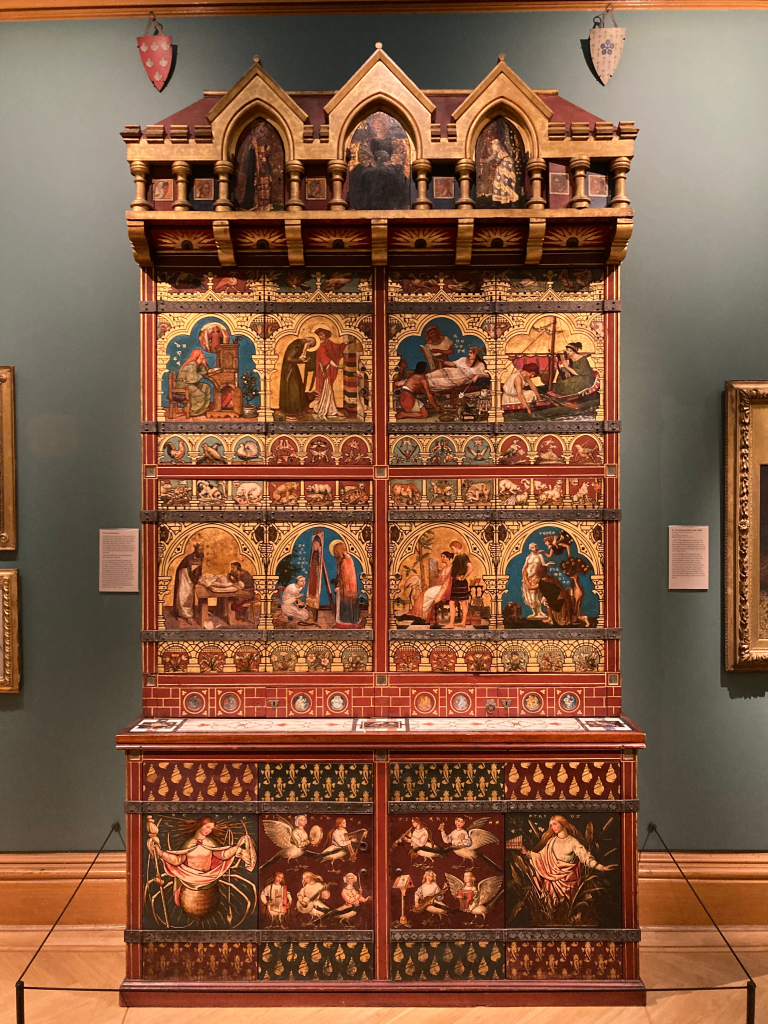
The Great Bookcase designed by William Burges. He commissioned fourteen artists to paint it including Edward Burne-Jones and Henry Holiday (who was also responsible for the stained glass windows at Worcester Chapel.) It formed the centrepiece to the ‘Medieval Court’ at the International Exhibition held in London in 1862, and is on display on the third floor of the Ashmolean in the Pre-Raphaelite gallery.
4 Comments
Join the discussion and tell us your opinion.
A lovely tour round what is one of Oxford’s true hidden gems. Well not as hidden as it once was. The College is now much more open in allowing outsiders to glimpse beyond the walls. Anyone can go to Sunday evensong in the chapel. And as the Sausage suggests it is a wonderful experience. Something everyone should experience ar least once.
My college, but I can’t say that I frequented the chapel during my time there. Will definitely visit again when I am next there.
Wonderful article and photos. Really fascinating! We’re now planning a visit to the chapel for an evening service.
Thank you and you must. Such a special place.