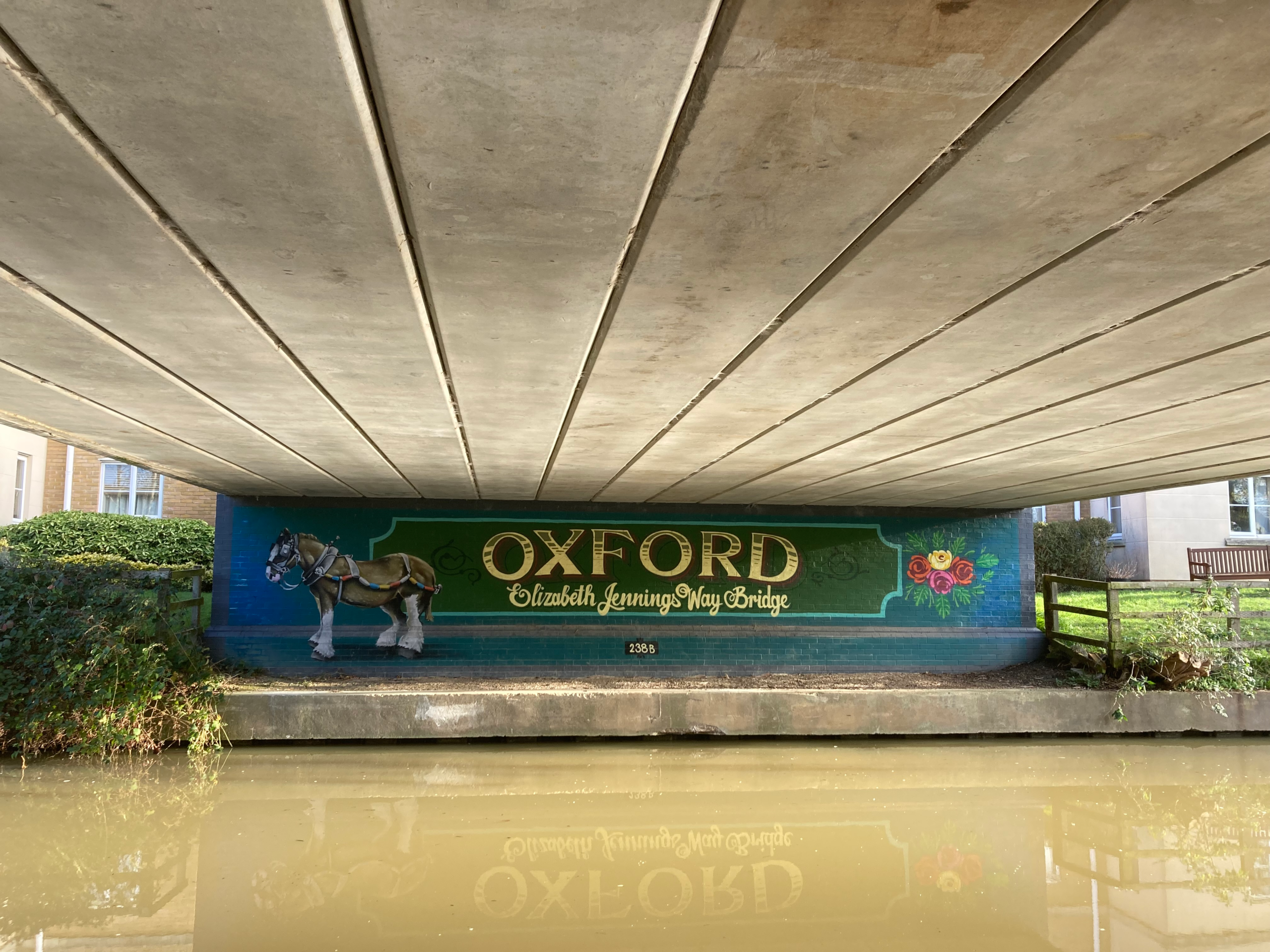
It was on the way to have lunch with a friend last week in Summertown that I first encounter the name Elizabeth Jennings. I’d decided to take the scenic route north out of the city along the Oxford Canal. Starting at Hythe Bridge, over Isis Lock, under Walton Well, Aristotle Lane and Frenchay Road Bridges, and then just at the point at which I need to peel off to reach my destination there it is; Elizabeth Jennings Way Bridge, the painted words on the arches of its underbelly part of a fun folk-artsy mural portraying the story of the neighbourhood. The bridge carries the eponymous street that links the Woodstock Road with Waterways, a swathe of flats and houses built in the early 2000’s herded into neat terraces and cul de sacs. So who was Elizabeth Jennings? I was keen to find out.
It doesn’t take me long. For on mentioning the name on arrival, my host informs me that Jennings was an Oxford poet, who by serendipity had written her favourite poem of all time. Called ‘Delay’ and being short she recited it on the spot.
The radiance of the star that leans on me
Was shining years ago. The light that now
Glitters up there my eyes may never see,
And so the time lag teases me with how
Love that loves now may not reach me until
Its first desire is spent. The star’s impulse
Must wait for eyes to claim it beautiful
And love arrived may find us somewhere else.
The poem struck me as powerful in its emotional sensitivity. A beautiful riff on the part chance plays in finding love, and when I get home, I feel the need to revisit it online where I discover that amongst the many comments that had been posted underneath was this. “I first saw this poem on The Underground in London in 1989, and memorised it quickly during that tube ride, so that I could get back to my hotel and write it down, so that I would remember it forever.”
What a tribute. I order a copy of her Selected Poems at once and soon discover the remarkable story of a woman who many consider to be amongst the finest of our 20th century poets. And she lived pretty much her whole life in Oxford.
Born in 1926, Elizabeth Joan Jennings arrived in the city from Lincolnshire aged six where she lived with her family on the Banbury Road, first attending Rye St Anthony (she was raised a Roman Catholic) then Oxford High School, after which she studied English at St Anne’s College. Literary success soon followed. By 27 she had published her first book of poetry, her second won the prestigious Somerset Maugham Prize. She became the only woman to become part of the celebrated set of 1940’s and 50’s poets that included Philip Larkin, Thom Gunn and Kingsley Amis who once described her as ‘the star of the show’. She wrote and wrote – hundreds and hundreds of poems, around thirty published books of them in all. And then there were other accolades including the WH Smith Literary Award, and in 1992 a CBE from the Queen for her contributions to literature.
But while her work was well honoured, her life was far from straightforward. Her friend, the author and journalist Christina Hardyment describes Jennings as ‘not domesticated’, a lovely way of saying that day to day living didn’t come easily to her. The only nine to five job she held down for any length of time was as City Librarian for eight years, relying thereafter on her freelance writing. Very briefly engaged she never married, though love, loss and longing are constant themes in her poetry. She had a breakdown in the early 1960’s that sent her for long spells to the Warneford Hospital – her experience I found explored with observant clarity in ‘After an Operation,’ the third part of her ‘Sequence in Hospital.’
What to say first? I learnt I was afraid,
Not frightened in the way I had been
When wide awake and well, I simply mean
Fear became absolute and I became
Subject to it; it beckoned, I obeyed.
And for much of her life she moved from bedsit to modest flat back to bedsit. “Once while living in a place on the Banbury Road, she was burgled,” recalls Hardyment. “Understandably anxious she rang me and asked if she might spend that night in our basement. She stayed for six months.”
Eventually Jennings moved to more settled sheltered accommodation in Headington. Here she continued to fill every side board, table, shelf even the bath with things she had purchased from her daily trips into Oxford. Books of course, sometimes left unopened from their packaging but also what she called her ‘collectibles’, glass animals, snow domes, music boxes and the like. Christina used to take her on trips to a shop in Lechlade that only sold Christmas stuff. The allure Jennings describes in a poem about Grove House in Iffley belonging to her friend Vivien Greene (Graham’s ex-wife and an avid doll’s house collector) with whom Jennings would often spend Christmas.
And yet there is no sense of objets d’art,
Of rarities just valued for their worth,
The handsome objects here invite one’s touch,
As well as sight. Without the human heart,
They’s have no value, would not say so much.
……
Nor are they an escape for anyone.
Simply you’ve fashioned somewhere that can give
Not titillation, pleasure, but a sense
Of order and of being loved;……
A well-known figure around Oxford, Jennings would frequent many of the city’s cafés and pubs. The Rose and Crown in North Parade (“always a bitter lemon, great skin, twinkly eyes and talked non-stop,” remembers the landlady,) The Anchor in Jericho, The Grapes in George Street all claimed her as a regular. For reasons of observation or for human contact, probably both. She liked to sit and write at The Randolph Hotel where for £2.25 you could get four cups of coffee and a biscuit. Sadly no longer. And then from around the corner, she could take the coach to Stratford to see the latest Shakespeare play or wander up to the Phoenix on Walton Street to catch a film.
Never one for dressing up she was somewhat unkindly dubbed ‘the bag lady of the sonnets’ by the tabloids when after receiving her CBE at Buckingham Palace she turned up for dinner at Rules Restaurant in London wearing her hallmark knitted hat, duffel coat and plimsoles. “But the bags she carried with her were always purposeful,” laughs Hardyment. She always maintained supportive friends. Though Christina had to set rules – banning her from phoning between ten in the evening and eight in the morning (Jennings often worked through the night) she was a regular at her Sunday suppers in Chalfont Road. And it was her old friend Priscilla Tolkien (JRR’s youngest daughter) who arranged for her to spend her last days in a comfortable nursing home in Bampton where she died in 2001. A huge sale of her belongings was held on the Green in Carterton.
I wonder what she would have made of this road named after her. It’s on an interesting spot – near where a 155-million-year-old dinosaur skeleton was discovered, and the first wharf was built in 1789 to dump coal carried into the city via the new Oxford Canal from Coventry. The pit from the old Victorian brickworks still survives as a large pond now landscaped with trees and bushes, but there’s nothing from the days when William Morris developed the area to make radiators for his Cowley plant, and which during the war employed 3,000 people to manufacture parts for Spitfire engines. And as well as being so close to many of her old haunts she might well have liked the fact that the new bridge is built on an ancient medieval right of way called ‘My Lady’s Way’ dating from the time when the abbesses at Godstow nunnery owned much of the land around here.
But in truth the residents of Elizabeth Jennings Way should feel privileged to be living on a road named after a woman with such a way with words; a volume of her verse ought to be obligatory in every property. But I am so pleased it was. For I am not sure I would have found her work otherwise. And I have so much to catch up on.
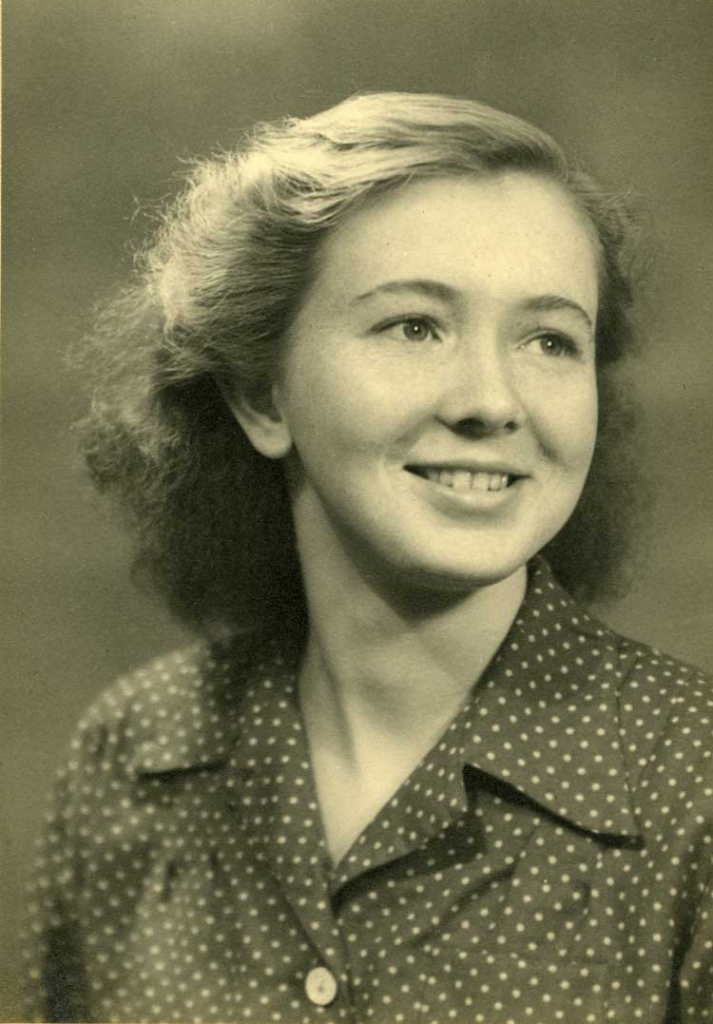
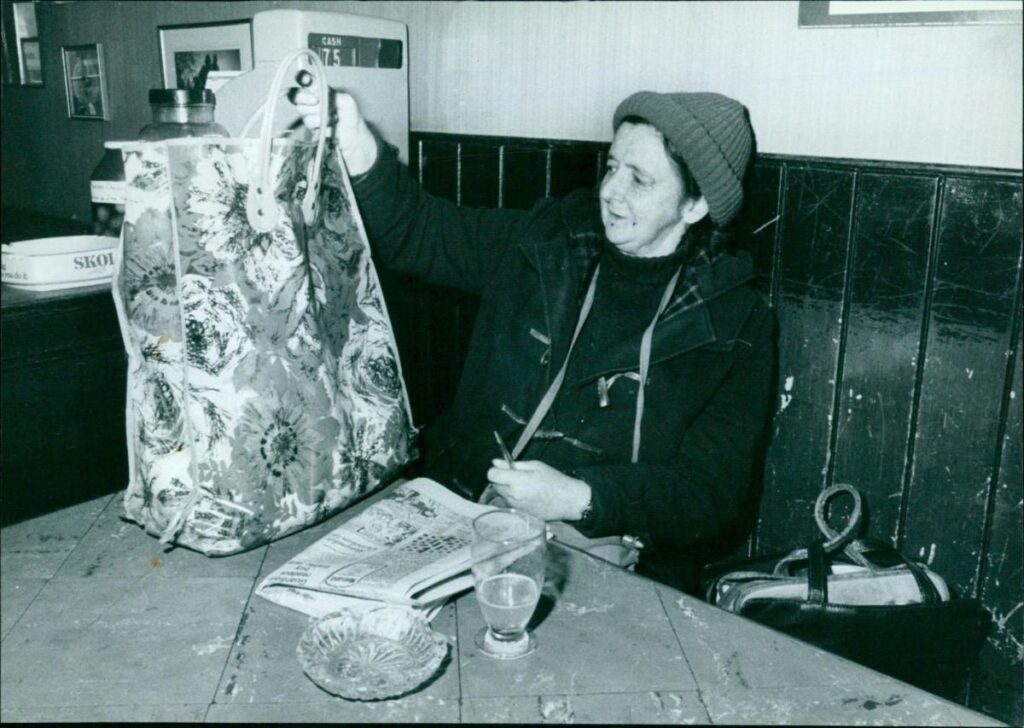
Elizabeth Jennings at The Rose and Crown in North Parade.
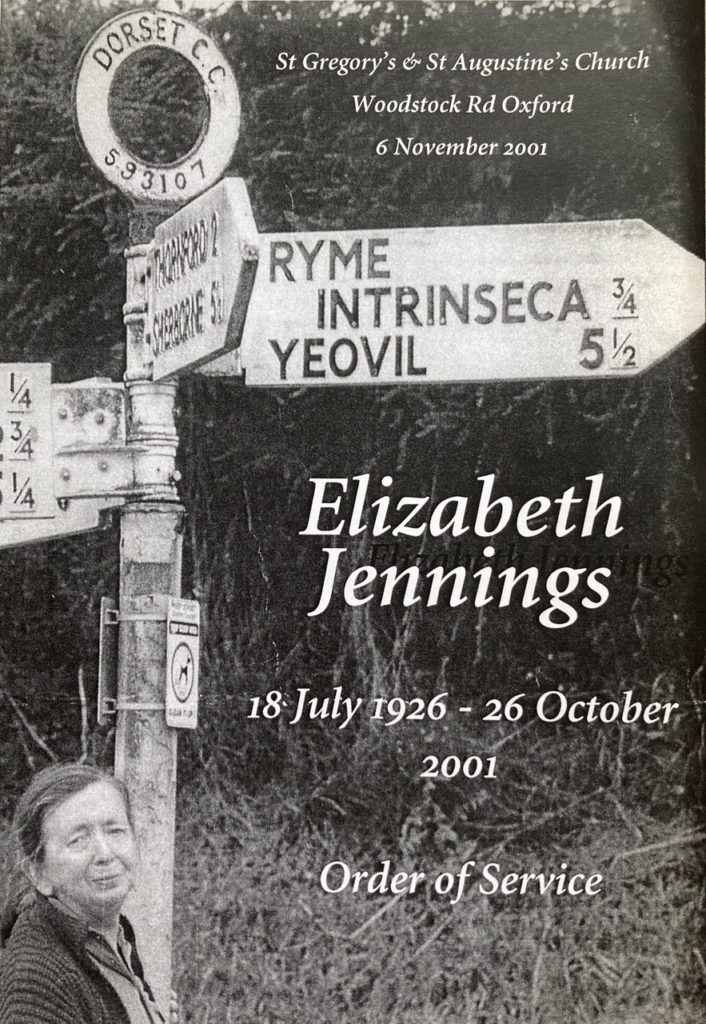
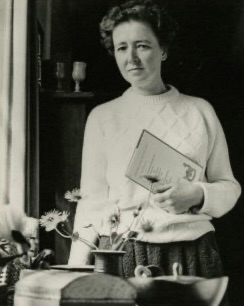
The Order of Service for her funeral at St Gregory’s and St Augustine’s Catholic Church on the Woodstock Road. The photograph was taken by Christina Hardyment on a trip with Elizabeth to Ryme Intrinseca in Dorset.
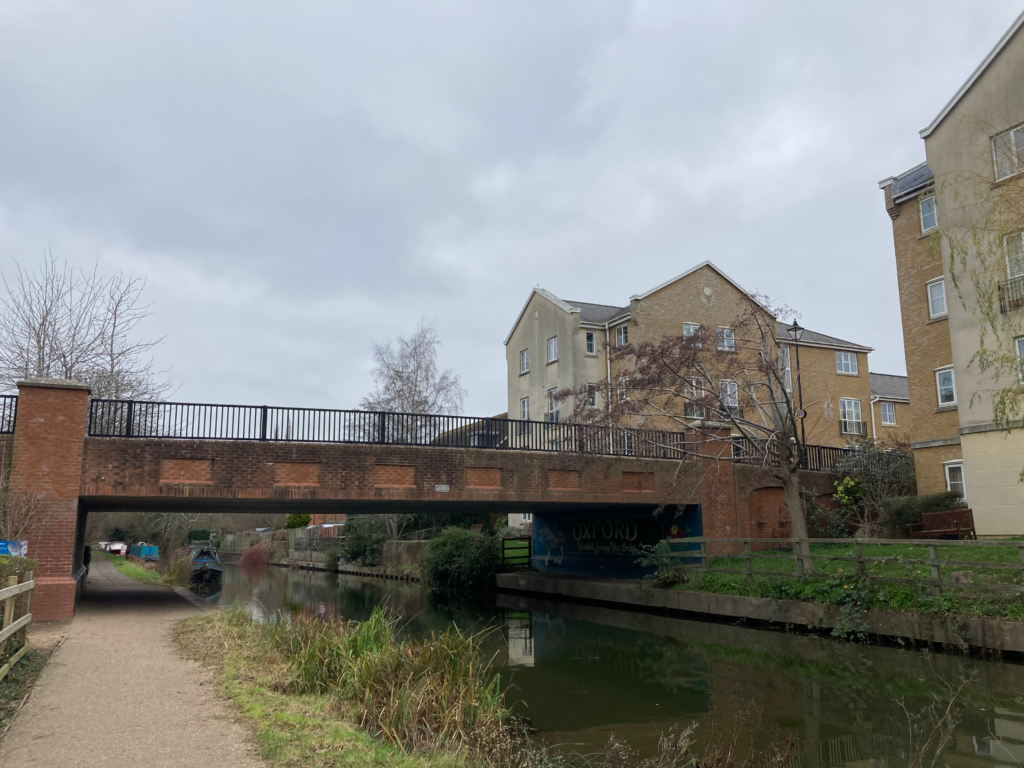
Elizabeth Jennings Way Bridge over the Oxford Canal.
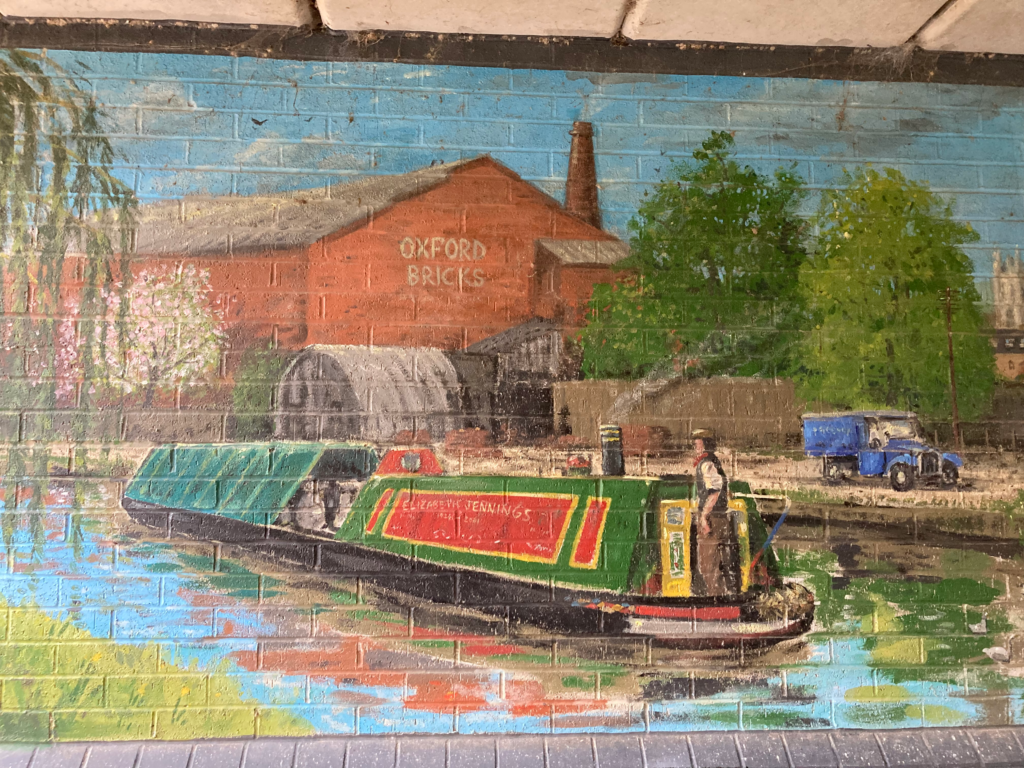
In order to deter graffiti, the Oxford Canal Mural Project commissioned Dan Wilson to paint interesting aspects of the local area under the arches of the bridge. Elizabeth Jennings has her name displayed on the narrowboat here, though she didn’t have any connection with the canal or the boat community as far as I am aware.
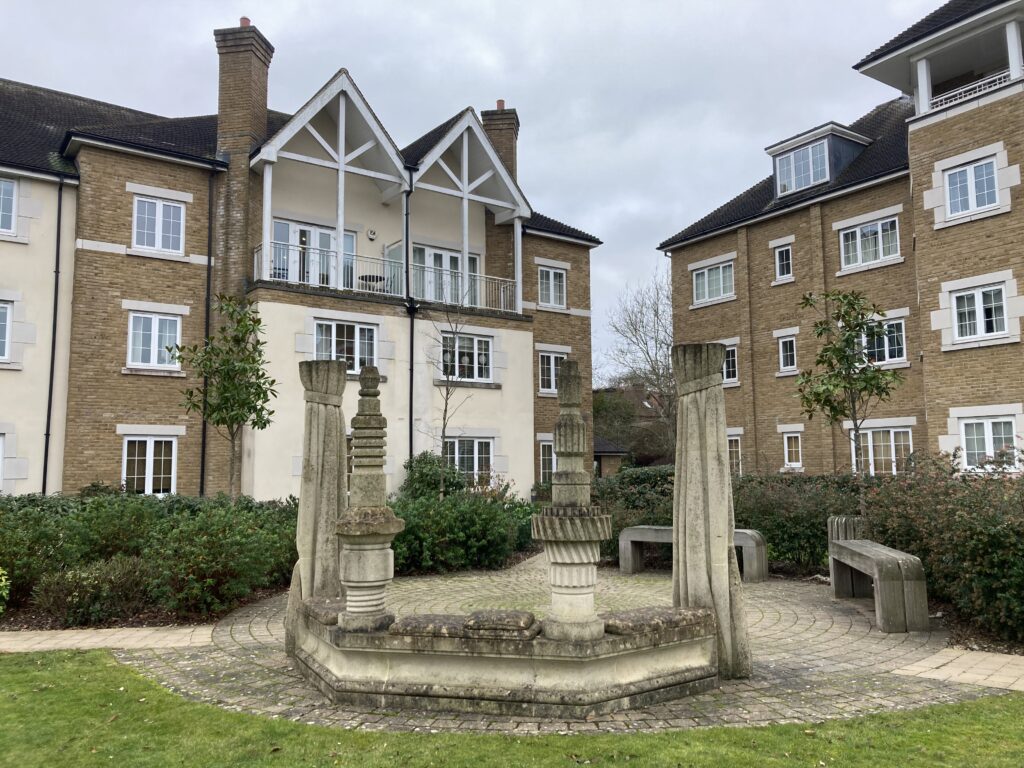
A concrete sculpture is the only reminder that this place was once the location for the Osberton Radiator factory (later Unipart).
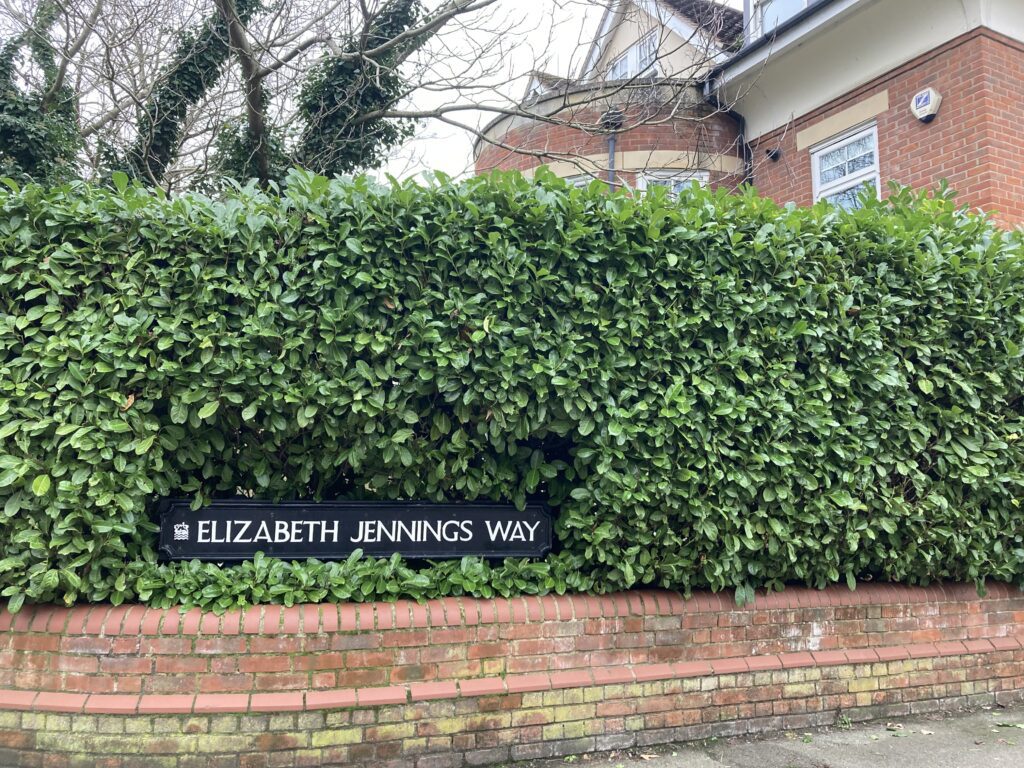
Leading from the Woodstock Road, with Keble College sports ground to the north.
12 Comments
Join the discussion and tell us your opinion.
Wonderful piece. Thank you dear friend xx
Lovely. EJ looks like an OHS and St Anne’s kind of girl in the early photos – or is that just the benefit of hindsight? I’m going to read some more of her poems now. ‘Delay’ was too sad!
Thank you! This sent me back to look at more of her poems. There is so much more than the few I knew!
Cracking piece about Elizabeth Jennings whom I once interviewed for the Telegraph, over tea at the Randolph. We got on famously and she told me, among other things, that one of her idols was John Gielgud, of all people, who offered her discreet financial support at one point in her life. My favourite Jennings poem, which Julia’s sister read at our wedding in Melbourne, is Such Love I Cannot Analyse. Exquisite. I hope you know it.
I learnt SOOO much from your piece, including the fact that EJ was a regular at the Rose and Crown, which we sometimes frequent. Thank you.
Great piece
Happy new year to you
I just read the wonderful story of Elizabeth Jennings Way (which I represent on the County Council). My wife, Susanna Pressel, managed to get the road named after Elizabeth Jennings and persuaded City Council colleagues to name the road after a woman, for once, rather than Spitfire Way, the original proposal. Many thanks for the Sausage. (Presumably you have heard the Liz Woolley talk on Beer, Sausages and Marmalade. It covers the Oxford Sausage in some detail.)
The way you write about Elizabeth Jennings makes me wish I’d met her. Thanks for a great read.
I really enjoyed the Oxford Sausage today and I am fascinated by Elizabeth Jennings – Why have I never heard of her ?? Heard of all the men on the list of poets but not her –
Very interesting piece. I met her in the early 70s when I was working as a barman at the Mitre (in its Berni Inn days) in the High. We had quite a chat as she was the only customer in the front bar. She told me her name and that she was a poet. Of course, I had never heard of her (I was only 19 and not greatly interested in poetry) and confused her with Elizabeth Jenkins (and maybe Elizabeth Jane Howard?) which did not amuse her. I remember her having a plastic bag with her. I think she was drinking double whiskies (or was it double brandies?). She was a bit flushed (from the spirits I assume) and she had quite piercing eyes. She was quite amiable, but she drifted away when more people started coming into the bar. Looking back now I wish I’d been more mature and had a more interesting conversation wit her.
This is a very interesting tale. I have so often wondered who Elizabeth Jennings was when cycling along the canal to my daughters in Summertown. Loved her wistful poetry. Will find a copy of her poems.
Thank you
I am new to Oxford and have enjoyed reading your articles as I get to know the city. As I walked along the canal recently and under the bridge, I kept meaning to look up her name. Then your email arrived in my inbox!. ‘Delay’ is simple but exquisite. I will be looking into more of her poetry.
I have long been an admirer of Elizabeth Jennings’ poems and was delighted to see the road named after her. Thanks and congratulations to Susanna Pressel for achieving such suitable recognition.