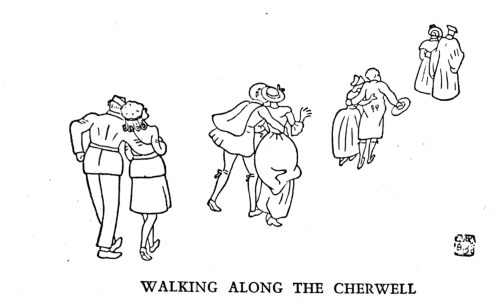
Opposite Meadow Walk on St Aldates, there is a shop where tourists like to buy souvenirs after their visit to Christ Church. It’s appropriately called ‘Alice’s Shop’ as this pretty 15th century building was where the real Alice in Wonderland, daughter of Dean Liddell and friend of Lewis Carroll, used to buy her sweets. But these visitors are missing a treat. The place they should be heading is next door. Venture under a stone arch and down a narrow alley and you will find St Philip’s Books, the kind of Oxford bookshop I remember from my schooldays; a warren of passageways, every wall crammed with shelves of antiquarian and second-hand books, opening on to rooms where tables groan with tottering towers of tomes on every subject imaginable. This one specialises in theology, there are nine shelves labelled ‘Liturgy’, and three on ‘Thomas Aquinas’. But my favourite spot is the one marked ‘local interest’. Because of its tight location, you must keep moving aside to let other browsers by. But today something quickly catches my eye. ‘The Silent Traveller in Oxford’ by Chiang Yee is inscribed in a flowing red script along the spine of a cream linen bound volume, with its Chinese calligraphic equivalent written vertically from top to bottom on the front cover. Open its pages and there are exquisite watercolours, deliciously comic cartoons and beautifully written poems and travelogues describing Yee’s perambulations around the city in the early 1940’s. A snip, I thought, at £14. When I return home, I discover that Yee was something of a celebrity.
Chiang Yee had come to England in 1933, disenchanted with the corruption he witnessed in China. He first lived in London where he taught Chinese, wrote books, designed costumes for the theatre and painted – his father had been an artist too. Then in September 1940 a year after war was declared with Germany, his flat in Hampstead was bombed in the Blitz. He only survived as that night he happened to be in Oxford delivering a speech on Chinese art to the Chinese Society. The following day he went knocking on doors looking for temporary accommodation. Henry and Violet Keene and their three-year-old daughter Rita who lived at 28, Southmoor Road in Jericho agreed to take him in. He stayed for 15 years. A blue plaque outside now celebrates his time there.
Yee very nearly didn’t write this book on Oxford – a modest man he was worried that so many scholarly minds had already done so and his might attract criticism. I am so pleased that he did. For ‘The Silent Traveller in Oxford’ is quite unlike any book on the city I have ever read. Not for him the historical facts and dates of the University. This being a city of learning he advises you to go and stand on the narrow bridge on Aristotle Lane and dwell on the Greek man’s philosophy. He suggests you visit University Parks in the winter to see the seven tall fir trees at its entrance unhindered by bright summer flowers, so much the personification of dignity that he calls them ‘The Seven Gentlemen.’ And proposes that if you ever meet an elderly couple as he does while out walking along the River Thames during Eights Week, you should bow to them courteously as his ancestors have done to their elders in China for centuries.
Many of the walks and bus rides Yee takes are ones that I have done on many occasions and remain pretty much unchanged. Along the banks of the river to Wolvercote to see the peacocks at The Trout; a visit to the lake at Worcester College and its well-kept lawns – only open in the afternoons as it still is; a trip to view the magnolias on Morrell Avenue. But when you read his descriptions, it is as you are looking at the familiar sites of the city through an altered lens. Magdalen College Tower is like one of the four square forts along the Great Wall of China, St Mary’s Spire resembles the top of a Tibetan Pagoda with eight sides, and the pond under the Mercury statue in Tom quad at Christ Church might well be an ancient Hans bronze mirror with a lid. Though English is not his native tongue, his love of language flows naturally into poetry. Here’s one he composed after smelling the scent of a peony in the rain.
In the midst of the gentle rain
You come out smilingly in your charming pink and dark red garments.
Why do you, angel-like faces show special kindness to me?
Filled with emotion I must thank the East wind!
Chiang Yee’s meditations on Oxford are written with an honesty, charm and humility we would all do well to learn from. It was serendipity to have discovered him in the bookshop that day. But I am so grateful that I did.
Pictures © Estate of Chiang Yee
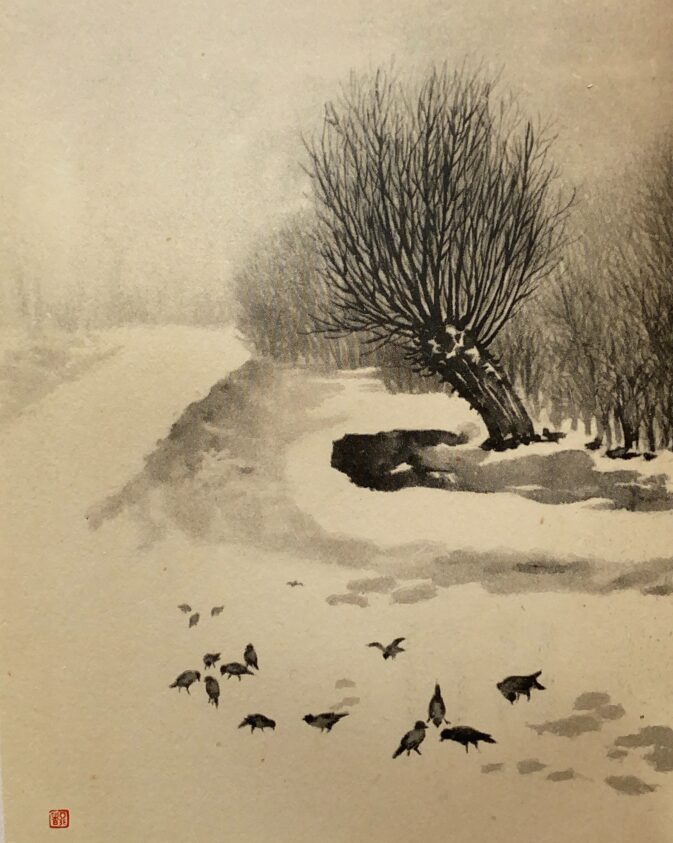
SNOW ON PORT MEADOW
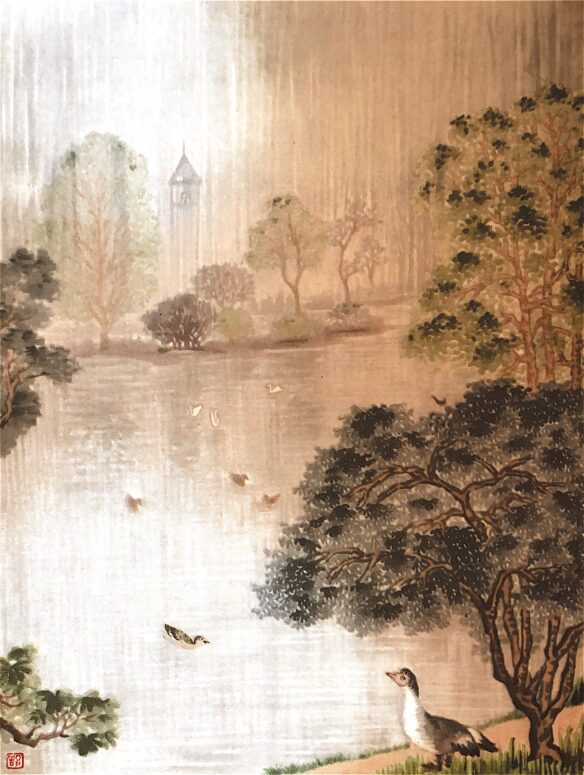
WORCESTER COLLEGE LAKE IN RAIN
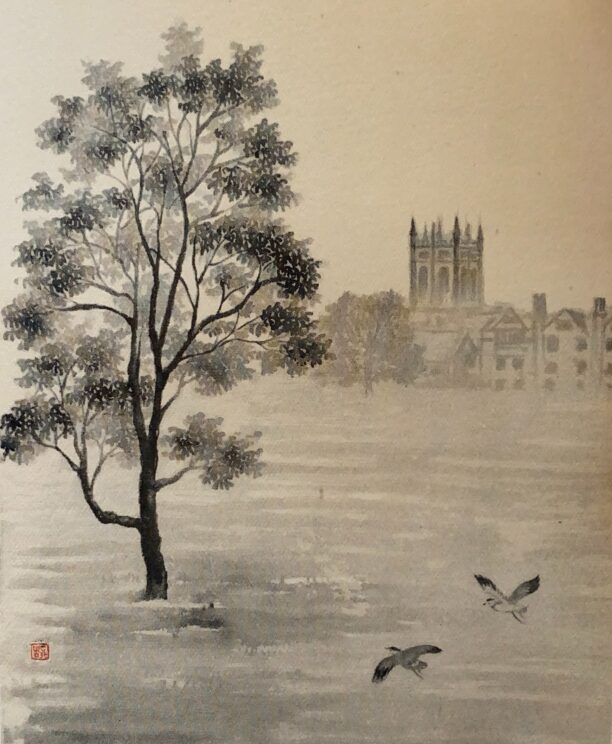
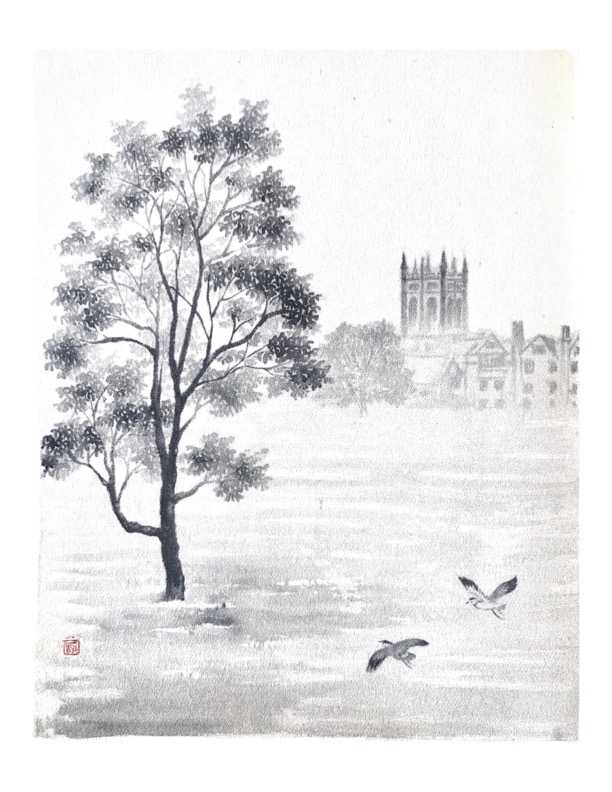
LAPWINGS OVER MERTON FIELD
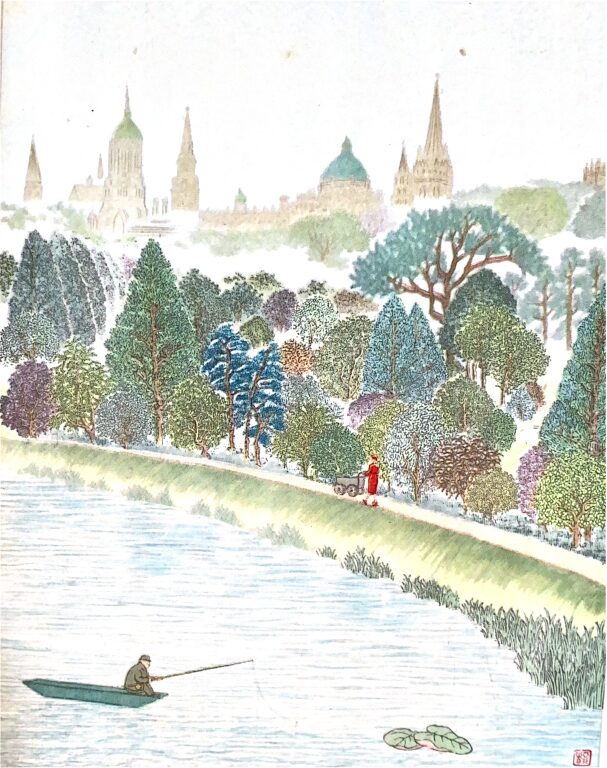
VIEW OF OXFORD’S TOWERS AND SPIRES FROM A RAILWAY BRIDGE NEAR LAKE STREET
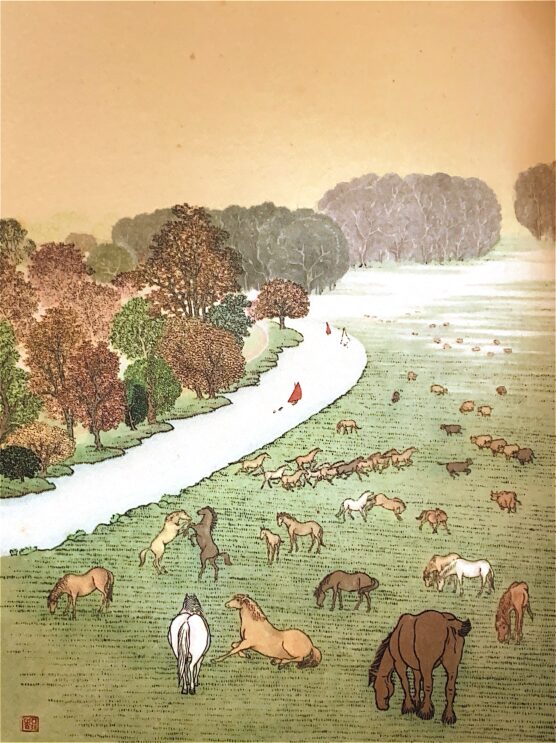
AUTUMN IN PORT MEADOW
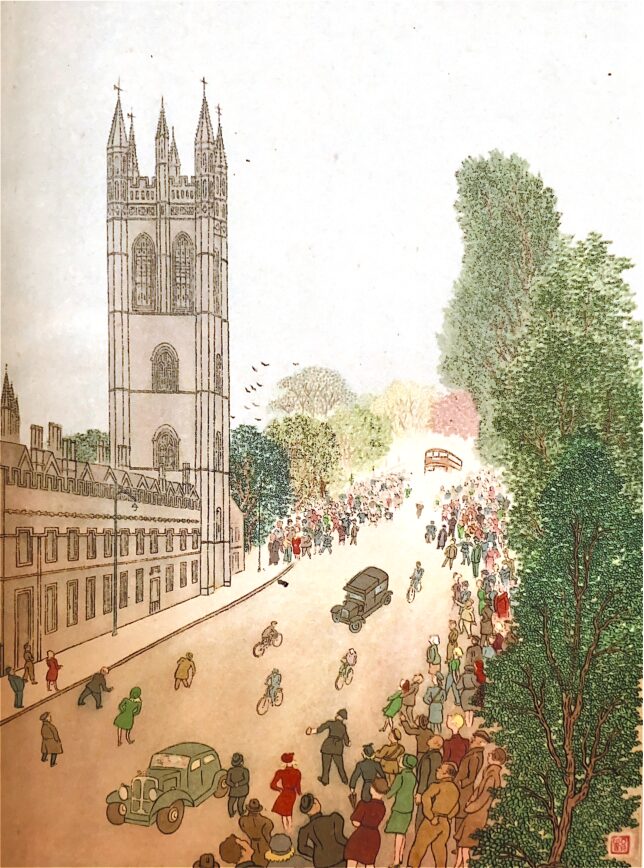
MAY DAY SERVICE ON MAGDALEN TOWER (This picture is from 1944, when wartime attendance was sparse.)
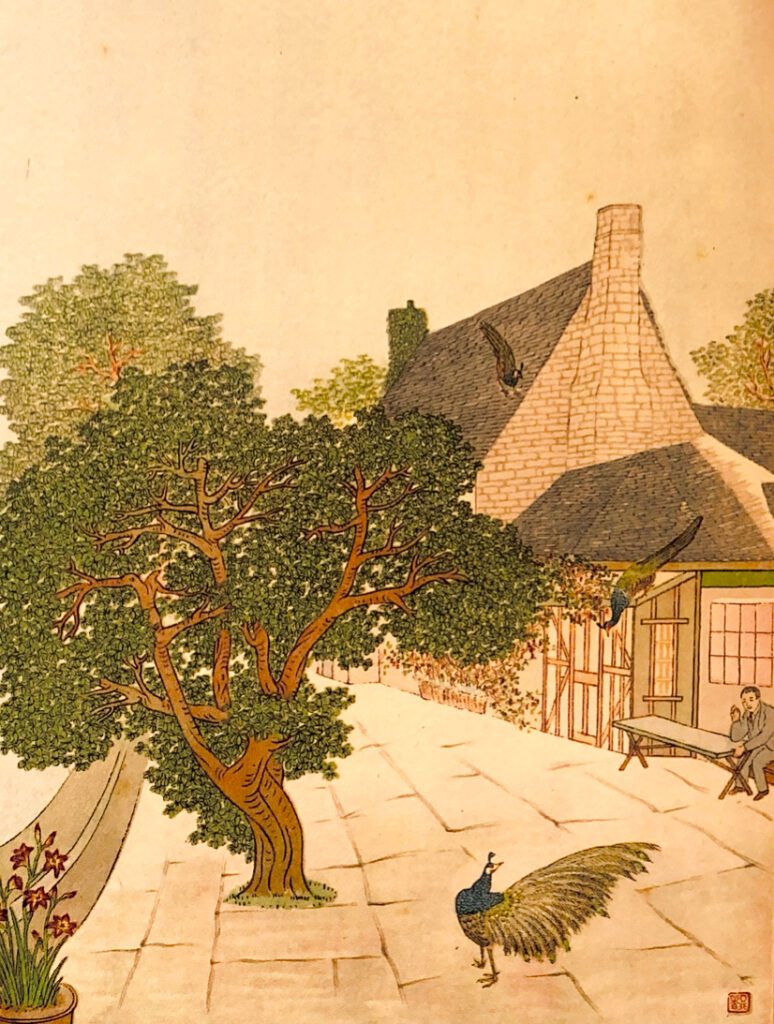
PEACOCKS AT TROUT INN
7 Comments
Join the discussion and tell us your opinion.
Much enjoyed, thankyou – but, with apologies, a small pedantic point: In Chinese, surnames come first, so it’s perhaps more polite to call him “Chiang” (and not “Yee”) when writing about somebody you don’t know as a personal friend. Anyone interested to learn more about this fascinating figure would enjoy the book: Paul Bevan, Anne Witchard, and Da Zheng eds, “Chiang Yee and his Circle: Chinese Artistic and Intellectual Life in Britain 1930-1950” (Hong Kong, 2022)
Thanks very much for pointing this out.
I enjoyed this reminder. I too have a copy, along with several letters and Christmas cards from Chiang Yee to my grandparents, Prof Leonard and Ethel Hodgson, who were friends of his. The illustrations are beautiful.
Thanks-just ordered a copy for myself
Intrigued by the reference to visiting Morrell Avenue to view the magnolias. Makes it sound as if this was a well known sight to view in the city. I’ve never come across anything about this before. As the avenue itself was lined with lime and false acacia trees that would only leave the possibility that all the houses had magnolias blossoming in their front gardens. I don’t suppose Chiang Yee did a picture of this scene, did he?
Absolutely gorgeous, I wish I had the originals! It’s also been a while since I paid a visit to St Philip’s Books, so thank you for the inspiration to go there again and hopefully find another gem like The Silent Traveller in Oxford.
I had a wonderful morning in that bookshop, last time I was in Oxford – I could have bought six books in ten minutes, if I’d had the money, but they didn’t mind me reading, even brought me a chair. I’m a wheelchair user now – no hope of getting in there, I think!