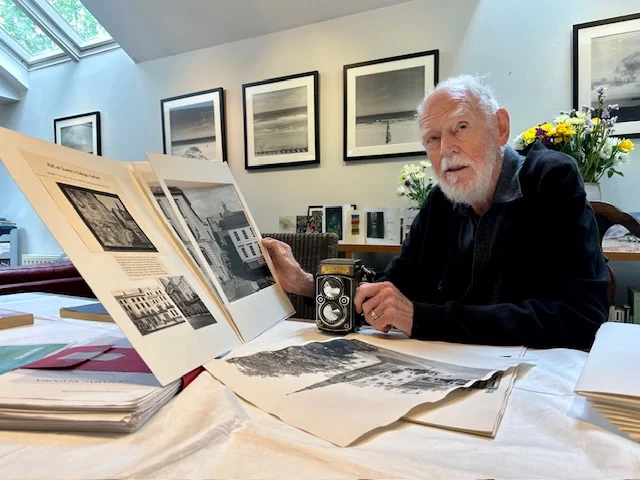
In between showers a couple of weeks back I cycled over Magdalen Bridge to East Oxford to meet with photographer Simon Murison-Bowie. He’s written a book in which he explores some of the very first photographs taken of Oxford, back in the 1840’s. What were the images of? From what vantage points are they taken? At what time of day and year? Might it be possible if he were able to find the exact same spot, to make the same composition with his own camera? Or has too much of our cityscape changed over the last 180 years or so? It all sounded right up my street.
I had made all the arrangements for this visit with his wife Irmgard. It is she who welcomes me at the door, leads me past a cabinet filled with an assortment of interesting looking box cameras, and into a light filled conservatory, its walls covered with pictures. Many are Simon’s photographs; of landscapes, buildings, people shot from angles you don’t quite expect, a lifetime of carefully captured moments. They are beautiful things, painstakingly developed in a dark room and printed in black and white. They look quite different to the digital photography we see so much of today. Perfect I thought for a project like this.
“I have only ever worked with black and white film,” says Simon who greets me from behind a long wooden table laden with a mix of photography books and paper folders holding the prints he has selected to show me. “Not having colour removes part of the reality. I like the semi abstract images it creates.”
It’s a poignant statement. For since his eyesight began to fade some years back, light, shape and shadow are now pretty much all he can make out. A rota of friends read to him. It is Irmgard who writes the messages on the computer he needs to communicate with the outside world. New photographs are increasingly difficult to take.
But today he is keen to talk about the book. It was his last project he completed before ill health made such close work impossible. And it’s not surprising why he is so passionate about it. For the idea was to recreate the viewpoints not of any old early photographer, but Henry Fox Talbot himself. I had no clue that the man considered to be the father of photography, (“the French entrepreneur Louis Daguerre invented only the daguerreotype” insists Simon firmly) had ever been to Oxford let alone created some of its earliest photographic images. But Simon has been aware of Fox Talbot from an early age. When installing his own black outs in the garden shed as a boy, while learning the basics of processing images from the local chemist (his father was a doctor so had the contact) it was Fox Talbot who was there as his ultimate hero. He even chose Talbot’s old college, Trinity Cambridge as his place of study.
“He was a multi-talented scientist,” Simon enthuses. “And an anthropologist. It was he who invented the negative positive process which is the foundation for what I would call photography.” Later Simon became a regular visitor to Lacock Abbey where Fox Talbot lived and worked up until his death in 1877. For him to get the chance to study Talbot in depth, to consider his methodology and to walk in his footsteps was the ultimate gift.
It all started when I heard that the Bodleian Library were beginning to collect a catalogue raisonné of Fox Talbot’s work. I became a researcher looking at the geography of the photographs. There were around 10,000 of them in all. And I discovered there were over 200 of Oxford. There had been a direct coach service between Chippenham (close to Lacock Abbey) and London where he also had a house. You could get to Oxford relatively easily en route, particularly when the rail lines were opened in 1844.
If you walk from here into the centre of Oxford, you pass at least half a dozen places that Talbot photographed. And this began to get under my skin. I started to look more closely at the whole thing. I wanted to know when he visited Oxford, where he stayed, who he knew, how he gained access to the places from where he took his photographs. For he often used an elevated viewpoint for his photographs in order to reduce the effect of convergent verticals. This led to more research than any other. I have rephotographed over 100 of Talbot’s views, approximations not exact reproductions but finding those exact same elevated viewpoints in the modern city was a case of a lot of trial and error.
An example is Fox Talbot’s photograph of the corner of Queens College and Queens Lane.
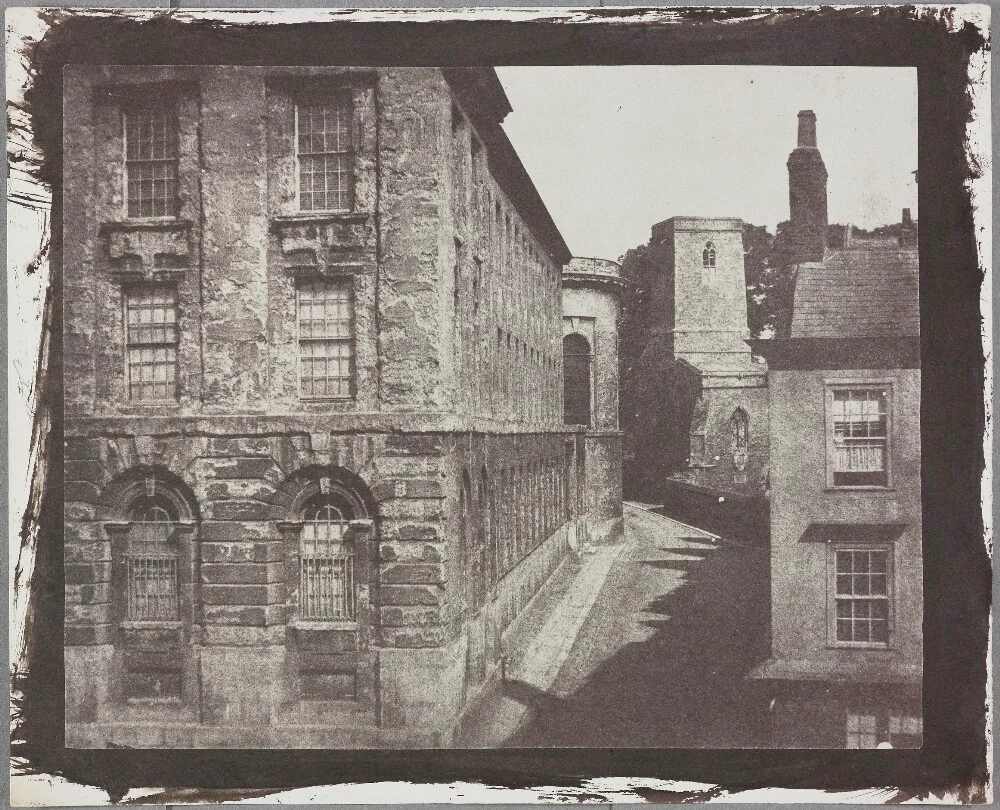
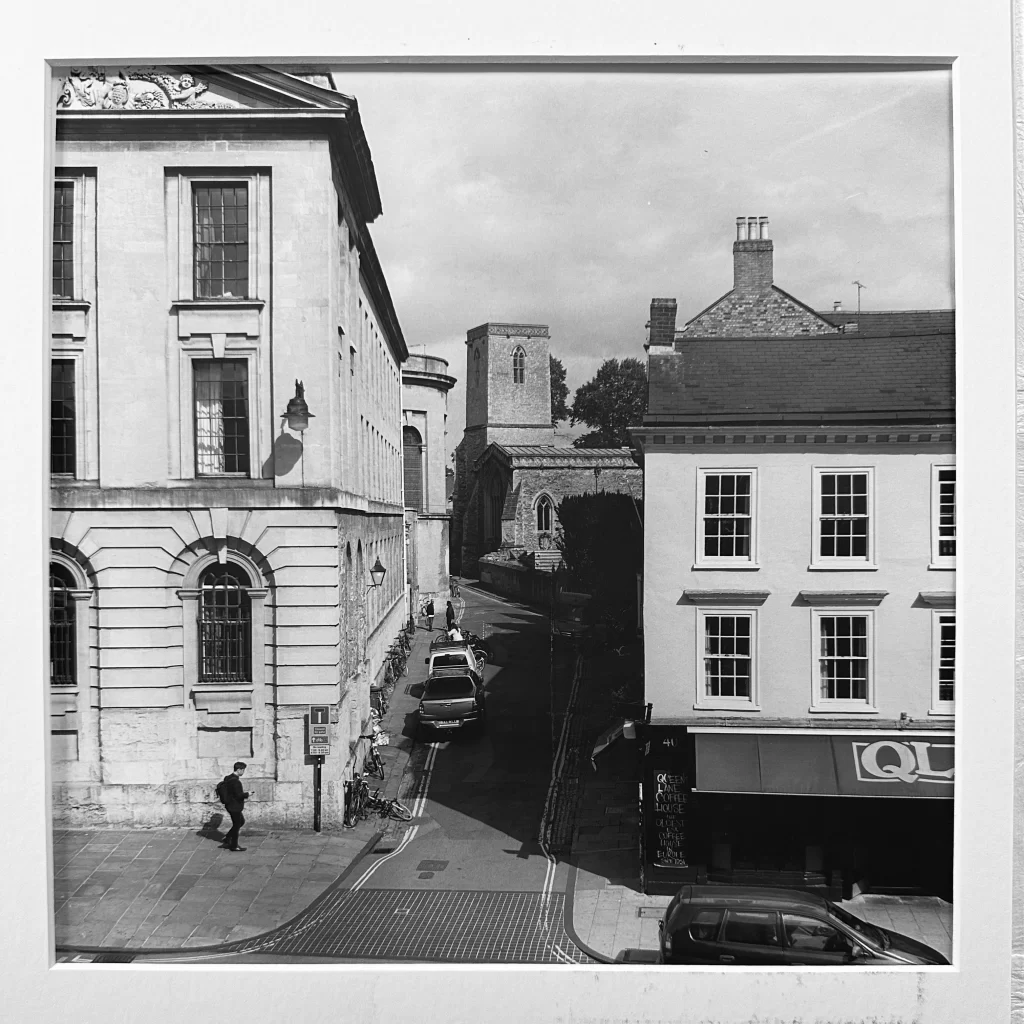
In the 1840’s one of the major coaching inns in Oxford was the Angel Inn. Talbot’s photograph was taken from halfway up this building. Most of it was knocked down to make way for the Examinations Schools in 1876, but the Grand Café remains. Much of that side of the High Street is owned by University College and I had to get permission from them to get out on to the little wrought iron balconies that exist above the café. I spent months negotiating with the Bursar there to get access for its now student accommodation. And it needed to be in September when the sun was shining to attain the same shadow. Eventually I got access, but it was on a dull and horrible day in October. It took me a year to get back. But with the help of the archivist, I eventually did at the right time in the right weather. When I stepped out on to the balcony I felt a complete frisson of excitement. Because I knew I was standing exactly where Talbot had taken his photograph from. Photography is all about light and time. And this photograph of Talbot’s in 1843 demonstrates this knowledge that he had about the nature of what he invented. The shadow is desperately important here. I’d be going back to the street several times a week to establish how he got that shadow.
Another example of that point of view issue is the photograph he made of the Martyrs’ Monument on St Giles.
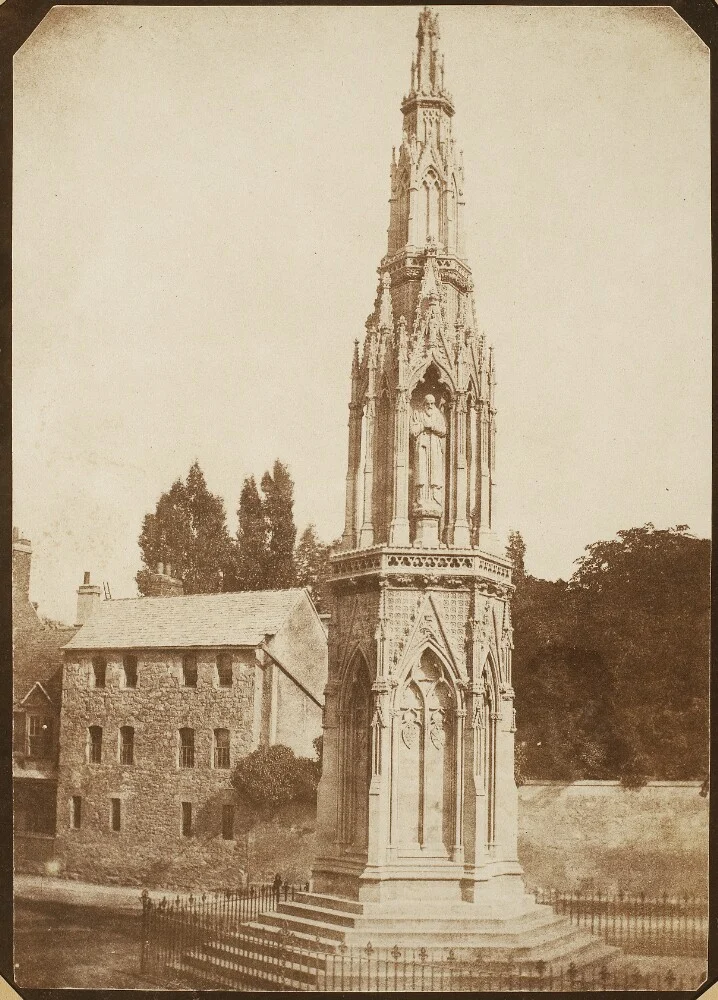
In Talbot’s photograph you can see the side of Balliol College, but without the ‘medieval’ gateway that shows in my photograph . This gateway was part of an extension built later in the 1800s.
Fox Talbot had found a position in what was then a private house on Magdalen Street from which to take his photograph in 1843. This house was demolished to make room for the Randolph Hotel which was not built until the 1860’s. I think Fox Talbot’s photograph was taken from what was then the first floor window of No 20 Magdalen Street, the residence of a Mr Joseph Richardson, a landscape painter and self-styled ‘Professor’ of Drawing and Painting. There was a lot of new construction going on at this time. The monument itself had only just been completed, the Randolph galleries (now the Ashmolean Museum) and the Taylor Institute were nearing completion. So Fox Talbot’s exact position doesn’t exist anymore.
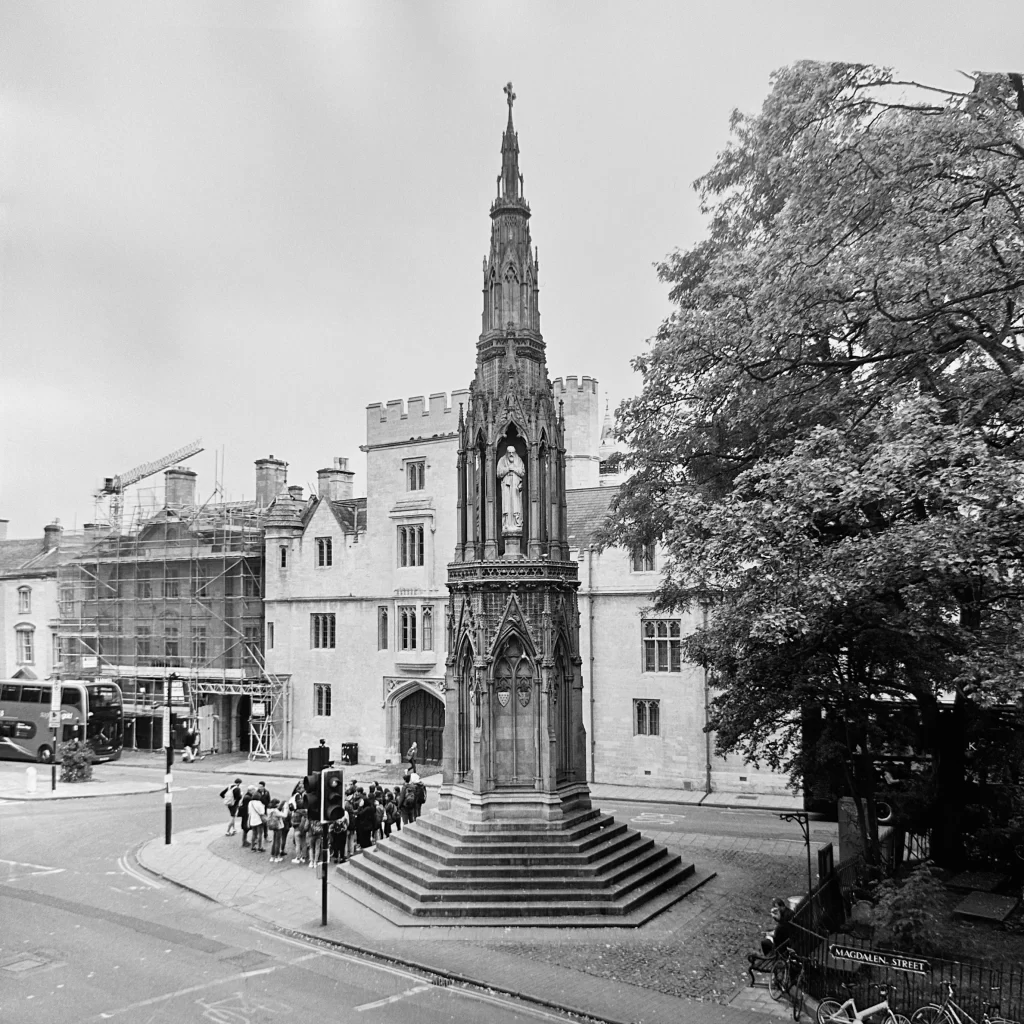
After half a dozen visits to the Randolph, I established he must have been on the same level as what is now Room 103. I had to then wait until the room was empty to be allowed in and as it was difficult to open the window I also had to negotiate the old double glazing to capture my version of Talbot’s photograph.
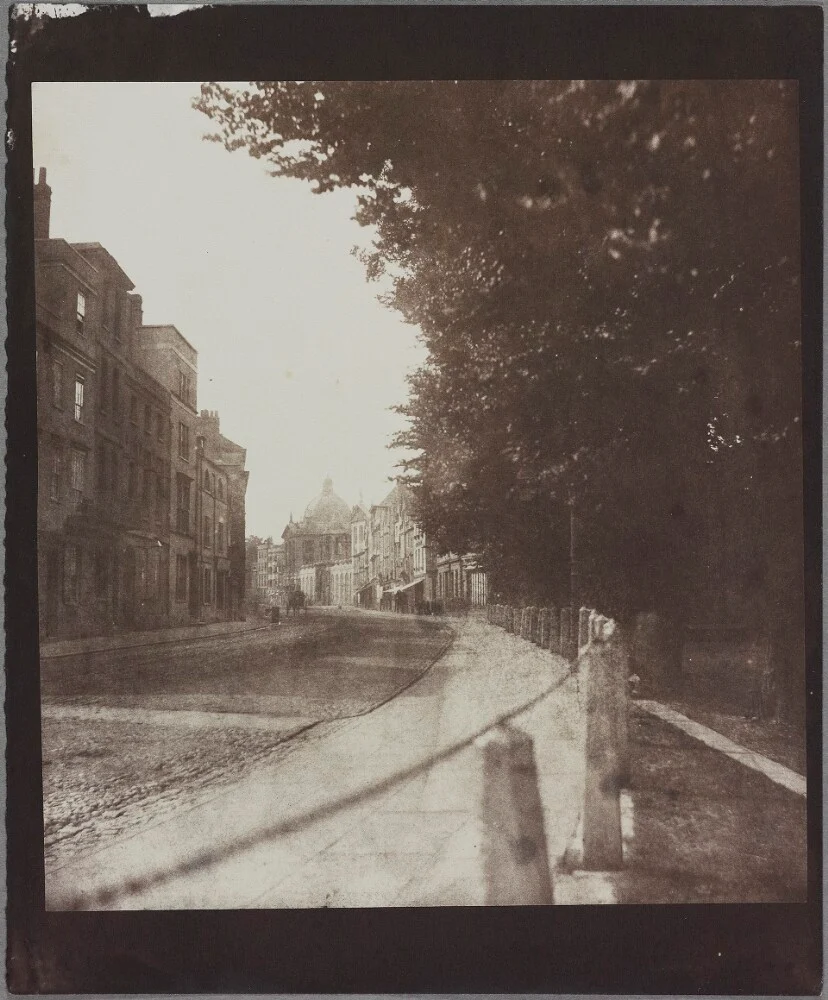
Fox Talbot made about 20 prints of this image of the High Street, but this viewpoint is no longer achievable today. Previously the gateway to Magdalen College had been approached via a gravel walk which ran parallel to the road and then entered through a gateway designed by Pugin. This was done away with in the 1880’s and replaced what I consider an inferior gateway facing the road. Before you could get this wonderful sweep of the High Street. You can’t get that view any more without standing in the middle of the road and even then it’s not the same.
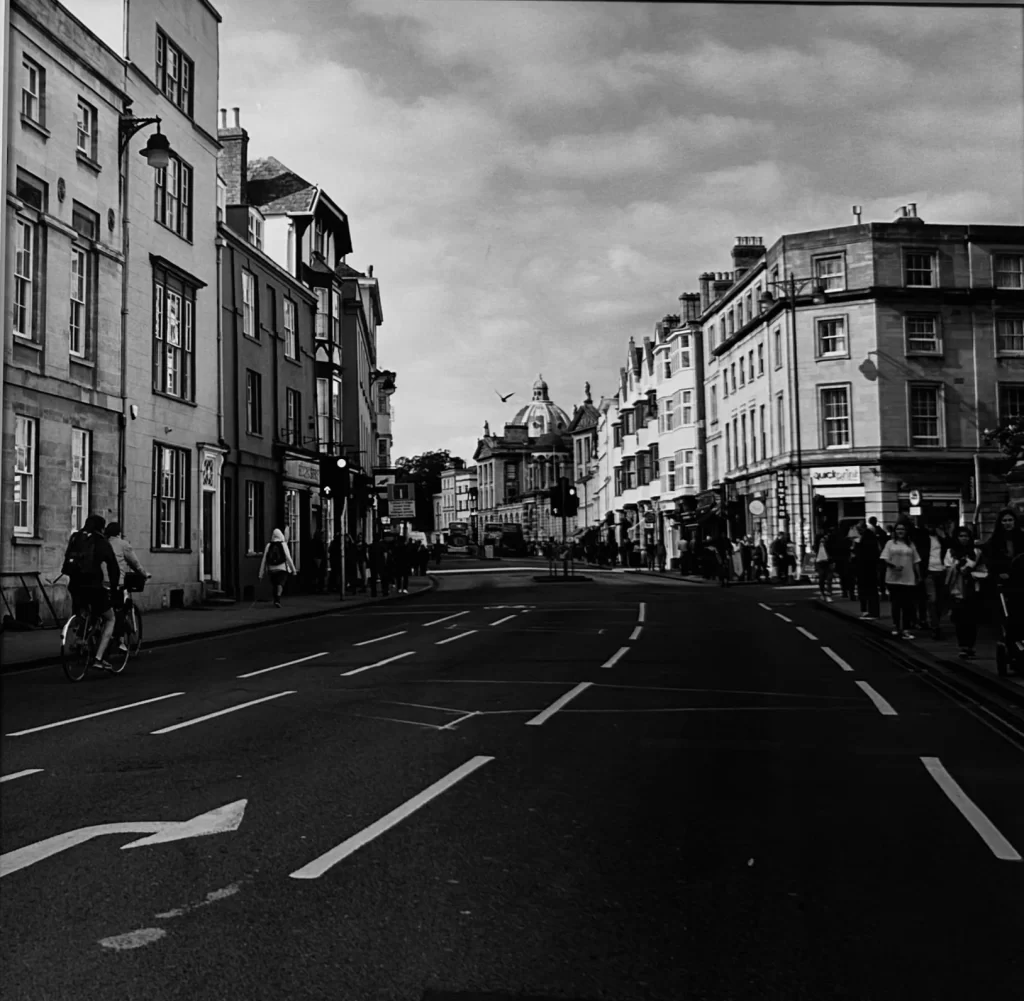
It’s been a fascinating few hours talking to Simon about what he calls his retrospective sharing of Fox Talbot’s experience. Such a great way of looking at how Oxford has changed, and at how much it has remained as it once was. He has called his book, ‘Chasing Shadows’, which is essentially what he has been doing on this project. It’s a great title. Now all he needs is a publisher.
Main image courtesy of Irmgard Hueppe. Simon at home with his Rolleiflex TLR, the camera he used to recreate the Talbot images.
All Simon’s images © Simon Murison-Bowie
All Talbot’s images are available to view on the Bodleian website
5 Comments
Join the discussion and tell us your opinion.
I have published an article on one of these Talbot photographs in the most recent issue of the Exeter College Register: “The earliest photograph of Exeter College: A new discovery”, Exeter College Register 2024, 59-68. The photograph, which the Bodleian’s online Talbot Catalogue Raisonné was unable to identify, shows the north side of the front quad of Exeter College. The view looks very different today because all the buildings in the Talbot photograph were demolished in 1856 and a new chapel built on the site. It might make a good subject for a photograph by Mr Murieson-Bowie since the “before” and “after” views are so strikingly different. If someone would be kind enough to give me Mr Murieson-Bowie’s email address I would be glad to send him a pdf of the article.
Brilliant, will do.
A story of dedication to a craft and time travel. Beautifully written as ever.
Sadly Simon died on 17 September, less than 3 months after this blog was posted. It’s nice that he was able to to talk abut his work here – he was pleased.
And I was so happy to have spent a most enjoyable morning in his company. What a legacy he has left.